AI Isn't Your Strategist.
🤚Here's the mistake playing out across every marketing team right now: more creatives don’t win, better distribution does, and more!
Welcome to a space where every edition delivers insights, strategies, and inspiration to fuel your advertising brilliance. 🤯
🤚AI Isn't Your Strategist. Stop Treating It Like One.
Here's the mistake playing out across every marketing team right now.
Someone opens ChatGPT, types "give me a creative strategy for our Q2 campaign," reads the output, feels vaguely underwhelmed, and concludes that AI isn't as useful as advertised. The problem isn't the tool. It's the job title they assigned it.
AI doesn't have taste. It doesn't have market intuition. It has never felt the specific friction of a customer who almost bought and didn't.
Asking it to set creative direction is like hiring a first-week analyst to run your media strategy, technically they can produce something, but the output will be exactly as good as the experience they don't have.
The teams compounding with AI figured out a different org chart entirely.
AI as the analyst who never sleeps and never complains about the brief.
Think about what a genuinely useful junior strategist does before a creative brief gets written:
- Pulls 300 customer reviews and surfaces the exact language clusters that keep appearing, the phrases buyers use that never make it into ad copy
- Maps competitor creative across the last 90 days and identifies the positioning gaps nobody is owning
- Audits the current ad account by persona and flags which customer segments are being systematically underserved by the creative mix
- Identifies objection patterns from sales calls, support tickets, and community conversations that the creative team has never addressed directly
None of that is strategic. All of it makes the strategy dramatically sharper. And every single item on that list can be done by AI in the time it takes a human analyst to open the right spreadsheet.
The strategist still has to look at what came back, connect the dots, and make the call. AI just collapses the time between "we need to understand the customer better" and "here's what we found."
The audit most accounts have never run.
Pull your current ad account and map creative coverage by persona. Which customer types are receiving 70% or more of the spend? Which segments have one creative angle or none? Which objections appear consistently in customer conversations but have never been addressed in an ad?
AI can run that diagnostic in minutes. The strategic implications of what it surfaces, that's still entirely a human decision.
The mental model that separates leverage from noise.
Promoting AI to strategist produces mediocre direction at speed. Keeping it junior produces something more valuable: a research and analysis layer that makes every human decision more informed than it would have been otherwise.
The teams winning with AI right now aren't the ones giving it the most creative latitude.
They're the ones giving it the right problems, and staying firmly in the seat where taste, judgment, and market intuition actually live.
Together with Funnelish
90% more conversions. Same product. Different funnel.
Liquid Death didn't reformulate the water. They rebuilt what happened after the click, and the conversion rate jumped 90%. That's not a marketing story. That's a funnel story.
Most brands optimize the ad and ignore the rest. Pages drag. Checkouts leak. Abandoned carts go quiet. The revenue disappears before it ever lands.
Funnelish is built for everything the ad can't fix. And if you're already running a funnel somewhere else, their team will migrate it for you, free.
- Sub-1-second load times. Half of your traffic won't wait longer than 3 seconds
- Drag-and-drop builder covering every stage: landing pages, upsells, cart recovery, confirmation
- 70% of visitors abandon cart. Built-in email and SMS sequences pull them back
- Shopify, Stripe, Klarna, Google Sheets, Facebook Pixel, and 27+ integrations total
$2B+ processed. 33 million purchases. 4,600+ users who stopped patching and started scaling.
The traffic is already there. The funnel just needs to do its job.
Start free for 14 days. No card needed.
⚡ More creatives don’t win, better distribution does
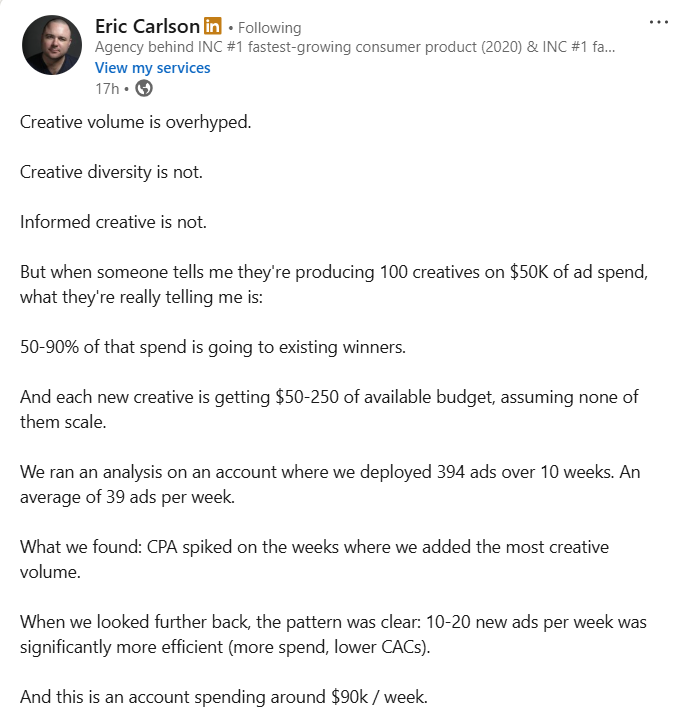
This idea challenges the obsession with high creative volume. When too many ads are launched relative to budget, each one gets insufficient spend to properly test or scale. Instead, focusing on informed creatives and controlled volume ensures enough budget per variant to generate meaningful performance signals.
Why it works: Algorithms need sufficient spend per creative to identify winners. Controlled volume ensures each ad gathers enough data to optimize. Fewer, higher-quality tests improve signal clarity and reduce wasted budget on under-tested variants.
Where it needs balance: Too little creative volume can limit exploration and slow discovery of new winners. High-spend accounts may support larger testing pools. The key is aligning creative volume with budget, not universally reducing output.
Together with Norton Neo
Trust-First AI Built Directly Into Your Browser
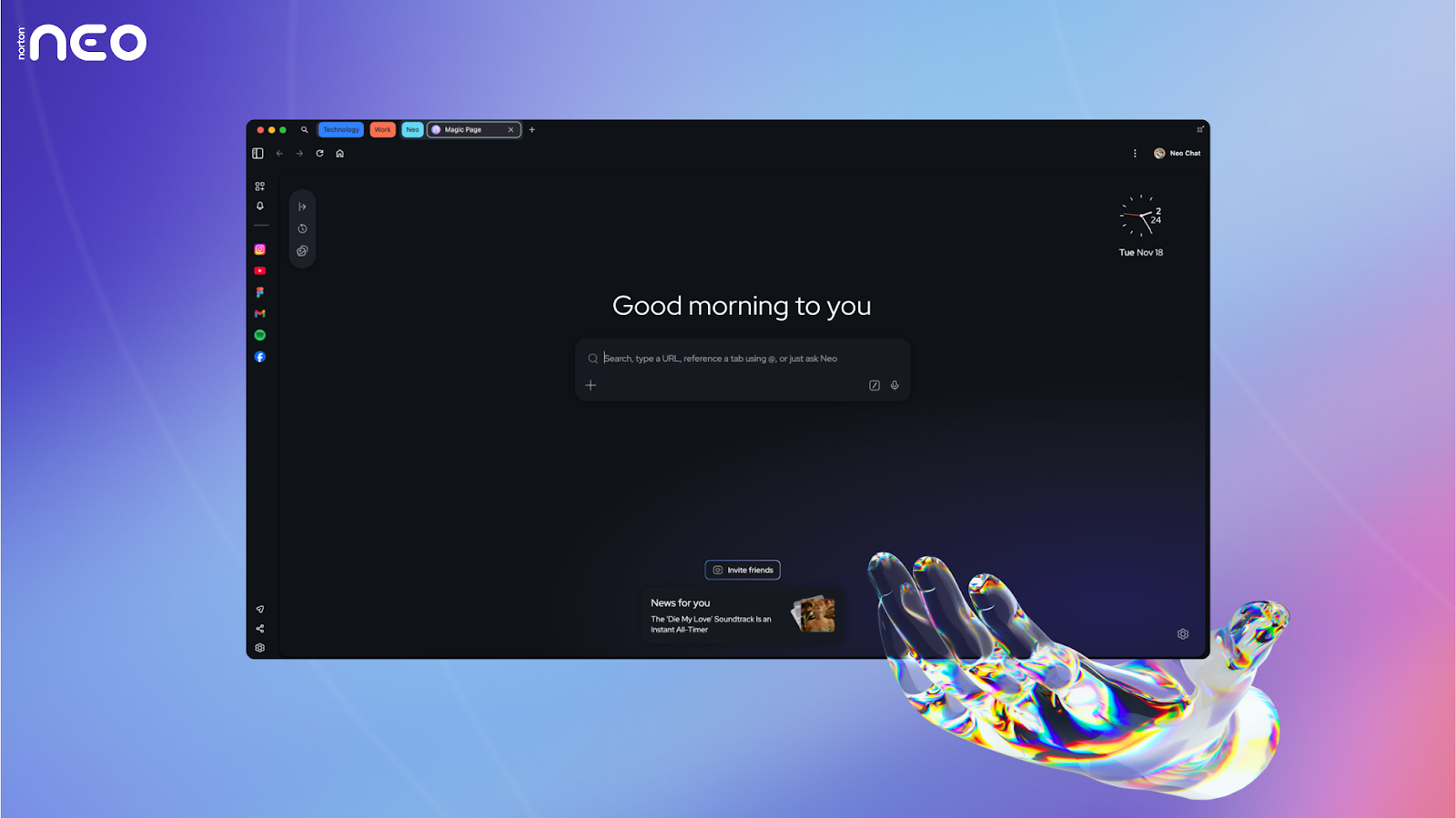
Most AI tools sit on top of your browser. Norton Neo builds AI directly into it.
Norton Neo is the world’s first AI-native browser designed for speed, clarity, and privacy from the ground up.
You browse, search, stream, shop, and work as usual, but with AI that organizes your tabs, adapts to how you work, and helps you move without constant prompting.
- Chats and browsing history remain local, ensuring your data stays private.
- You choose what Neo remembers, or turn memory off anytime.
- Norton Web Shield blocks malicious sites and phishing before you click.
No extra extensions stacking up. No AI tools floating in separate tabs. Just a browser built for how people actually use the web today.
If you want early access to what’s coming next, join the Norton Neo Discord and connect directly with the team building it.
🚀 Reel of the Day

What Works:
1. Scroll Stopper - The reel opens with an exaggerated, oversized product visual that immediately disrupts scrolling behaviour. This creates a high-impact thumb-stop moment, boosting initial hook rate and maximising first-second retention significantly.
2. Visual Curiosity Drives Completion Rate - Viewers instantly question how the oversized jeans will transform, creating an open loop. This curiosity gap increases watch time, completion rate, and replay value without needing complex storytelling or dialogue.
3. Lo-Fi Execution, High Perceived Creativity - Despite simple execution, the idea feels premium due to concept originality. This lowers production barriers while maintaining high perceived value, making it scalable for consistent content output.
Design “impossible transformations” anchored in everyday contexts, where the product visually resolves curiosity. This combination maximises retention, lowers ad fatigue, and turns simple ideas into high-performing, scalable creative assets.
Thanks for reading this edition! Keep pushing boundaries, testing ideas, and staying inspired. See you in the next edition with more ways to ignite your marketing success. 🥰