Amazon PPC Is Breaking Quietly
🤨 Why predictability is no longer luck, it’s architecture, The 2 real reasons meta ads stop working, and more!
Welcome to a space where every edition delivers insights, strategies, and inspiration to fuel your advertising brilliance. 🤯
😬 Amazon PPC Is Breaking Quietly
A growing number of brands are running into the same wall. Spend increases and rank drops. ACoS tightens, and visibility shrinks. Campaigns that once behaved reliably now swing unpredictably from day to day.
The platform isn’t breaking. The account structure is.
Accounts built on isolated campaigns, outdated bidding philosophies, or keyword buckets stitched together without behavioral logic eventually collapse under pressure. What feels like volatility is often the result of an engine designed for an older version of Amazon.
Unpredictability isn’t caused by the algorithm tightening. It’s caused by accounts that were never engineered for today’s environment.
The Scenario Playing Out Everywhere
A typical fragile account shows the same symptoms:
- Dozens of siloed campaigns that compete instead of cooperating
- Bids adjusted to maintain a “good-looking” ACoS rather than ranking outcomes
- Sponsored Products is doing the heavy lifting while the rest of the funnel sits underdeveloped
- Keyword structures built from assumptions instead of shopper behavior
- Decisions driven by single-metric reporting that hides true performance patterns
The result is a constant reaction. Lower bids when ACoS rises. Add budget when the rank slips. Build new campaigns when competitors show up.
Activity increases. Predictability decreases. The platform becomes harder to control, not because Amazon changed, but because the account hasn’t.
The Structure you need: Predictable PPC in 2026 begins with a new architecture.
1. Targeting Built on Audience Behavior: Intent clusters reveal how real shoppers move, not how marketers hope they move. Structuring campaigns around these paths stabilizes traffic and removes guesswork.
2. Bidding Tied to Rank Velocity: ACoS suppression sabotages ranking momentum. Modern bidding aligns with movement, not comfort thresholds.
3. Funnel Sequencing Instead of Campaign Islands: Awareness, validation, and conversion campaigns must work in sequence. The goal is flow, not fragmentation.
4. Decisions Driven by Multi-Signal Reality: CVR lift, session depth, add-to-cart velocity, and category movement form the truth. One report cannot tell the story anymore.
When these layers align, predictability returns, and campaigns stabilize. Rank becomes defendable. Budget finally behaves the way it should.
Amazon PPC in 2026 is no longer about heroic fixes or reactive optimizations.
It is about building systems that stay stable under pressure. If the engine relies on post hoc adjustments, unpredictability will follow. If the structure is engineered upfront, the platform becomes far more controllable than it appears.
Less guessing. Less rescuing. More outcomes you can actually shape. Predictability isn’t disappearing. It just belongs to the brands that build for it.
Together with The Operator's Stack
100+ Days of Campaign Data. Zero Guesswork.
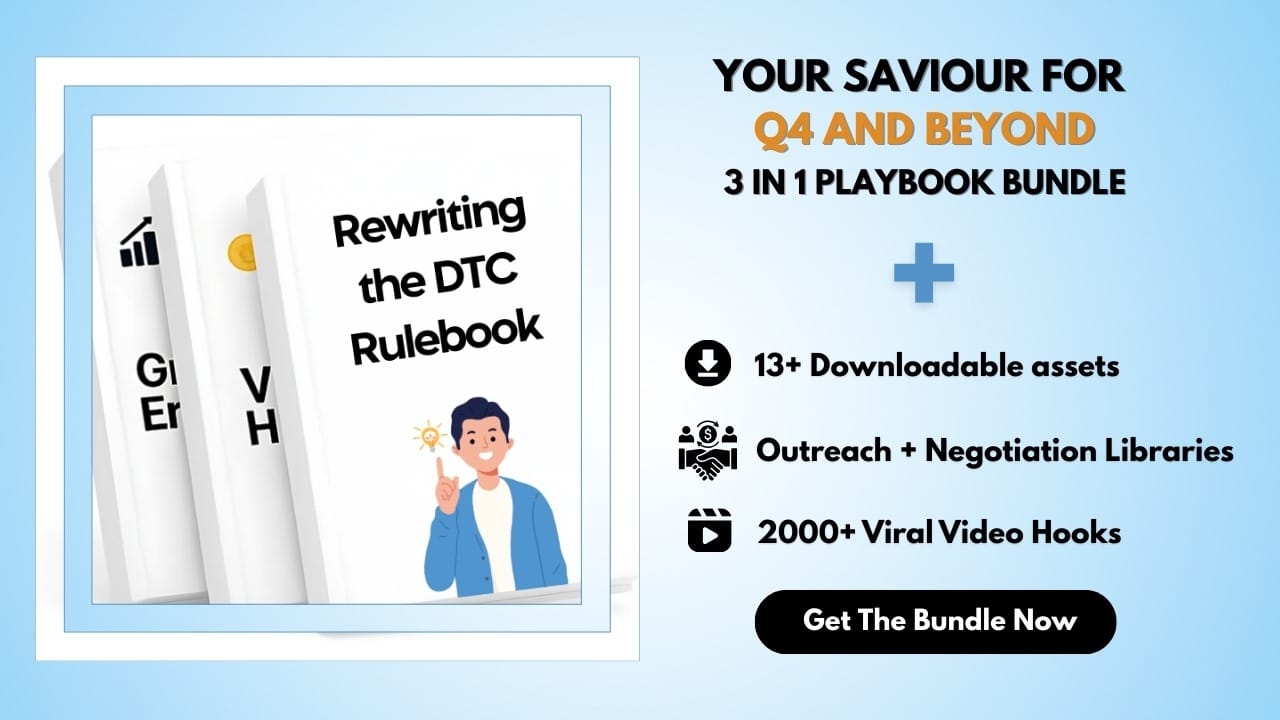
Your funnel didn’t just slow down; it’s being rewired against you. Buyers no longer follow the neat paths you designed. They’re ghosting faster, clicking less, and vanishing mid-funnel.
This isn’t another “trends list.” Our team spent 100+ days dissecting real campaigns to uncover three purchase-path shifts dismantling traditional funnels.
Inside, you’ll find immediate-use systems like the Community Cultivation Canvas, Emotional Storytelling Framework, and Owned Media Checklist, all ready to deploy today.
You’ll also unlock over $900 worth of bonus systems, including:
- Storytelling frameworks
- Brand positioning playbooks
- Referral ROI models
- Partnership campaign templates
- Community growth strategies
- Cashflow simulators
- Unit economics analyzers
- Supplier negotiation scripts
Plus: 2,000+ Viral Video Hooks (updated monthly) to keep you ahead of the curve.
The market has already shifted. This is your chance to adapt before “next quarter” becomes “too late.”
Download your bundle now and rebuild your funnel before buyers disappear!
⚡ The 2 real reasons meta ads stop working
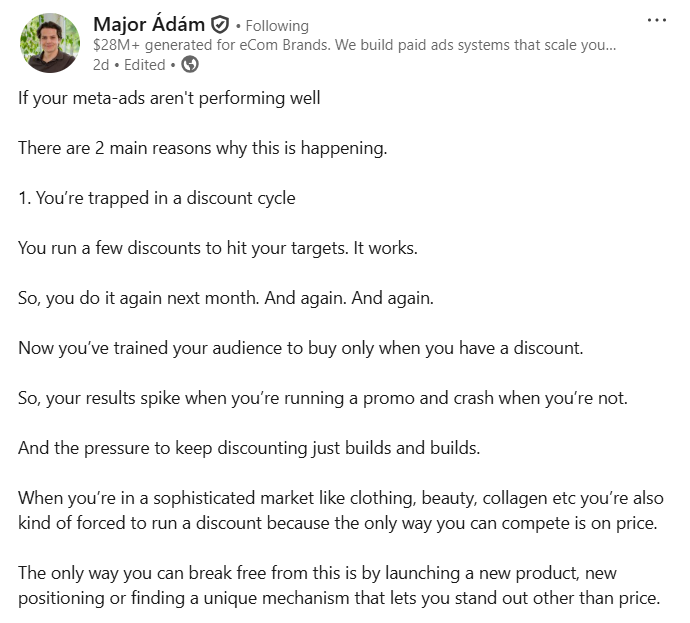
When Meta performance drops, it’s rarely random. Most of the time it comes down to either the offer losing power or the algorithm losing signal. If you’re stuck chasing weekly swings, these two issues are usually sitting underneath.
Why it happens - Discount cycles train customers to wait, so ads only work when a promo is running. In crowded categories, brands end up competing on price instead of differentiation, which collapses long-term efficiency. At the same time, weak pixel and event matching data makes Meta’s targeting inconsistent, because the system can’t reliably find buyers.
The real takeaway - Meta can’t scale what isn’t distinct, and it can’t optimize without clean signals. Break out of price-based marketing with stronger positioning, and make sure your data pipeline is tight. Fix those two foundations and performance becomes far more predictable.
🎥 Reel of the Day

What Works:
1) This is a “borrowed adrenaline hook” - They are hijacking a high-stakes cultural moment, the slap game, which already carries tension, anticipation, and crowd psychology. Your brain knows the slap is coming, so attention locks in.
2) The green powder slap is a perfect sensory metaphor - Matcha is normally abstract on screen; it looks like any drink. By making it physical, explosive, and violently visual, they turn taste into impact. That is embodied marketing: you don’t understand flavor, you feel it.
3) The transition is the persuasion mechanism - The cut from the slap arena into the café is a dopamine bridge. It makes the brand feel culturally fluent, not like an ad. This is modern Reels' strategy: entertainment first, brand second, memory locked through pattern disruption.
This is a masterclass in “metaphor-first product marketing.” Instead of describing taste, they dramatize impact. The slap is not random; it is a sensory positioning device that makes matcha feel powerful, modern, and socially native rather than wellness-generic.
Thanks for reading this edition! Keep pushing boundaries, testing ideas, and staying inspired. See you in the next edition with more ways to ignite your marketing success. 🥰