Are you stuck squeezing demand?
😤Many meta accounts get stuck at “Good” and never break through, The smarter way to do competitor analysis, and more!
Welcome to a space where every edition delivers insights, strategies, and inspiration to fuel your advertising brilliance. 🤯
❓Are you stuck squeezing demand?
There’s a specific kind of performance plateau that shows up after the first win.
CPAs stabilize. Spend scales modestly. The account looks healthy. Nothing is broken enough to panic, but nothing moves enough to matter. This is usually the moment teams start tweaking copy, refreshing hooks, and swapping creatives weekly, expecting momentum to return.
It rarely does.
The problem isn’t fatigue. It’s containment.
Most accounts hit a ceiling because they’re optimizing inside the same demand pocket over and over again. New ads speak to the same type of buyer, framed slightly differently, delivered to the same behavioral cluster. Performance improves locally, but the system never discovers new volume because it’s never given a reason to look elsewhere.
Angle testing feels productive because results move. CTR shifts. CPA nudges. Dashboards respond. But those gains are bounded. You’re squeezing efficiency out of a fixed audience instead of expanding the audience itself.
This is where the real cost shows up.
As spend increases, marginal returns decay faster. Auctions tighten. Creative refresh cycles accelerate. What once worked reliably now needs constant babysitting. Growth becomes fragile, because it’s dependent on perfect execution rather than structural leverage.
The underlying issue is that creative is being used as messaging, not exploration.
Segment-level shifts are the lever that break plateaus. When creative speaks to a different market entirely, Meta isn’t just testing ads. It’s mapping new demand. The system learns new behaviors, new conversion paths, and new eligibility pools. That’s when scale reopens.
Persona-level changes matter too, but they’re incremental. They refine how you speak to an audience you already understand. Segment changes redefine who the audience is in the first place.
There’s a tradeoff here that makes teams hesitate. Segment tests feel risky. They often start inefficient. Early CPAs look worse. Reporting gets uncomfortable. But those early signals are misleading, because discovery always looks messy before it compounds.
Accounts that never break through usually aren’t under-optimized. They’re over-contained.
If performance has been “solid but flat” for months, the answer isn’t a better hook. It’s a bigger question: who else could this product be for, that the account has never been allowed to learn?
That’s the difference between polishing performance and unlocking the next level of growth.
Together with Section
The AI Marketing Systems You Can Implement Tomorrow - January 29 | Free Virtual Event

If you’re still “experimenting” with AI while your team ships the same campaigns, you’re not early, you’re late.
On Jan 29 (12 to 4 PM ET), join Section’s free virtual AI Marketing Strategy Summit featuring Scott Galloway (Professor of Marketing, NYU Stern) and a tight lineup of leaders who’ve actually built modern growth systems.
- Get the AI marketing moves that drive measurable lift
- Learn what matters in 2026 so you stop chasing shiny tools
- Walk away with strategies you can deploy the very next day
Featuring Kieran Flanagan (SVP of Marketing, HubSpot), Aude Gandon (Chief Digital & Marketing Officer, Estée Lauder), and Dan Slagen (SVP of Marketing, Zapier).
⚡ The Smarter Way to Do Competitor Analysis
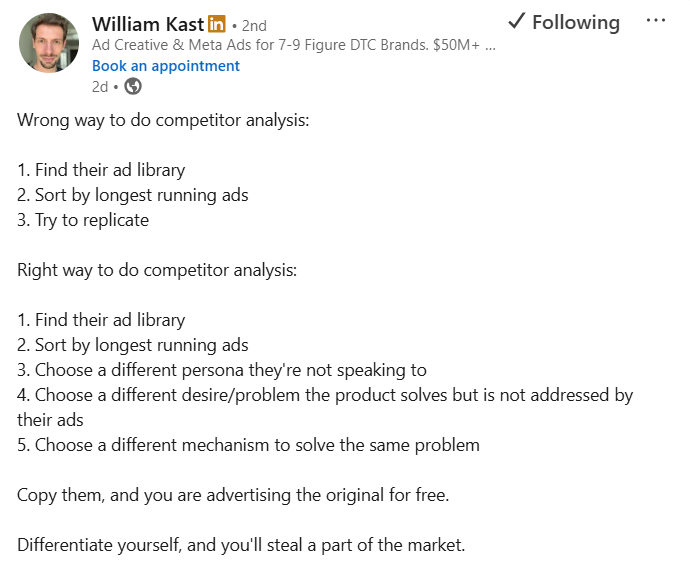
Competitor analysis usually turns into copying. Find their longest-running ads, rebuild them, hope it works. But that just trains your brand to sound like the category, and you end up paying to promote the same idea the market already associates with them.
Why it works - Longest-running ads show what the market is already responding to, which is useful, but copying them puts you in a losing fight on familiarity. The better move is to use their winners as a map of what they’re not covering. Pick a persona they’re ignoring, a desire they’re not tapping, or a mechanism they’re not claiming.
The real takeaway - Ad libraries aren’t swipe files, they’re opportunity maps. Don’t replicate their best ad. Find the gap next to it, then build creative that owns that space. That’s how you steal attention without paying to advertise the original.
Together with Levanta
Modern Shoppers Buy Everywhere. Your Affiliate Program Should Too
If your affiliate program only lives on your DTC site, it’s built for 2010. Today, customers research on Amazon, compare on Walmart, and purchase wherever it’s convenient.
When programs don’t follow that behavior, visibility suffers, making it harder to see what’s driving revenue and what to scale next.
Levanta helps modern e-commerce brands run affiliate and creator partnerships across multiple marketplaces as a single, measurable performance channel.
With Levanta, sellers can:
- Partner with 50,000+ vetted creators and affiliates
- Track clicks, sales, and ROI with clear analytics
- Amplify what works and stop paying for what doesn’t
- Manage creators, commissions, and payouts across marketplaces with ease
Qualified sellers who book a demo will receive a $75 Uber Eats or DoorDash gift card. Eligibility confirmed after booking.
🎥 Reel of the Day
What Works:
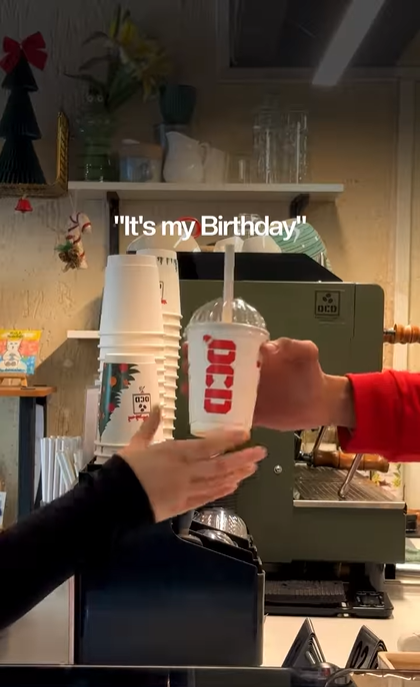
1. It’s a segmentation hook - “Birthday”, “Interview”, “Date”, “Vacation” is literally audience targeting inside the creative. Everyone finds their micro-niche in 2 seconds, so retention shoots up because you’re waiting for “your” scenario.
2. It’s customer-centric positioning - They’re not saying “we have 20 items.” They’re saying “Whatever your life moment is, we have the perfect pick.” That’s emotional framing + use-case marketing in the simplest format.
3. It’s soft branding + brand recall done properly - The OCD logo keeps appearing naturally on cups and packaging, so it’s high frequency branding without looking like an ad. That’s exactly how you build recall while still feeling organic.
This reel works because it’s a mini “moment-based menu funnel.” It grabs attention with relatable scenarios, sells variety through vibes, and builds brand memory quietly, which drives saves, shares, and store visits.
Thanks for reading this edition! Keep pushing boundaries, testing ideas, and staying inspired. See you in the next edition with more ways to ignite your marketing success. 🥰