Automation is making ads dumber
🥲 Performance holds while learning disappears inside black boxes, Why great ads start with real conversations, and more!
Welcome to a space where every edition delivers insights, strategies, and inspiration to fuel your advertising brilliance. 🤯
🥲 Automation Is Making Ads Dumber
Handing control to automation always feels like progress at first. Fewer settings to manage. Less manual work. Cleaner dashboards.
Performance often looks fine in the beginning, which is why this decision rarely gets questioned early. The real cost doesn’t show up as a spike in spend or a sudden drop in ROAS. It shows up as confusion.
Over time, nobody can explain what’s actually working anymore.
Control in advertising isn’t about micromanaging bids or obsessing over every keyword. It’s about maintaining economic signal clarity.
When you know which searches convert, which contexts matter, and which audiences actually respond, every dollar spent teaches the business something. That learning compounds.
Black-box systems blur those signals.
Queries get bundled together.
Placements collapse into reports you can’t unpack.
Audiences overlap in ways you can’t separate.
Spend continues. Sales may even continue. But learning slows down.
This same failure pattern shows up outside of ads, too. Workflows technically exist, but decisions stay locked behind text-heavy outputs that no one can interrogate.
Logic runs, results appear, but insight stays trapped in walls of text instead of becoming something teams can actually explore.
C1 by Thesys turns n8n workflows into intelligent AI apps with interactive UIs, so teams can see, test, and understand what their systems are doing without changing workflow logic or writing code.
You can sign up now and get 5M free tokens to get started!
This is where the hidden cost creeps in.
When performance dips, nobody knows why. When it improves, nobody knows what to double down on. Decisions become reactive instead of directional.
To compensate, teams spend more to “let the system figure it out.”
That’s not efficiency. That’s paying tuition because insight was outsourced.
What makes this tricky is that simpler setups feel cheaper. Fewer levers look like lower overhead. Less management feels like savings. In reality, the cost just moves.
You save time upfront. You pay later in wasted exploration.
Automation doesn’t remove learning costs. It raises them by making experimentation implicit instead of explicit. Every lever you give up doesn’t disappear. It gets priced into higher spend and slower understanding.
This is why control should be treated like capital, not preference.
The question isn’t whether automation works. It’s whether the business can afford to lose visibility into what’s driving value.
If the goal is short-term capture, black boxes can be fine. If the goal is building a system that improves over time, signal clarity matters more than convenience.
The smartest teams don’t reject automation. They choose where to use it. They automate execution while protecting insight.
They simplify workflows without flattening feedback. They keep enough control to know why something works, not just that it does.
Because once clarity is gone, every future decision gets more expensive. And by the time that shows up on the P&L, the cost has already been paid.
Together with Belay
Growth hides finance mistakes until it’s too late
Hitting $50k, $100k, even $250k a month feels like momentum. But this is where many operators quietly lose control. Not because revenue slows, but because decisions start getting made on numbers that are already outdated.
When financials are updated retroactively, you are always driving in the rearview mirror. Hiring feels right until cash tightens. Spend looks justified until margins disappear. DIY accounting works early, then cracks as complexity scales.
This is the inflection point where smart founders and operators pause and reassess:
👉 What changes when your financials are updated weekly instead of retroactively?
👉 Why does delayed financial data cause bad decisions even when revenue looks healthy on paper?
👉 What breaks first when founders try to “DIY accounting” while scaling growth and operations?
BELAY’s fractional finance model gives you U.S.-based experts who take ownership of your books and surface weekly clarity before problems compound.
If finance feels heavier as you grow, that is the signal.
Download the Guide to Outsourced Accounting and regain control!
⚡ Why Great Ads Start With Real Conversations
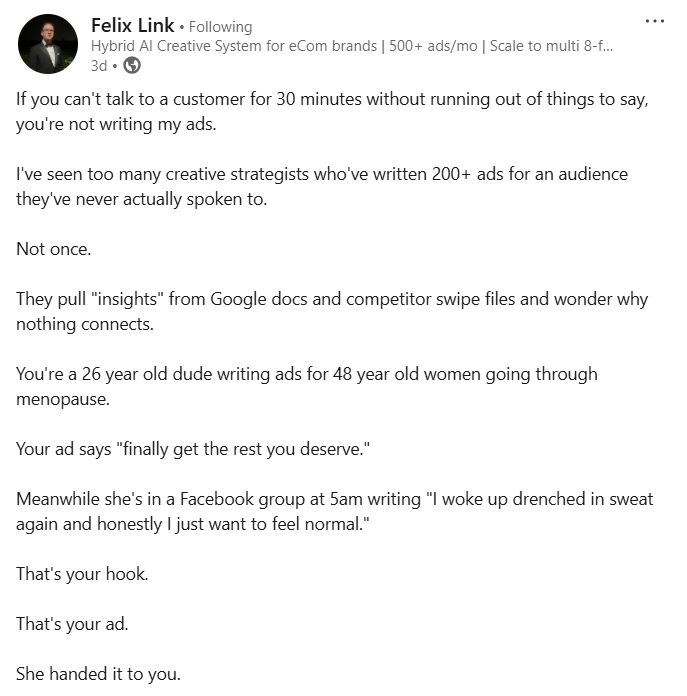
This is a reminder that ads don’t fail because of bad writing; they fail because of distance. When strategists never talk to customers, they end up writing about people instead of for them. That gap is where relevance dies.
Why this works: Real conversations give you language you can’t invent. Customers tell you exactly what hurts, what they’re afraid of, and how they describe it when no brand is watching. When ads use those exact words, they feel understood, not marketed to. That’s what makes people stop, read, and trust.
The real takeaway: Swipe files and frameworks can’t replace listening. If you haven’t sat in customer calls, forums, or DMs long enough to hear raw emotion, you’re guessing. The best hooks aren’t clever lines, they’re borrowed sentences. Customers give you the ads if you’re willing to show up and listen.
🎥 Reel of the Day

What Works:
1. That opening line is a pure pattern interrupt hook. “Some idiot backed into my Bugatti” triggers outrage, curiosity, and status-signal all at once, then the toy-car reveal flips it into humor, which spikes retention because people rewatch to catch the trick.
2. The outfit change is the real conversion mechanic. The edit-snap wardrobe switch compresses “try on, fit check, styling” into seconds, turning the product into a visual payoff, so the viewer gets instant gratification and a clear reason to comment, share, and buy.
3. The “dropping on the 13th” timestamp builds scarcity and a micro-deadline funnel. It pushes urgency without begging, and the crown logo plus “002” makes it feel like a collectible series, which creates community identity and repeat buyers, not just one-time hype.
This brand isn’t selling a sweatsuit; it’s selling a moment. The hook farms attention, the twist locks retention, the styling payoff drives desire, and the drop date turns engagement into a purchase deadline. That is why the shares explode, and the sales follow.
Thanks for reading this edition! Keep pushing boundaries, testing ideas, and staying inspired. See you in the next edition with more ways to ignite your marketing success. 🥰