Cheap Proof Beats Expensive ROAS
💪The quiet advantage of being everywhere before you spend anywhere, Why Google Ads keeps sending you junk leads, and more!
Welcome to a space where every edition delivers insights, strategies, and inspiration to fuel your advertising brilliance. 🤯
💪 Cheap Proof Beats Expensive ROAS
There’s a reason some brands seem to “know” what will work before they ever turn ads on. It isn’t intuition, and it isn’t luck. It’s exposure without obligation.
When content is posted from faceless or semi-anonymous accounts, the algorithm treats it as a probe, not a bet. No brand equity to protect, no conversion target to hit.
That absence of pressure changes how ideas get tested, and more importantly, how quickly weak ideas die.
The mechanism is simple. Organic distribution systems reward early interaction velocity and retention, not polish. When a faceless account posts daily, the platform rapidly clusters viewers around recurring themes, hooks, and tones.
Within days, you can see which idea pulls people in for a second watch, which comment threads stretch, and which posts quietly disappear. Those are signals you never get cleanly inside a paid account, because spend masks early rejection.
The cost of skipping this layer shows up later. Brands jump straight into paid, burn budget validating basic positioning, then call the market “expensive” when CPAs climb. What actually failed was upstream learning. The algorithm wasn’t wrong. It was under-informed.
This is where faceless networks earn their keep. They let you separate message discovery from brand risk. You can test blunt claims, niche language, or slightly uncomfortable frames without worrying about screenshots circulating in Slack.
If something lands, it earns the right to graduate. If it doesn’t, it disappears quietly.
There’s a tradeoff, and it matters. Faceless content won’t teach you everything. It won’t validate trust signals, pricing tolerance, or long-term brand lift. But it excels at one job: narrowing the field.
By the time you move into brand accounts or paid distribution, you’re no longer guessing what to say. You’re choosing what to scale.
The practical setup is not complicated. Run a small cluster of faceless accounts tied to the same customer mindset, not the same product. Post daily variations on one core idea for two weeks.
Track hold rate, saves, and comment quality, not follower growth. When an angle repeats success across multiple accounts, promote it into branded content or paid tests.
Think of this as building a wind tunnel before you build the plane. You’re not trying to win attention here. You’re trying to remove uncertainty.
Paid media works best when it amplifies conviction, not curiosity. Faceless testing gives you conviction early, cheaply, and without consequences. That’s how some teams arrive at launch day already knowing what the market will accept, and what it won’t.
Together with Shipfusion
Your Checkout Isn’t the Problem. Fulfillment Is.
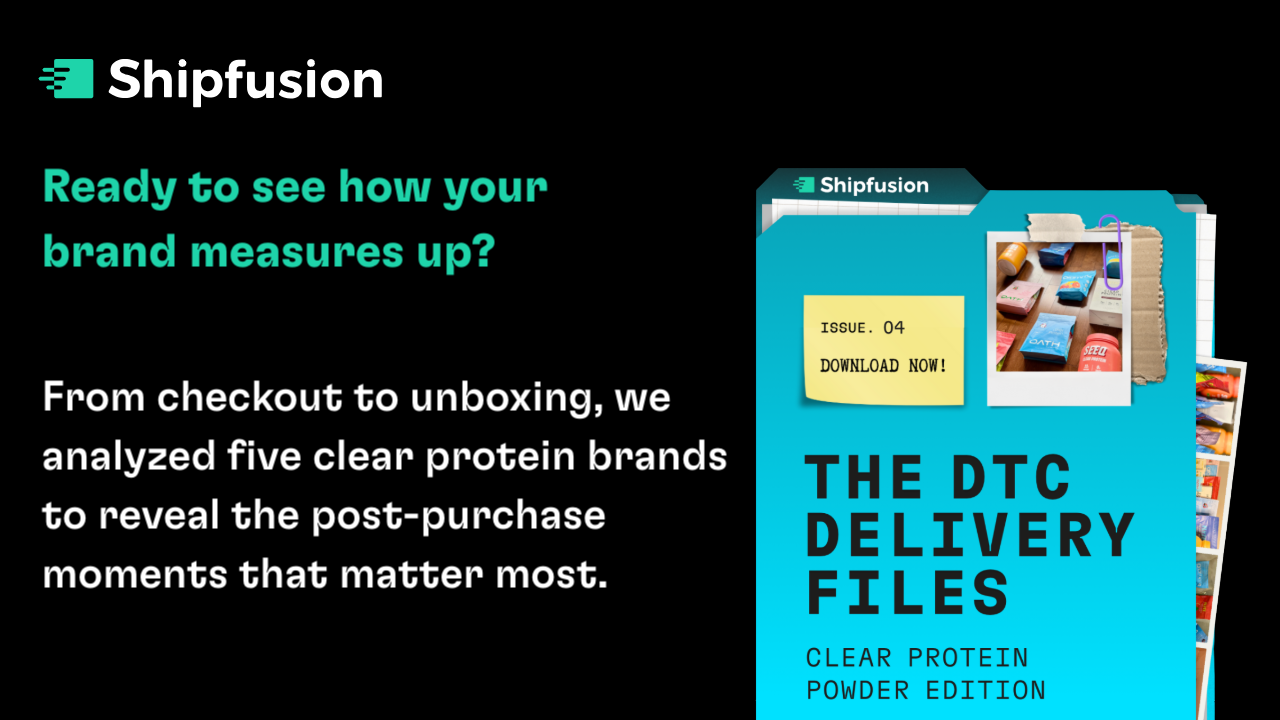
You can have great ads, a clean PDP, and a perfect checkout. And still lose the customer the moment the order is placed.
Shipfusion placed five real orders across leading clear protein brands within the same hour and tracked every step after purchase. Same cart moment. Completely different delivery realities. That inconsistency is where loyalty breaks quietly.
Here’s what the audit exposed:
- Only 1 brand offered subscriptions in both cart and checkout, even in a habit-driven category
- 80% showed star ratings on PDPs, then removed social proof at checkout
- Only 2 brands upgraded tracking beyond Shopify defaults
- 50% of shipping labels didn’t show the brand name
This is the churn layer you can’t fix with better creative.
Clear protein was just the test case. If you ship products to customers, this report is for you, showing exactly how your brand compares with benchmarks you can act on immediately.
Download the DTC Delivery Files and benchmark your post-checkout reality!
⚡ Why Google Ads Keeps Sending You Junk Leads
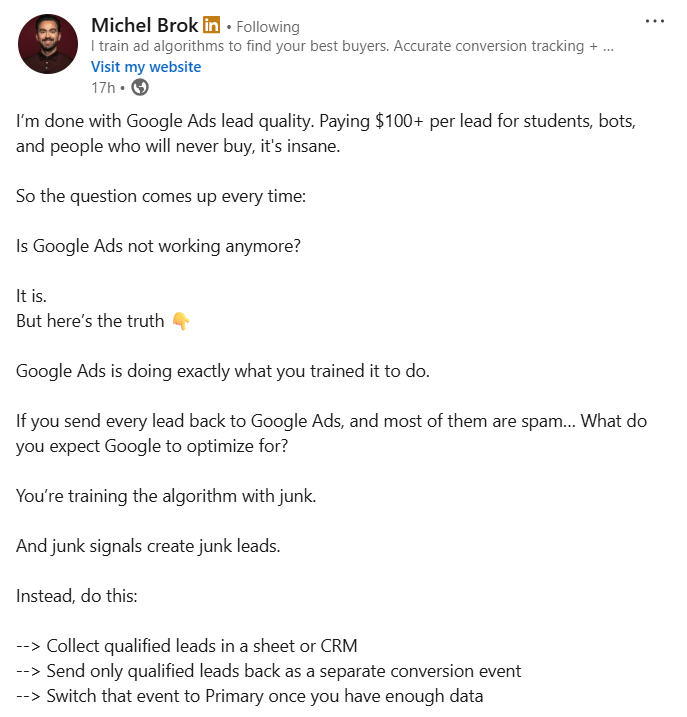
Google Ads isn’t “broken,” it’s just doing what it’s told. If every form fill counts as a conversion, Google will find more form fillers, even if they’re students, bots, or zero-intent leads. When spam gets fed back as success, the algorithm learns the wrong lesson and doubles down.
Why it works - Sending back only qualified leads teaches Google what “good” actually looks like. Instead of optimizing for cheap submissions, it starts optimizing for buyers. The moment you track qualified leads separately, and then make that conversion Primary, lead quality usually improves fast because the system has cleaner signals.
The real takeaway - Stop rewarding Google for junk. Track quality in your CRM, upload only real leads, and let the algorithm learn from buyers instead of browsers.
Together with Tatari
Why Winning DTC Brands Are Getting Pickier About Their TV Partners
If you've been eyeing TV for 2026, you've seen the flood: hundreds of platforms promising to "unlock CTV for your brand."
Here's what they're not saying: who you pick determines whether TV becomes a growth channel or an expensive experiment.
Most new players are programmatic-only – limited transparency, low-quality supply, and measurement that crumbles the second you scale.
The brands actually winning on TV (Jones Road Beauty, Tecovas, Ridge Wallet, Calm) use partners who offer:
- Not just programmatic, but linear, streaming, and direct publisher inventory
- Full visibility into where ads ran
- Outcomes measurement that actually works at scale
2026 will reward marketers who are thoughtful about their TV partners. The space is crowded, but the right choice actually moves the needle.
And don't forget to gut-check those shiny offers. Free ad credits? Performance guarantees? If it sounds too good to be true, it is.
Start smart or switch to a reliable partner: Tatari.tv
🎥 Reel of the Day

What Works:
1. The phone-on-lips trick is the real hook - It looks too real, so your brain goes “wait… is he actually talking?” That tiny confusion makes people rewatch, and those rewatches are exactly what push the reel harder.
2. It’s not promoting an event, it’s inviting a mood - They’re not shouting “Emo Night tickets.” They’re basically saying, “You’ve had a long day, come be chaotic with us.” That’s super niche, super customer-centric, and it lands.
3. The kiss zoom-out is a cute little mic drop - It ends on something funny and unexpected, not a boring info card. So instead of swiping away, people smile, replay it, and save it like a tiny comfort reel.
This works because it feels like a magic trick + an inside joke for the right crowd. It grabs attention fast, holds retention, and sells the vibe of the night before it ever sells the ticket.
Thanks for reading this edition! Keep pushing boundaries, testing ideas, and staying inspired. See you in the next edition with more ways to ignite your marketing success. 🥰