Coupons are killing sales
🧠 Coupon fields don’t lower conversion. they reset the buyer’s brain, Google ads custom audiences that actually matter in 2026, and more!
Welcome to a space where every edition delivers insights, strategies, and inspiration to fuel your advertising brilliance. 🤯
🧠 Coupon Fields Don’t Lower Conversion. They Reset the Buyer’s Brain.
Coupon fields don’t fail because people want lower prices.
They fail because they change what the buyer thinks the next step should be.
Right before checkout, the buyer is mentally closing a loop. The moment a coupon box appears, that loop reopens. Not around money, but around optimization. The question shifts from “Am I ready to buy?” to “Am I buying this the right way?”
That shift is where momentum breaks.
Coupon Fields Signal the Decision Isn’t Finished Yet
A visible coupon box suggests there is a better version of this purchase available elsewhere.
Even confident buyers start wondering if they’re missing something. That sense of incompleteness shows up at the worst possible time, right before commitment. The product didn’t change, but the confidence did.
The cart stops feeling final and starts feeling provisional.
Searching Kills Momentum, Not Because of Price
When someone leaves checkout to look for a code, the emotional state changes.
They move from commitment to comparison. Even if they come back, they return colder and more analytical. Many abandon not because they didn’t find a coupon, but because the act of searching broke the buying rhythm.
Checkout works when it feels like a straight line. Coupon hunting turns it into a detour.
Auto-Applied Discounts Keep the Decision Intact
Applying eligible discounts automatically preserves flow.
The buyer gets the reward without effort, and the system clearly confirms it’s active. That confirmation matters more than the size of the discount. It tells the brain, “You’re not missing anything. This is settled.”
No searching. No second-guessing. Just continuation.
Closure Beats Generosity at Checkout
A small, visible discount often outperforms a larger hidden one.
What matters most isn’t the incentive value; it’s the certainty that the best outcome has already been achieved. When optimization instincts are shut down, completion rates rise.
Check out isn’t where you invite better options. It’s where you signal there are none left to consider.
When the system communicates finality, buyers stop evaluating and start finishing.
Together with The Shift
The Only AI Newsletter Built for Output
Most AI newsletters flood you with tools, headlines, and hype. The Shift does the opposite.
Every issue cuts through the noise to show you what actually works, with real-world breakdowns of workflows, systems, and strategies that use AI to get real results, not just automate busywork.
Plus, get instant access to 3,000+ top tools, vetted prompts, and free courses so you can apply, not just absorb.
If you want less noise and more wins, you belong here.
⚡ Google ads custom audiences that actually matter in 2026
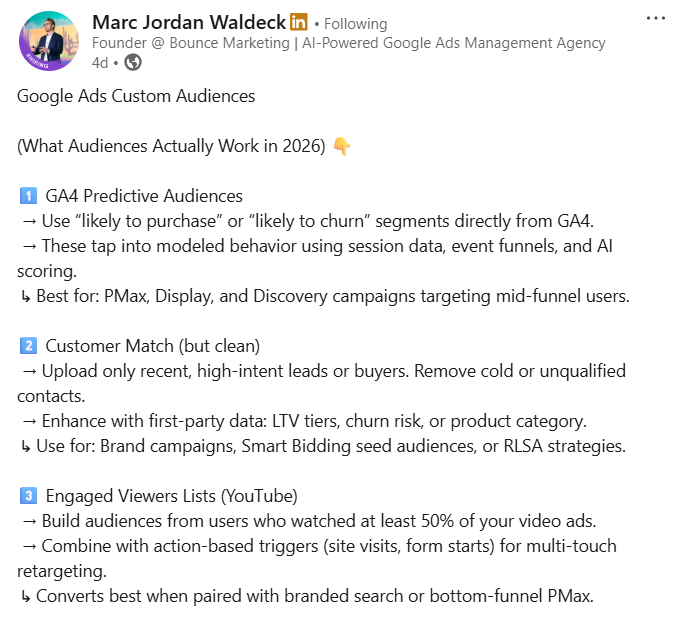
Custom audiences aren’t about clever hacks anymore. They’re about feeding Google cleaner, more meaningful signals so automation can do its job properly. The brands winning in 2026 aren’t using more audiences, they’re using better ones.
What’s working now - Clean Customer Match lists outperform bloated uploads every time. YouTube engaged viewers filter for real attention, not impressions. Offline conversion imports teach Google who actually buys. Page category audiences add funnel-level context instead of lumping everyone together.
The real takeaway: Audiences have shifted from targeting tools to signal inputs. The quality of what you feed Google matters more than the size of the list. Better signals create better models, and better models are what drive performance in 2026.
🚀 Reel of the Day

What Works:
1. The hook weaponizes interruption psychology - Throwing the object at the car triggers pure threat-based attention. Your brain locks in because damage is imminent. That forced attention creates instant thumb-stopping retention without needing shock value or gimmicks.
2. Countdown builds anticipation instead of urgency - The 5–4–3–2–1 resume mechanic creates controlled suspense. People wait because they want a payoff, not because they’re being sold to. That anticipation boosts average view duration and algorithmic distribution.
3. Product reveal happens at emotional peak, not impact - They show the product at the highest tension moment, then let the fall happen after. The brand anchors itself to relief and control, not damage, subtly positioning it as protection and confidence.
This reel works because it sells timing, not features. By hijacking attention, reframing ads as entertainment, and placing the product at peak emotional tension, it earns massive reach, retention, and brand memorability without feeling like marketing.
Thanks for reading this edition! Keep pushing boundaries, testing ideas, and staying inspired. See you in the next edition with more ways to ignite your marketing success. 🥰