Creative Diversity Is Now Survival
🫠Why repeating the same “look” is now a performance killer, Why TikTok shop isn’t always a “Profit or Loss” channel, and more!
Welcome to a space where every edition delivers insights, strategies, and inspiration to fuel your advertising brilliance. 🤯
🫠Creative Diversity Is Now Survival
A lot of media buyers still think creative testing means swapping hooks.
Same structure, same creator, same pacing, just ten different openers. That used to be enough. Meta would treat them as fresh inventory, and you could scale by iterating inside one template.
That era is fading.
Meta’s auction has changed, and accounts are now getting penalized for what I think of as visual sameness, even when the copy looks different. Once your ads start sharing the same creative footprint, performance begins to slide in ways that feel mysterious until you zoom out.
Visual Signature Dilution is when your ads carry the same underlying visual DNA.
The same b-roll sequences. The same font overlays. The same creator framing. The same edit rhythm. The same familiar UGC template. To a human, these look like variations. To Meta, they look like clones.
And when the platform sees you flooding the auction with redundant inventory, it stops exploring. Delivery tightens, CPMs rise, reach worsens, and the account starts feeling stuck. Not because your hook is bad, but because the system is tired of the pattern.
Meta’s recommendation engine thrives on variety. Its job is to match different creative identities to different micro-audiences in different moments. But if every ad looks like the same piece of content wearing a different headline, the algorithm has nowhere new to go.
That is why Meta is surfacing tools like the Creative Similarity Report. The message is blunt. Ten versions of the same ad is not diversity.
The new standard is treating every ad like its own mini universe.
Not just a new hook. A new visual language.
Different environments. Different creator energy. Different pacing. Different textures and formats.
This is also where creator sourcing becomes a real performance lever. Platforms like Insense make it easier to work with multiple brand-aligned creators quickly, so your account naturally produces different filming styles, tones, and visual signatures instead of recycling the same template with minor edits. You can book a discovery call by Feb 6 and get a $200 bonus for your first campaign.
One ad feels like a founder diary. Another feels like a street interview. Another feels like a blind test. Same product, completely different content world.
If you want Meta to find winners again, stop building variations inside a template.
Start building separate creative worlds. In this era, diversity is not a bonus. It is survival.
Together with The Shift
Knowing AI Isn’t the Problem. Applying It Is.
You’ve read the articles. Watched the demos. But if it’s not improving how you work every day, what’s the point
At The Shift, they don't teach AI like a concept... they turn it into execution.
✅ Build workflows that run 24/7 behind the scenes
✅ Use AI to think through ideas and not just finish them
✅ Learn to build systems that scale you, not just your output
This isn’t surface-level AI knowledge. It’s a deep performance built in 5 minutes a day.
Subscribe and get 3000+ tools, 500+ prompts, and free AI training courses. Make AI work to your advantage
⚡Why TikTok shop isn’t always a “Profit or Loss” channel
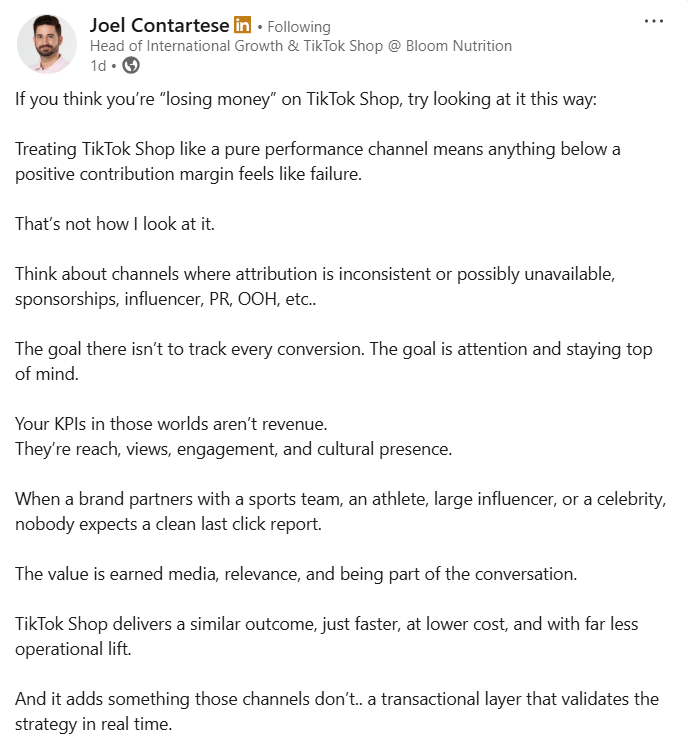
TikTok Shop feels frustrating when it’s judged like Meta, where every dollar needs a clean contribution margin. But it behaves more like an influencer or PR, messy attribution, huge attention upside, and value that shows up everywhere else, not just in last-click revenue.
Why it works: TikTok Shop creates cultural presence fast. The content spreads, affiliates push volume, and the brand stays top of mind even when tracking is imperfect. Unlike sponsorships or OOH, it also has a built-in transactional layer; sales happen in real time, not as a vague long-term effect.
TikTok Shop isn’t just a performance channel. It’s awareness, distribution, and commerce stacked together. Sometimes the sale isn’t the finish line; it’s the signal that the brand is landing.
🎥 Reel of the Day
What Works:
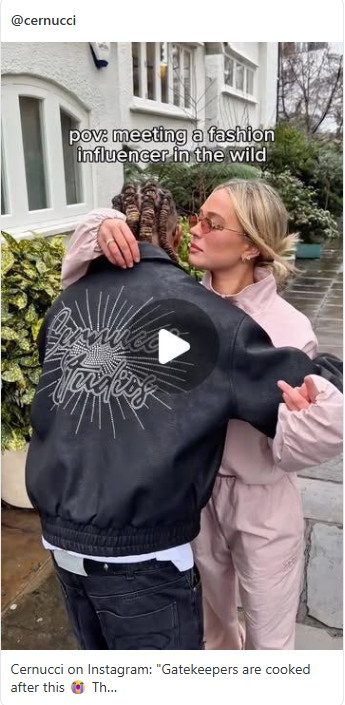
1) This reel is basically a social heist disguised as a cute interaction - It feels like a wholesome moment at first, but underneath, it’s actually about access. She hugs him not for affection, but for information, which flips the whole scene. That quiet tension makes it instantly addictive.
2) The humor comes from how real the behavior feels - People genuinely do this, they pretend to be casual while secretly trying to figure something out. The “you smell good” line is such a human cover-up; it’s awkward in the most relatable way.
3) The offer reveal feels like the payoff to a mini story - The discount isn’t random, it feels earned because you watched her “mission” unfold. The scrolling moment makes the app feel like the natural next step, not a sales push.
What’s different here is that the reel doesn’t sell clothes, it sells the feeling of being in the know. It turns shopping into a social hack, like fashion is a hidden world you can unlock. That’s why it feels smart, modern, and honestly kind of brilliant.
Thanks for reading this edition! Keep pushing boundaries, testing ideas, and staying inspired. See you in the next edition with more ways to ignite your marketing success. 🥰