First-Screen Contradictions
📱The silent reason good landing pages still bleed revenue, Why Post-Purchase is the real growth lever, and more!
Welcome to a space where every edition delivers insights, strategies, and inspiration to fuel your advertising brilliance. 🤯
Together with Wing
Get Back 20+ Hours Every Single Week with Wing
You know the trap. You start Monday with big priorities, and by Wednesday, you’re buried under inbox fires, calendar chaos, vendor follow-ups, and tasks that generate zero lift. Those lost hours add up. So do the missed targets.
There’s a cleaner path. Wing high-performing, trained human virtual assistants who absorb the operational drag and give you back the bandwidth you actually get paid for.
• 20 to 30 hours reclaimed weekly across admin, scheduling, CRM, and research
• 35% faster project cycles because your follow-ups and reporting run on autopilot
• 50% reduction in task switching, freeing you to focus on real work
With 10K+ customers and a 4.9 average rating, it’s built for operators: zero training, zero micromanagement, zero onboarding friction
If you had an extra 20 hours next week, what would you build? What would you finally fix?
Get matched with a high-performing assistant and buy back your time today!
📱 First-Screen Contradictions: The Silent Reason Good Landing Pages Still Bleed Revenue
A buyer can understand a page and still leave immediately. That is the part most teams miss, because they assume “clarity” is the same as “trust.”
First-screen contradictions are the tiny mixed signals between headline, subhead, hero visual, and CTA that quietly trigger suspicion and stop motion.
The first screen is processed like a threat scan, not like a blog post. If the page tells two different stories at once, the brain defaults to safety. Safety on the internet usually means closing the tab.
What a contradiction looks like in real life
A headline promises speed, but the hero image feels slow and ceremonial. A subhead claims simplicity, but the visual is cluttered and effort-heavy. A CTA demands a hard commitment, while the rest of the screen still feels like an introduction.
The 4 contradiction types that tank conversion
1) Tone contradiction
Copy sounds casual and human, but the design feels sterile and corporate, or the opposite. The buyer senses performance instead of a real brand.
2) Promise contradiction
The headline sells one outcome, and the subhead sneaks in two more. Instead of increasing desire, it creates uncertainty about what is actually being bought.
3) Effort contradiction
The page says easy, but the first screen feels dense, busy, or demanding. The checkout might be simple, but the brain has already decided it is going to be work.
4) Commitment contradiction
The CTA asks for “Buy Now” energy before the screen has earned belief. That gap creates resistance, even when the product is a good fit.
The fix: The One-Sentence Agreement Test
Force every element to complete the same sentence. Headline defines the outcome, subhead clarifies it, visual shows it, CTA advances it. If any element pulls the sentence in a different direction, that element is the leak.
People rarely bounce because they hate the offer. They bounce because the page feels internally unstable in the first seconds. Remove contradictions, and the rest of the page finally gets a fair chance to convert.
⚡ Why Post-Purchase Is the Real Growth Lever For Scaling DTC
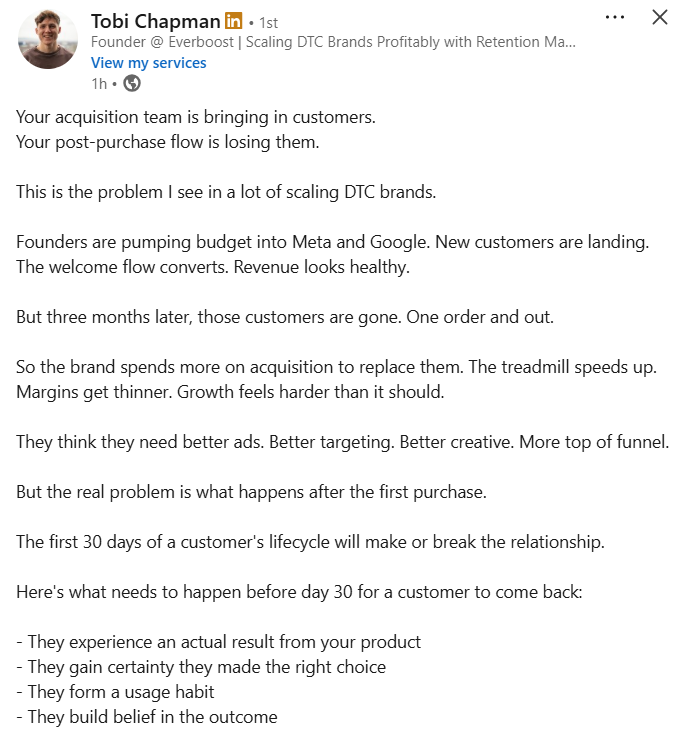
This idea reframes the real leak in scaling brands. Acquisition brings customers in, but the first 30 days decide whether they become repeat buyers or churn after one order. If those days are unmanaged, you end up buying replacements forever, which quietly destroys margins.
Why this works: It focuses retention on four concrete outcomes that actually drive repeat purchase: results, certainty, habits, and belief. Speeding up time to value prevents early quitting, while expectation-setting reduces product blame. Founder-led reassurance and relevant testimonials lower post-purchase doubt, and habit cues plus milestones make usage automatic.
Where it needs balance: Not every product can show results within 30 days, so the flow must set honest timelines and emphasise proxy wins like consistency and early signals. Over-emailing can backfire, especially if reminders feel naggy or generic. Personalization also adds complexity, so start with simple segmentation by goal, product, or usage cadence before building a fully branched system.
Together with Section
Ten Truths and a Lie About AI in 2026 – December 9 | Free Virtual Event

If you feel like everyone is “doing AI” but no one actually knows what’s working, you’re not crazy. Most teams still don’t know what’s real, what’s noise, and what’ll actually move the bottom line.
On December 9, join Greg Shove, CEO of Section, for a rare, insider-only breakdown of what separates AI winners from the rest. This isn’t theory, it’s what enterprise operators are already doing to turn AI from hype into measurable ROI.
You’ll uncover:
- What defines a profitable AI strategy vs. a PR stunt?
- How top orgs are structuring AI investments that scale beyond experimentation.
- The single mistake that’s killing ROI for 90% of teams.
Greg’s taking off the filter, sharing insights usually reserved for Section enterprise clients.
🚀 Reel of the Day

What Works:
1. The loop technique hijacks retention - Starting and ending with the exact same visual (the Cann float being dispensed) creates a perfect loop, a known editing technique used in food reels to trick the brain into watching twice.
2. The machine + beverage combo - By using the Ninja Kitchen (a premium, high-status appliance), they turn Cann into something more premium by association. The viewer subconsciously thinks: “If you have this machine, you can turn Cann into a gourmet dessert.”
3. The reel is engineered for shareability - THC drink fans, dessert lovers, and foodie communities all share overlapping interests. This single reel hits all four tribes, letting the content cross-pollinate across niches and dramatically increasing reach.
This reel wins because it merges loop-editing, sensory cinematography, and cross-brand social proof into one irresistible micro-experience. Cann gains premium value and flavour desirability simply by being shown as the ingredient that “unlocks” the final product.
Thanks for reading this edition! Keep pushing boundaries, testing ideas, and staying inspired. See you in the next edition with more ways to ignite your marketing success. 🥰