Free beats discounts
🤩 Luck converts better than engineered savings, Recap of Google Ads in 2025, and more!
Welcome to a space where every edition delivers insights, strategies, and inspiration to fuel your advertising brilliance. 🤯
🤩Why Free Beats Discounts
Here’s a blind spot in how buyers interpret value.
When the product people actually want is framed as a free gift, purchase intention jumps. Not because the deal is objectively better, but because the buyer feels fortunate, not targeted.
That emotional shift matters more than price. But this effect is fragile. Used incorrectly, it doesn’t lift conversion. It destroys trust.
The Real Mechanism (Beyond “Free”)
This isn’t about generosity. It’s about misattribution. Buyers don’t think, “This brand engineered a smart offer.” They think, “I got lucky.”
The moment an offer feels optimized, personalized, or algorithmic, the luck signal collapses and persuasion awareness kicks in. What’s left is skepticism.
So this is not a pricing tactic. It’s a perception tactic.
The Operator Rules (Where This Actually Works)
Rule 1: Only invert products that feel inevitable
The “free” product must feel like something the buyer was already going to own.
Hero SKUs. Category defaults. Best-sellers. If the free item feels niche or optional, the effect weakens. Luck requires recognition.
Rule 2: Never pair this with visible targeting
Targeting salience kills the effect. That means:
- no behavioral references
- no “recommended for you” cues
- no personalization language
It should feel like a shelf discovery, not a recommendation engine.
This is where teams often misstep by over-optimizing. Tools like Lindy AI CMO help here by letting you spin up agents to map offer variants, test framing logic, and document where perception breaks, without defaulting to over-personalization. You can sign up for free and see AI CMO in action here.
Rule 3: Free beats discounted, every time
Once the target product is discounted instead of being free, the effect collapses. Discounts signal intent.
Free signals anomaly.
If the margin is tight, reduce the paid product’s scope or bundle size. Don’t discount the target product.
Rule 4: Use this to acquire, not to retain
This works best on first exposure.
Existing customers already understand your strategy, which explains the offer and weakens the luck signal. Use this to reset consideration and break category fatigue.
Final Take
You’re not lowering the price. You’re lowering resistance.
Do this where inevitability is high, targeting is invisible, and the freebie feels like fate, not marketing. That’s how a lab result becomes an operator advantage.
Together with Insense
Stop Guessing. Start Working With Creators Who Actually Convert
You don’t need more creators. You need the right creators, the ones who look like your buyer, speak their language, and move your metrics from the first piece of content.
But manually sourcing them? Total momentum killer and the fastest way to fall behind in Q5.
That’s why 2,000+ brands and agencies now rely on Insense. In under 48 hours, you get high-fit creators hand-matched to your exact niche so you can run everything end-to-end: product seeding, UGC, TikTok Shop, Meta Partnership Ads, and TikTok Spark Ads without the sourcing chaos.
Here’s what brands are actually seeing:
- Revolut: 350+ UGC assets from 140+ creators across 10+ countries.
- goPure: 150+ UGC videos generated at zero cost through product seeding.
- Maty’s: 12x higher reach using TikTok Spark Ads at roughly $0.60 CPC.
Now imagine your Q1 pipeline built on creators who actually convert, not creators you hope will convert.
Book a free strategy call by December 31 and get a $200 bonus for your first campaign!
⚡ Google Ads in 2025: The Shift That Actually Matters
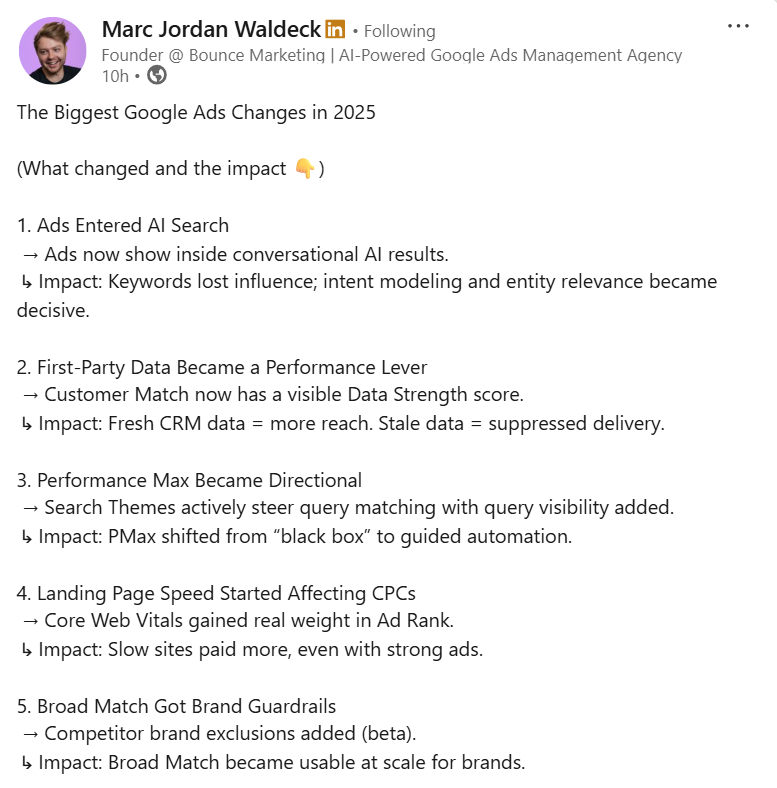
2025 wasn’t about new buttons. It was about where control moved.
Google Ads shifted away from keywords and manual tweaks and toward intent, data quality, and system alignment. Ads now live inside AI search, first-party data decides reach, and Performance Max can finally be guided instead of guessed.
At the same time, Google started rewarding fundamentals again. Fast landing pages lower costs. Shorts became a controllable channel. Spend and attribution became more transparent.
How to carry this into 2026:
Think of Google Ads as an ecosystem, not a switch you turn on. Keep your customer data fresh, fix your site before spending more, and guide automation instead of letting it run wild. Focus on intent, not keyword volume, and recheck performance often because the rules keep shifting.
🎥 Reel of the Day

What Works:
1. It feels like you walked into a moment mid-scene - The flip is so random it feels accidental. Like you opened Instagram at the exact wrong time, and now you have to see how this ends.
2. The “cops won’t like this” line is a cheat code - It adds a tiny edge of danger, but stays playful. That micro tension creates a reason to keep watching because your brain expects consequences.
3. The random passerby shot is doing real work - That moment makes it feel like a real street scene, not a staged ad. You are not watching for the jacket anymore, you are watching to see what happens, and the jacket becomes the solution.
This reel wins because it does not market clothing; it markets control. The product is framed as “flip and reset your identity in one second,” and that is a way stronger emotional promise than “reversible fleece dropping on Black Friday.”
Thanks for reading this edition! Keep pushing boundaries, testing ideas, and staying inspired. See you in the next edition with more ways to ignite your marketing success. 🥰