Good Ads Are Raw Material
💪Scale comes from decompression, not tweaks, how meta actually groups and delivers your ads, and more!
Welcome to a space where every edition delivers insights, strategies, and inspiration to fuel your advertising brilliance. 🤯
Together with Wing Assistant
Get Back 20+ Hours Every Single Week with Wing
You know the trap. You start Monday with big priorities, and by Wednesday, you’re buried under inbox fires, calendar chaos, vendor follow-ups, and tasks that generate zero lift. Those lost hours add up. So do the missed targets.
There’s a cleaner path. Wing high-performing, trained human virtual assistants who absorb the operational drag and give you back the bandwidth you actually get paid for.
• 20 to 30 hours reclaimed weekly across admin, scheduling, CRM, and research
• 35% faster project cycles because your follow-ups and reporting run on autopilot
• 50% reduction in task switching, freeing you to focus on real work
With 10K+ customers and a 4.9 average rating, it’s built for operators: zero training, zero micromanagement, zero onboarding friction
If you had an extra 20 hours next week, what would you build? What would you finally fix?
Get matched with a high-performing assistant and buy back your time today!
💪Good Ads Are Raw Material
When an ad starts winning, most teams do the same thing.
They duplicate it. They tweak the hook. They change a line or two. They hope the performance stretches a little further.
That instinct leaves most of the money on the table.
A winning ad is not a finished asset.
It’s compressed evidence.
It proves that a specific belief, tension, or promise resonates with the market. What it does not prove is that you’ve extracted all the value from that insight. That’s where scale actually comes from.
The Mistake: Treating Ads as Units
Most teams think in units. One ad. One angle. One winner. But buyers don’t respond to ads. They respond to decision contexts. The same message can feel completely different depending on how it’s framed:
- A story activates identity and empathy
- A tutorial activates competence and control
- Authority activates safety and risk reduction
When you reword a hook, you stay inside the same decision context. You’re polishing, not expanding. That’s why performance stalls even when the message is “still working.”
The Reframe: Winning Ads Are Raw Material
A winning ad tells you one thing with certainty: Something in this message unlocked desire.
That insight can be decompressed. Instead of asking, “How do we make another version of this ad?”
The better question is, “How many decision frames can this insight live inside?”
One message can become:
- An emotional narrative for buyers driven by identity
- A step-by-step explanation for buyers who need clarity
- An authority-backed claim for buyers who fear risk
Same promise. Same proof. Different mental doors. Each format doesn’t compete with the original. It expands the surface area of conversion.
Why This Scales Better Than New Ideas
New ideas are expensive. They require validation. They introduce risk.
Decompression is cheaper.
You’re not guessing what might work. You’re repackaging what already did, so it can reach buyers who ignored the original format.
That’s why brands with fewer core ideas often scale further than brands constantly chasing novelty. They extract more value per insight.
The Strategic Payoff
When teams shift from “making more ads” to “decompressing winners,” a few things change:
- Creative fatigue slows down
- Testing becomes directional instead of random
- Performance stabilizes across audiences
The ad account stops behaving like a slot machine and starts behaving like a system.
If an ad wins, don’t ask how long it will last. Ask how many forms it hasn’t taken yet.
Because your best ad is rarely finished. It’s just under-expressed.
Scale doesn’t come from saying something new. It comes from letting the same truth speak in more ways.
⚡ How Meta Actually Groups and Delivers Your Ads
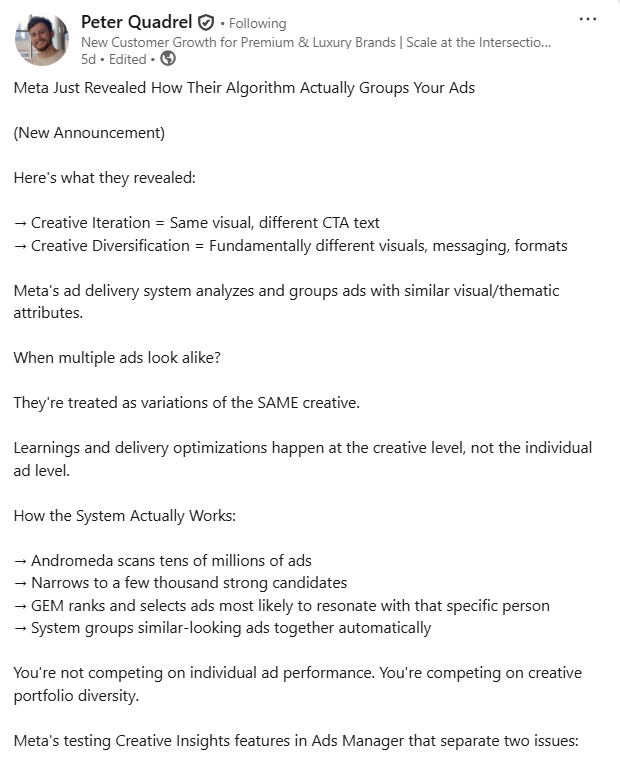
Meta just made something very clear. The algorithm does not evaluate ads one by one the way most teams think it does. If multiple ads look and feel similar, Meta treats them as the same creative, even if the copy or CTA is different.
Why this works: Meta’s system is built to match people, not ads. Andromeda scans massive volumes, narrows options, and GEM selects what fits each user best. A diverse creative portfolio gives the algorithm more ways to match different people, moods, and contexts.
The real takeaway: Stop chasing one “winning ad.” Start building creative ecosystems. Breadth beats refinement. When your assets are genuinely different in format, message, and persona, Meta has more paths to personalize delivery. That’s what the algorithm is designed to reward going into 2026.
Together with The Shift
Knowing AI Isn’t the Problem. Applying It Is.
You’ve read the articles. Watched the demos. But if it’s not improving how you work every day, what’s the point
At The Shift, they don't teach AI like a concept... they turn it into execution.
✅ Build workflows that run 24/7 behind the scenes
✅ Use AI to think through ideas and not just finish them
✅ Learn to build systems that scale you, not just your output
This isn’t surface-level AI knowledge. It’s a deep performance built in 5 minutes a day.
Subscribe and get 3000+ tools, 500+ prompts, and free AI training courses. Make AI work to your advantage
🎥 Reel of the Day

What Works:
1. The upside-down can instantly hijack pattern recognition - Your brain already knows Stranger Things before the logo appears. That instant recognition reduces skip behavior and buys attention without explaining anything.
2. The comment prompt exploits cultural timing, not curiosity - “Comment your theories” works because people already want to talk about Stranger Things right now. Bubblr doesn’t create discussion; it plugs into an existing one.
3. Brand restraint signals confidence and earns goodwill - No benefits, no hard sell, no voiceover. That restraint makes the brand feel culturally fluent, which increases shares from people who want to signal taste.
This reel works because Bubblr doesn’t advertise inside Instagram. It advertises inside a cultural moment. The product becomes a prop in a story people already care about, and attention does the rest.
Thanks for reading this edition! Keep pushing boundaries, testing ideas, and staying inspired. See you in the next edition with more ways to ignite your marketing success. 🥰