Google isn’t crawling what matters
⚡Even SEO is now a game of attention and most sites are wasting every second of it, Why creative should be measured by customer quality, not clicks, and more!
Welcome to a space where every edition delivers insights, strategies, and inspiration to fuel your advertising brilliance. 🤯
⚡ Google has a finite attention span. Most sites are wasting every second of it.
Google doesn't owe your site attention. It allocates it. And right now, it's spending yours on pages that will never rank, never convert, and never justify the bandwidth they consume.
That's not a traffic problem. That's a capital misallocation problem wearing an SEO costume.
Every crawl is a spend decision Google makes on your behalf without asking permission. The sites compounding in search right now aren't publishing more; they're engineering fewer, heavier pages that earn disproportionate crawl priority and convert it into revenue before competitors even get indexed.
Run the site like a portfolio. Fire the underperformers.
Every page either generates yield or consumes it. The ones generating nothing aren't neutral, they're diluting the signal quality of the pages that actually matter.
The dead weight hiding inside a typical site:
- Thin blogs ranking for zero commercial intent queries while eating crawl budget like it's free
- Duplicate variants fragmenting authority that should be stacking on one URL
- Dead collection pages are getting revisited out of pure algorithmic habit
- Informational content with no monetization path floating inside the index like lost tourists
Cutting, consolidating, or noindexing these isn't a content decision. It's a capital reallocation with a better ROI than most paid campaigns.
Build gravity. Stop building flat roads.
Flat internal linking distributes crawl attention like a participation trophy; everyone gets some, nobody wins. The goal is gravity. Dense, intentional linking clusters make high-value pages impossible for the algorithm to walk past without stopping.
Then manufacture urgency. Google reads activity signals, not good intentions. Fresh updates on priority pages, new internal links pointing toward revenue-generating content, deliberate activity bursts around pages that deserve more oxygen, these train the algorithm on what matters today, not what mattered at publication eighteen months ago.
The gap where the real money hides.
Ranking is the easy flex. Converting ranked traffic is where the leverage actually lives and where almost nobody is paying attention.
The funnel sitting underneath already-performing traffic is chronically under-optimized relative to the ads feeding it. Funnelish closes that gap specifically, built to turn traffic that's already arriving into revenue that's actually captured rather than quietly bouncing. You can try it for free for 14 days.
Fewer pages. Heavier signals. Faster crawl cycles. Revenue on every visit. Not an SEO strategy. A compounding asset.
Together with AirOps
Stop satisfying the algorithm. Start getting retrieved.
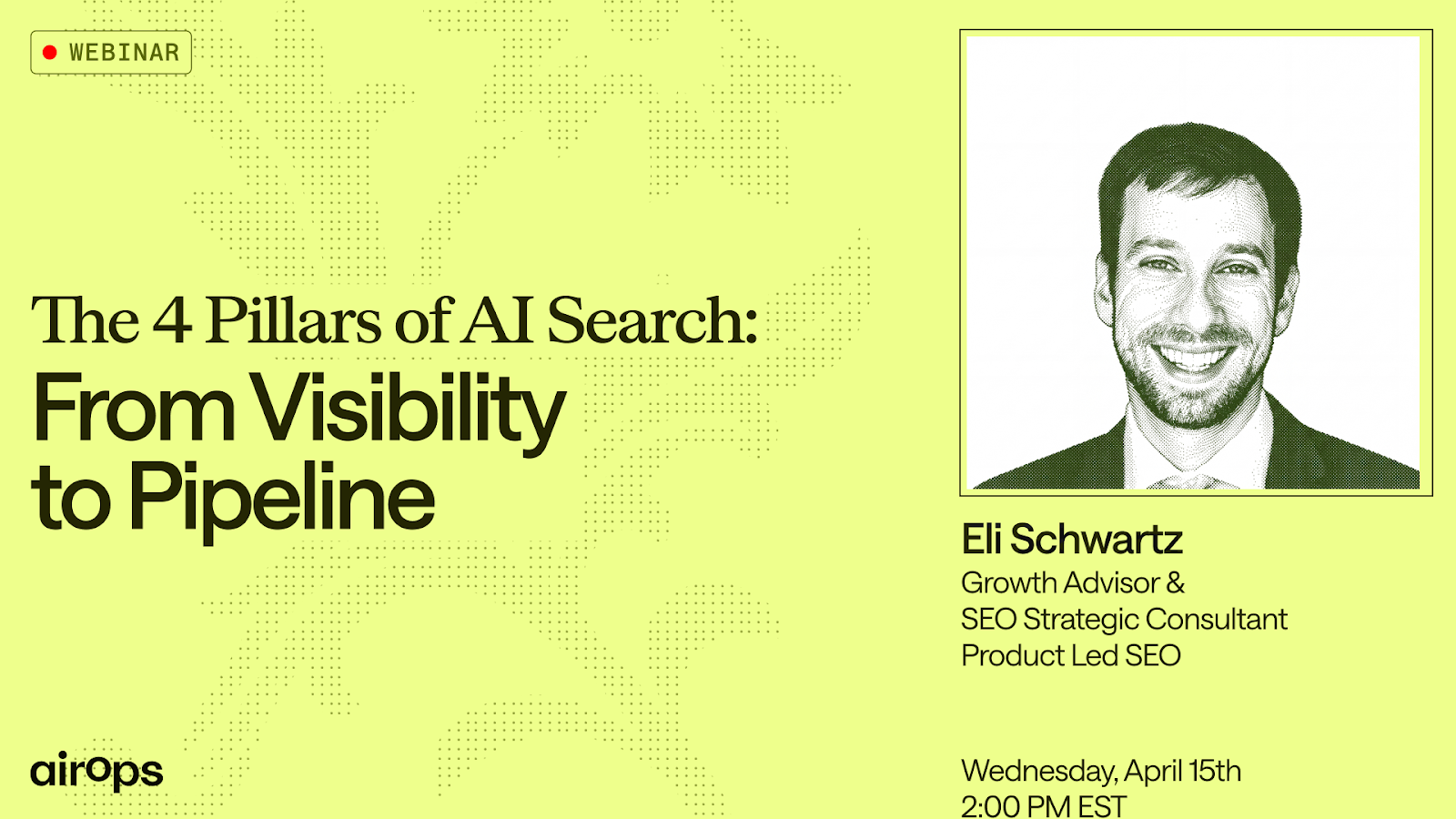
AI answers don't reward rankings. They pull from content that signals trust, structure, and relevance at the passage level. If your brand isn't being retrieved and cited, you're invisible where decisions are already being made.
Join AirOps on April 15th at 2 PM EST for a live session with Eli Schwartz, Growth Advisor and Author of Product-Led SEO.
Eli has created billions in organic search revenue, consulting with companies like Coinbase, Tinder, LinkedIn, Gusto, Quora, Zendesk, and more.
He’ll break down the exact framework he's shared with board rooms and VCs for how AI search is functioning now in 2026. You'll walk away knowing:
- The 4 pillars that determine whether AI retrieves your content
- How to identify the highest-leverage SEO stages to fix first
- Why deep customer research is still the most underused edge in AI visibility
One live session. A framework you can action the same week.
Can't make it live? Register anyway and get the recording within 24 hours.
⚡Creative should be measured by customer quality, not clicks
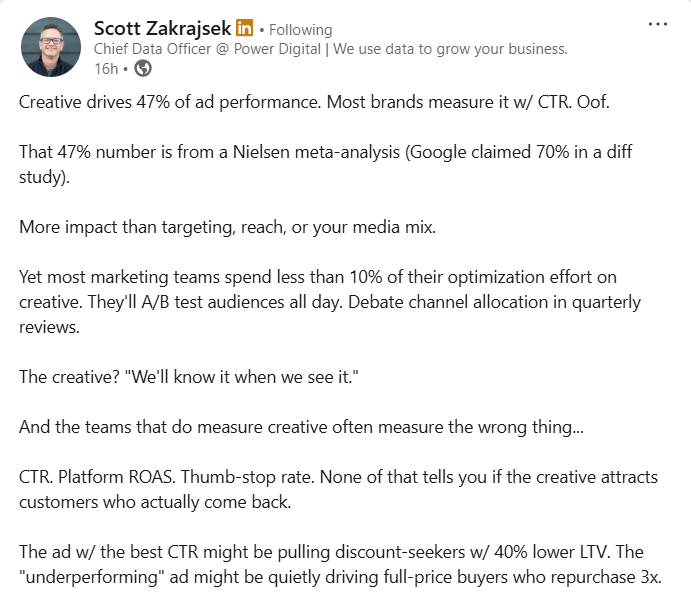
This framework argues that creative impact is massively under-measured and often optimized using shallow metrics like CTR or ROAS. Instead, it proposes evaluating creatives based on attributes, funnel stage performance, incrementality, and most importantly, the quality and lifetime value of customers it brings in.
Why it works: Creative influences not just conversions, but who converts. Measuring against LTV and incrementality reveals which creatives drive profitable growth, not just cheap clicks. This leads to smarter budget allocation and stronger long-term returns.
Where it needs balance: Advanced measurement, like MMM or cleanroom matching, is resource-intensive. Smaller teams may struggle to implement fully. Overcomplicating measurement can slow execution without clear incremental insights if data quality is poor.
🚀 Reel of the Day

What Works:
1. Generational Flip - This works because it flips the expected roles in a very human way. Instead of younger creators leading trends, the “boomer boss” becomes the main character, which feels unexpected but oddly wholesome.
2. Cringe Comfort - There’s a layer of “this is slightly awkward” energy throughout. But instead of pushing people away, it pulls them in because it feels real and relatable, like something your own boss would actually try.
3. Comment Trigger - The concept naturally invites opinions. People either find it hilarious, relatable, or slightly embarrassing, which makes them want to react publicly.
Role Reversal - Take a familiar trend and give it to the “wrong” person, that tension alone can carry the entire reel.
Thanks for reading this edition! Keep pushing boundaries, testing ideas, and staying inspired. See you in the next edition with more ways to ignite your marketing success. 🥰