Most winning ads are misread
🧪Your winners have no explanation, and that's the problem: sequential channel stacking from search to direct mail, and more!
Welcome to a space where every edition delivers insights, strategies, and inspiration to fuel your advertising brilliance. 🤯
🧪 Your winners have no explanation. That's the problem.
Variant B won. The team moves on. Nobody asked why. Nobody wrote it down. Next quarter, the same test runs with different creatives, a different winner, and nobody connects the two.
That's not a testing culture. That's a preference confirmation with a media budget attached.
Volume without architecture is just noise
Fifty tests a quarter sounds rigorous. It isn't, not if each test is structured the same way.
When you change three things between variants and one wins, you learned nothing. You know that combination of changes, in that market, at that budget, against that audience, in that week, outperformed the other one. That's a receipt, not an insight.
Real learning compounds. A real testing program builds a library of isolated, replicable truths you can apply to the next brief, the next launch, the next hire's onboarding. What most accounts have instead is a folder of past winners and no explanation for why any of them worked.
The false positive problem nobody talks about
A variant wins. You scale it. Performance drops. You blame fatigue and move on.
Often, the real issue is simpler. The winning ad had a different hook, different body copy, and a different CTA. You assumed the hook drove the win. But the CTA was the variable that actually mattered; you just couldn't see it because you changed too much at once.
Now you've scaled a misread. The next brief gets written toward the wrong lesson. The error doesn't announce itself. It just quietly degrades output over the next three creative cycles until performance is soft and everyone is guessing again.
False positives don't just waste test budget. They corrupt every brief that comes after.
What isolation actually requires
One variable. One hypothesis. One defined success metric before the test launches.
If you're testing the hook approach, everything else stays identical. Same body copy, same offer, same CTA. When one wins, you know exactly what you learned. You can write it down as a transferable principle.
The hypothesis matters as much as the variable. Most creative tests don't have one. They have a hope.
One extra line fixes this. Before every brief goes out, fill in: "The one thing this test will tell us is ___." If you can't answer that, the test isn't ready.
This is exactly what Motion's Creative Strategy Bootcamp is built around, moving from reactive testing to repeatable frameworks that actually compound. Free, live, 8 weeks. Registration closes March 17th. Reserve your spot now.
The brands with the best creative aren't testing the most. They know exactly why their best ads worked, and they can repeat it on purpose.
Together with Modash
Your Affiliate Program Might Be Profitable on Paper. That Doesn’t Mean It Works.
You launch an affiliate program. A few creators join. Some sales come in. Then growth plateaus.
Not because affiliate doesn’t work, but because the math, structure, and incentives were never designed to compound.
Modash just released the complete A-Z guide to building an affiliate program that actually holds up under scale.
Inside, you’ll discover:
- Why commission rates mean nothing without understanding margin compression
- How most tier systems accidentally demotivate top affiliates
- How code leakage and cookie gaps quietly distort attribution
This isn’t a surface-level playbook. It’s built from working with thousands of creators and real-world programs.
If you’re building affiliate as a real growth channel in 2026?
⚡Sequential channel stacking from search to direct mail
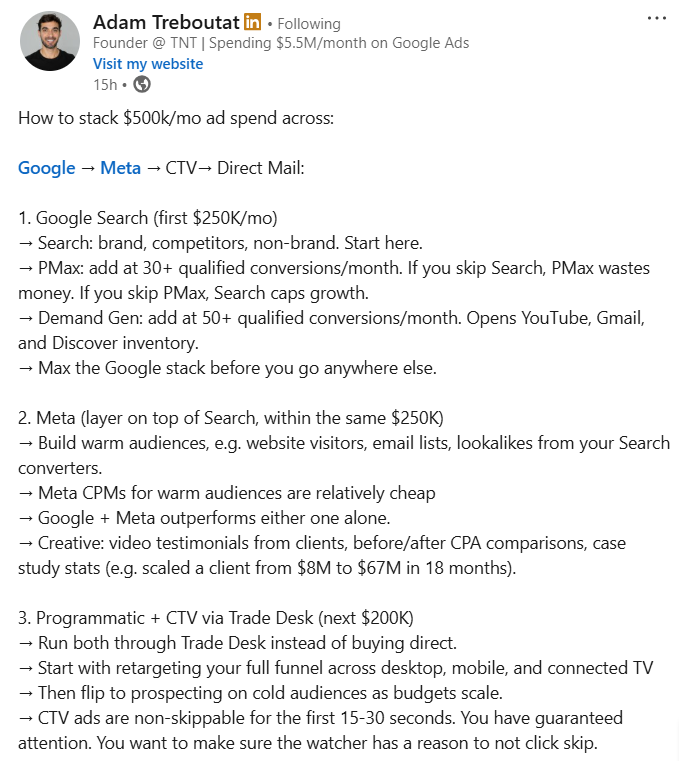
This strategy stacks channels sequentially. Google captures intent first, Meta expands and retargets, CTV builds broad attention, and direct mail converts known viewers. Each layer compounds data and familiarity across digital and offline touchpoints.
Why it works: High-intent search generates conversion data. That signal powers retargeting and audience expansion across Meta and programmatic. Sequential exposure across channels increases familiarity, reduces acquisition friction, and improves overall conversion probability.
Where it needs balance: Requires large budgets, advanced attribution, and strong creative coordination. Smaller brands may struggle with operational complexity. Without disciplined sequencing and incrementality measurement, stacked channels can duplicate reach and inflate acquisition costs.
🎥 Reel of the Day

What Works:
1. Opening with drinks intentionally falling feels wrong in the best way. People instinctively pause because waste triggers attention. That confusion becomes the hook, pulling viewers deeper as they try to understand what’s happening.
2. The repeating fall-and-reset motion creates a hypnotic rhythm. Every time a glass drops, another magically appears. Your brain anticipates the next moment, which quietly stretches watch time and flattens the retention curve.
3. The bar environment quietly does brand work in the background. Neon glow, polished counter, premium glassware. While people focus on the trick, the venue’s vibe builds perceived value without selling anything.
Start your reel with something that looks wrong or wasteful, then slowly reveal the creative logic behind it. When curiosity turns into understanding, viewers stick around and watch the whole story.
🥳Events
🤖 From AI Hype to Board-Level Results
Today | 11 AM - 6 PM ET | Virtual Event
If AI can’t show up in real numbers, it won’t survive 2026. At the AI:ROI Conference, DJ Sampath, SVP of AI Software and Platform at Cisco, joins Brice Challamel of OpenAI to share how leaders tie AI directly to adoption, efficiency gains, and margin growth.
🎯 The Private Testing Framework That Separates Top 1% Creative Teams From Everyone Else
Starts March 17 | Tuesdays at 1 PM EST | Virtual Bootcamp
Most teams run tests. Very few run controlled learning cycles. Motion’s free Creative Strategy Bootcamp walks you through the exact testing architecture used inside high-growth brands, how they validate angles, scale winners, and extract insights that compound. This is normally locked inside internal strategy docs.
Can’t attend every session live? Register anyway, you will get the recordings within 24 hours.
Thanks for reading this edition! Keep pushing boundaries, testing ideas, and staying inspired. See you in the next edition with more ways to ignite your marketing success. 🥰