Nobody cares about the math
🫣They care about what $1,200 actually is, Net New Reach reveals hidden saturation before CPA spikes, and more!
Welcome to a space where every edition delivers insights, strategies, and inspiration to fuel your advertising brilliance. 🤯
😬Nobody cares about the math
They care about what $1,200 actually is.
It's 11 months of Netflix. It's a flight to Lisbon. It's 240 Costco rotisserie chickens if that's how your brain works, and for a surprising number of people, it is.
The number itself means nothing. The translation is everything.
Most brands report savings in the abstract, annual totals, percentage reductions, and cost-per-seat comparisons. Clean, professional, completely forgettable. The finance brain processes it and moves on. Nothing sticks because nothing landed anywhere real.
The brands that actually convert on ROI messaging aren't making better arguments. They're making more embarrassing ones.
They're telling you that the money you're currently wasting on a broken retention stack is exactly enough to fly your entire team to Cancun, business class, with budget left over for bad decisions at the resort. They're making the number stupid on purpose because stupid is specific and specific is what gets screenshotted.
This is a mechanics problem, not a copywriting problem. The fix isn't better adjectives around the same number. It's a translation layer that converts savings into something the human brain can actually picture.
Here's how to build it. Take your product's average savings figure, time, money, headcount, whatever the core value is. Then run it through three conversion filters: something aspirational, something absurd, something domestic.
The flight, the rotisserie chicken, the years of a Netflix subscription. You don't need all three in every execution. You need the one that makes your specific audience stop and laugh before they realize they're being sold to.
The laugh is the conversion moment. It creates a memory. The person who chuckles at your email is the person who remembers your product name three weeks later when the budget conversation happens.
Run this as a single email to your list. Subject line does the heavy lifting, lead with the absurd translation, not the dollar figure. The body explains the math and lets the ridiculousness breathe. Don't over-explain it. The joke that needs a footnote isn't a joke.
Omnisend is built for exactly this kind of high-intent email moment, segmentation sharp enough to make sure the right version of the message hits the right part of your list, and automation that lets you run the sequence without rebuilding it every time. You can start for free here.
Your product probably saves people real money. Make it embarrassingly obvious how much.
Together with Planable
Agency Profitability Report: Benchmarks & Trends (2026)
Every agency founder runs the same mental checklist. Do we need to raise our prices? Maybe we need a bigger team? Should we just go all-in on AI?
Planable surveyed 186 SEO and Social agencies to understand which patterns are most strongly associated with profitability.
The agencies reaching 41%+ margins look structurally different:
- They’re more likely to have a broader client base. 53% of single-client agencies are losing money. Meanwhile, 53% of solo founders serving 5-10 clients are high-profit.
- They’re more likely to optimize labor. 40.8% of high-profit agencies use labor optimization as their primary lever.
- They don’t rely on AI alone. AI works very differently depending on the surrounding operational and commercial model.
Find out where you stand, what may be driving the margin gap, and which structural patterns are most closely tied to stronger margins.
⚡ Net New Reach reveals hidden saturation before CPA spikes
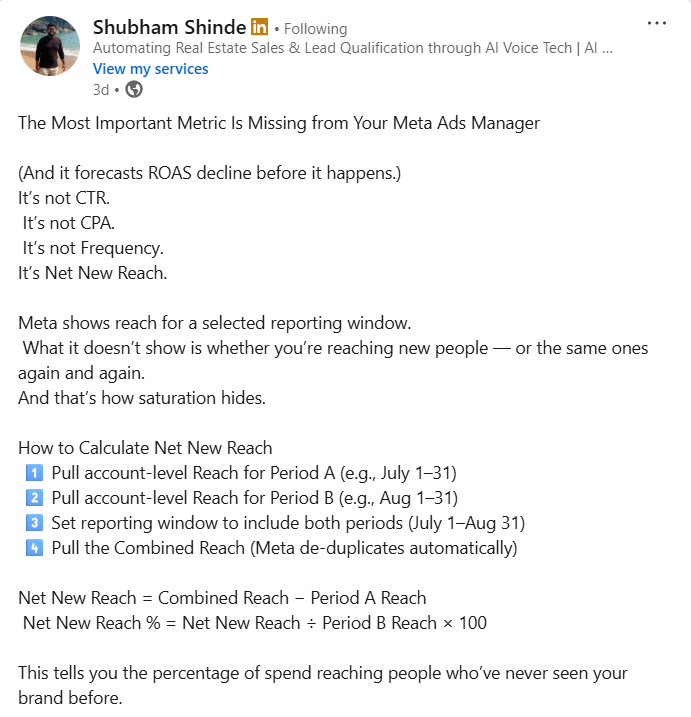
This framework introduces Net New Reach as a way to measure how much of your spend is reaching fresh audiences versus recycled ones. By comparing deduplicated reach across time periods, you can identify when growth is stalling before performance visibly drops. It shifts focus from surface metrics to audience expansion health.
Why it works: Growth depends on continuously reaching new potential buyers. When reach becomes repetitive, performance relies on existing demand. Tracking new audience inflow helps detect saturation early, before rising CPAs and declining acquisition efficiency appear.
Where it needs balance: Not all businesses need constant new reach at the same rate. High LTV or niche markets may rely more on repetition. Over-prioritizing new reach can reduce efficiency if existing audiences still convert profitably.
🎥 Reel of the Day
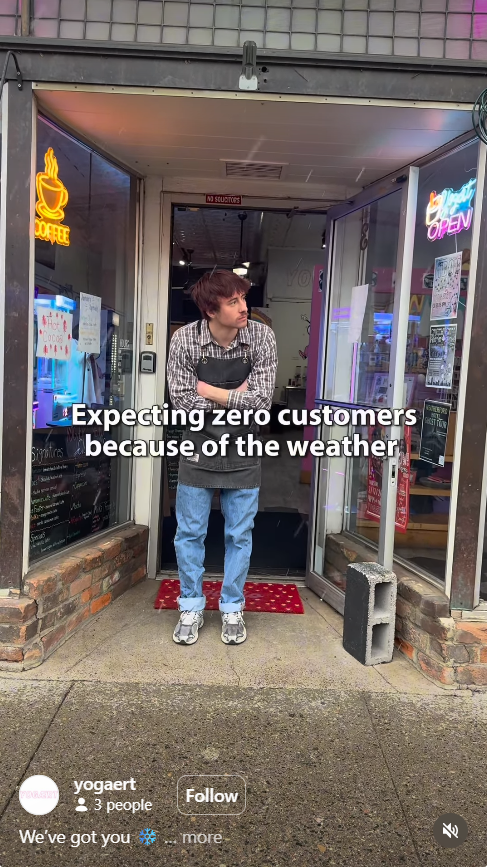
What Works:
1. Relatable Human Truth - Everyone has that one place they still go to, no matter what. This taps into comfort, routine, and loyalty, making viewers subconsciously think about their own “regular spot.”
2. Subtle Brand Positioning - They never say “we have great service,” but you feel it. If people show up in that weather, your brain assumes the experience must be worth it.
3. Scroll Stopping Visuals - The snow runway edit is unexpected and visually striking. It breaks the usual café content pattern, which is exactly why people stop, watch, and rewatch.
Don’t sell your product, sell why people come back to you. Show moments of loyalty, comfort, and habit, because that emotional pull converts harder than features ever will.
Thanks for reading this edition! Keep pushing boundaries, testing ideas, and staying inspired. See you in the next edition with more ways to ignite your marketing success. 🥰