Reckless by Design
🧘♂️When breaking your own ad rules is the correct play, showing up on Google without touching your website, and more!
Welcome to a space where every edition delivers insights, strategies, and inspiration to fuel your advertising brilliance. 🤯
🧘♂️ Reckless by Design
Every ad account runs on rules.
Budgets must be controlled. Tests must be clean. Learnings must be documented before action is taken. Those rules are what make scaling possible.
They are also what quietly prevent recovery when performance collapses. Because when ads stop working, the problem is rarely a lack of discipline.
It’s that the discipline was designed for a different phase of the account.
Why ad accounts trained for optimization fail at recovery
Most Meta accounts are built to extract incremental gains from a healthy system. Separate ad sets. Isolated variables. Structured testing cadences. This works when you can afford patience.
But when spend is dropping, creatives are stalling, and old winners no longer respond, time becomes the constraint.
Waiting two weeks to test each angle “properly” is no longer responsible.
It’s evasive.
This is where the best teams quietly shift modes. Not by abandoning rigor, but by suspending it intentionally.
What “reckless by design” means in ad terms
Recklessness in advertising is usually accidental. Recklessness by design is deliberate.
In practice, it looks like this:
First, the team declares recovery mode.
Normal testing standards are paused. The goal is no longer learning. It is finding a single creative that restarts spend.
Second, the system compresses decision paths.
Instead of testing 10 ads across 10 ad sets over two weeks, 50–100 ads get dumped into a single ad set.
This only works if you can source volume fast, which is why teams in recovery mode often lean on creator pipelines like Insense to generate diverse creative quickly and let Meta triage aggressively. You can book a discovery call by Jan 9 and get a $200 bonus for your first campaign!
Yes, winners will be missed. That is the trade.
Third, the team pre-commits to reverting.
The moment a viable ad is found and moved into scaling, normal structure returns. Reckless tactics do not become default behavior.
This is not sloppy testing. It is emergency signal extraction.
Why this works when nothing else does
Meta is bad at finding all winners. It is good at finding one winner quickly.
Large batch tests exploit this. They sacrifice accuracy to regain motion. When an account is frozen, motion matters more than insight.
This is the part many teams resist. They want certainty before action. But certainty only comes after momentum is restored, not before.
Why panic looks similar but fails
Panic throws everything at the wall. Reckless by design freezes most variables and breaks only the ones blocking speed.
Panic has no stop condition. Reckless deviation does. From the outside, both look messy. Inside the account, only one produces a path forward.
The real takeaway
Ad rules are not universal truths. They are phase-specific tools.
Accounts don’t recover because teams followed best practices harder.
They recover because someone knew when to violate them precisely.
Speed is not the opposite of discipline. Used correctly, it is discipline under pressure. The fastest turnarounds are not accidents. They are reckless by design.
Together with Lindy
Give Your Marketing Team Superpowers with AI Agents
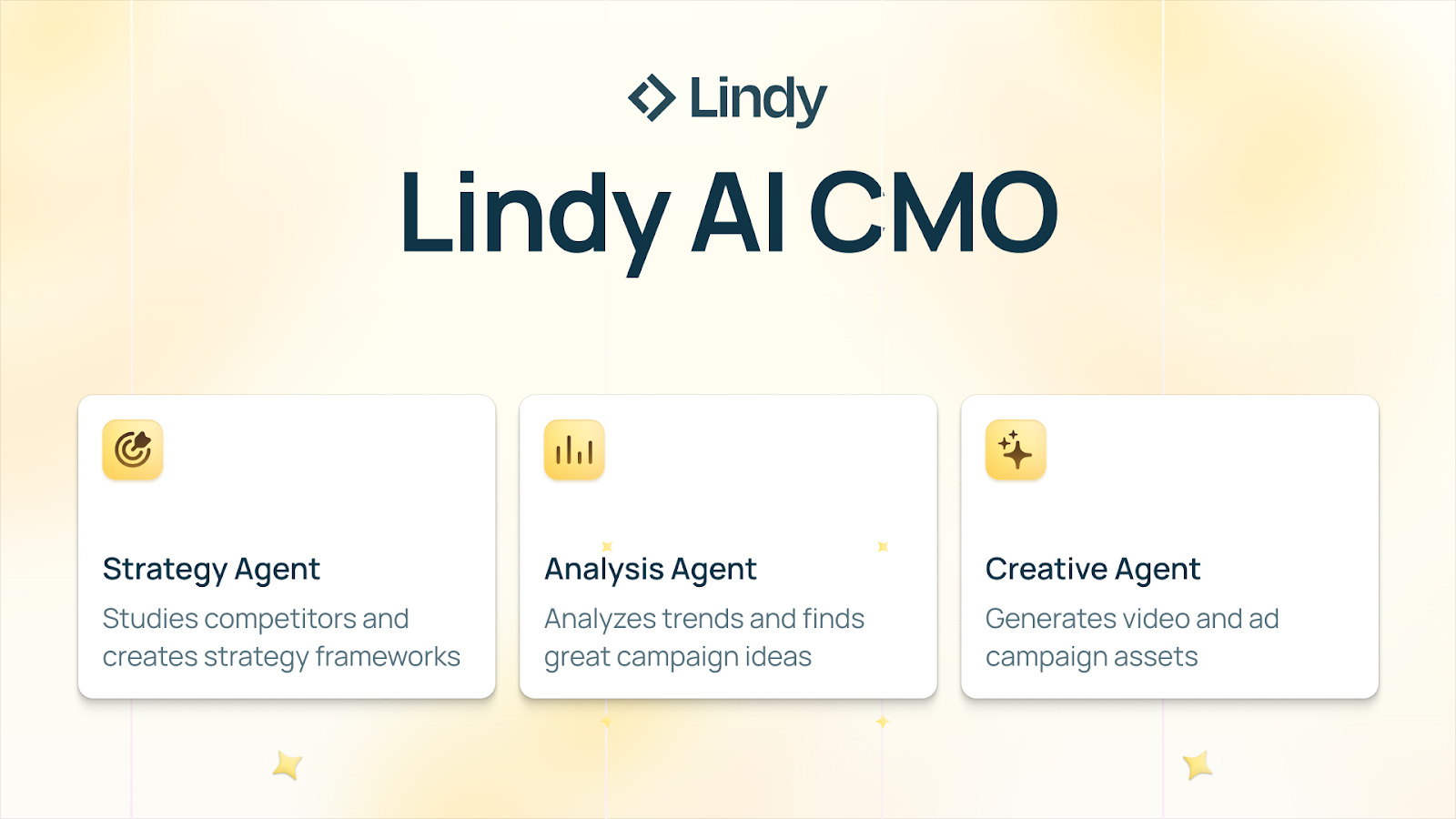
Lindy AI CMO is a suite of powerful agents that ship beautiful marketing campaigns quickly.
Simply enter your business's website, and watch AI agents study competitors, create messaging docs and campaign briefs, and generate creative assets. Everything is automatically organized in Airtable, ready to deploy.
With Lindy, marketing isn't a grind; it's a system that runs 24/7, handling strategy, analysis, and creative work while you focus on growth.
See AI Agents in Action today!
⚡Showing Up on Google Without Touching Your Website
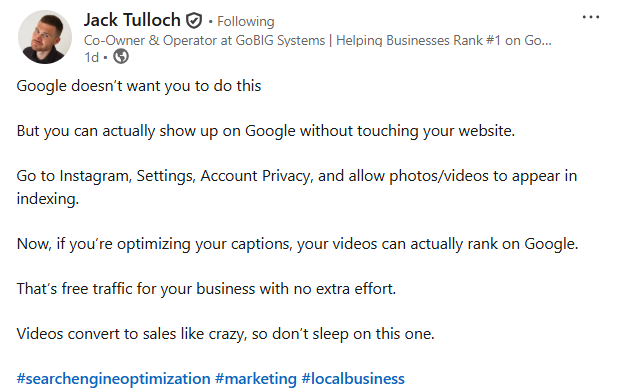
This is one of those small switches almost no one uses. Google can actually show Instagram posts in search results. Turn on indexing, write captions that clearly explain what your video is about, and suddenly, your existing content can show up on Google without building new pages.
Why it works: Google is leaning heavily into video and visual results. Instagram content fits that perfectly, especially for discovery and product-related searches. Since video already converts well, this gives you a chance to turn search visibility into sales without extra production or SEO-heavy work.
Where it needs balance: This isn’t a guaranteed traffic tap. Captions still need to clearly explain what the video is about, and not every search shows social results. It works best as a bonus layer, alongside your website and other acquisition channels, not as a replacement.
🎥 Reel of the Day

What Works:
1. GRWM makes the product feel necessary, not optional - The underwear isn’t the star, it’s the foundation. Viewers understand subconsciously that the dress only looks good because of what’s underneath.
2. Touch-based proof beats verbal claims - Pulling, flexing, and showing stretch replaces explanation. Physical interaction builds trust faster than words, especially for fit-sensitive products like shapewear.
3. The caption turns viewers into participants - “Yay or Nay?” invites judgment, not praise. That simple question drives comments, saves, and shares because people feel asked, not sold to.
This reel works because it sells confidence through process, not perfection. By showing how the product quietly fixes a real problem, Honeylove earns trust, engagement, and mass sharing naturally.
Thanks for reading this edition! Keep pushing boundaries, testing ideas, and staying inspired. See you in the next edition with more ways to ignite your marketing success. 🥰