Six pages that print money
🚀 Using Answer Packs to become a brand the internet repeats, When high CTR tanks ROAS in catalog campaigns, and more!
Welcome to a space where every edition delivers insights, strategies, and inspiration to fuel your advertising brilliance. 🤯
Together with Section
Ten Truths and a Lie About AI in 2026 – Today, December 9 | Free Virtual Event
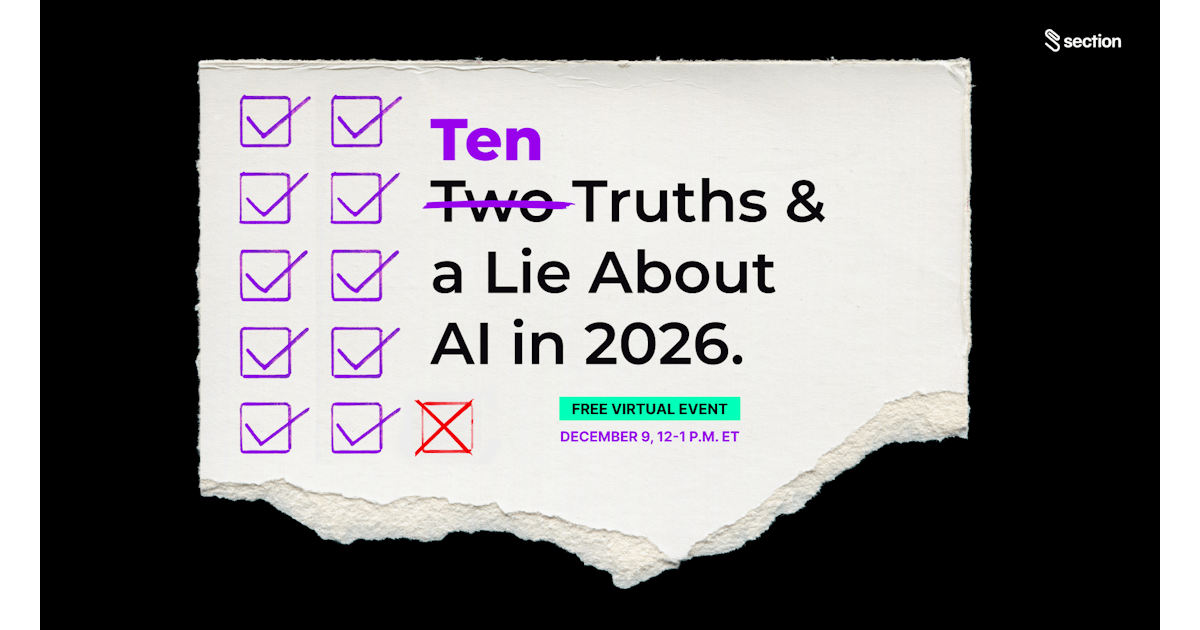
If you feel like everyone is “doing AI” but no one actually knows what’s working, you’re not crazy. Most teams still don’t know what’s real, what’s noise, and what’ll actually move the bottom line.
Today, December 9, join Greg Shove, CEO of Section, for a rare, insider-only breakdown of what separates AI winners from the rest. This isn’t theory, it’s what enterprise operators are already doing to turn AI from hype into measurable ROI.
You’ll uncover:
- What defines a profitable AI strategy vs. a PR stunt?
- How top orgs are structuring AI investments that scale beyond experimentation.
- The single mistake that’s killing ROI for 90% of teams.
Greg’s taking off the filter, sharing insights usually reserved for Section enterprise clients.
🚀 Six pages that print money
The old game was ranking. The new game is getting repeated.
Buyers do not search like they used to. They assemble certainty. They ask a question, scan a summary, open two tabs to verify, then purchase from whoever reduces risk the fastest. In that flow, the product page is rarely the hero. The hero is the page that resolves the doubt that was about to kill the purchase.
That is what an Answer Pack is. Not a blog post. Not a landing page. A decision file built to be cited, screenshotted, and trusted.
What an Answer Pack actually is
An Answer Pack is one page per high-intent doubt, designed to accomplish three tasks in sequence.
First, answer the question in plain language. Second, prove it with something verifiable.
Third, route the buyer to the right choice without making them think. A normal PDP tries to do all of this at once and becomes noise. An Answer Pack is surgical. It takes one fear and deletes it.
The six Answer Packs that print money for almost any DTC brand
- Comparison Pack: “This vs the default alternative.” One table, one rule for who should pick what, one honest tradeoff. Premium brands win here without discounting.
- Ingredients or Materials Pack: What is in it, what is not, and why it matters. The goal is not education; it is removing uncertainty. “Safe” is vague. “No X, tested for Y, sourced from Z” creates belief.
- Fit and Sizing Pack: A ten-second chooser with real examples and one line that prevents returns. Most sizing guides explain. This one decides.
- Shipping Certainty Pack: Cutoff times, real delivery windows by region, what happens if it is late. People abandon when delivery feels like a gamble.
- Returns and Warranty Pack: Written like instructions, not policy. What to do, how long it takes, and what the buyer gets back. This lowers the mental cost of committing.
- Authenticity Pack: How to verify, what packaging should look like, and what support to provide if something feels off. This matters more when resellers exist.
The Answer Pack layout that gets quoted
The first screen is everything. One sentence direct answer. One sentence who this is for. Three bullets of proof. Then receipts: tables, photos, tests, screenshots, timelines. If a buyer can screenshot the top fold and feel safe, it is working.
The scoreboard shift that makes this real
Rankings and sessions will underreport the win, because the win often happens inside summaries and recommendation layers.
Track two things.
First, Search Console query groups that signal doubt resolution, like vs, best, safe, ingredients, returns, shipping, real, warranty, and sizing.
Second, measure qualified verification clicks in analytics and referral logs, traffic from AI surfaces, review sites, forums, and list pages. If those visitors convert at a higher rate, the Answer Packs are doing their job.
Answer Packs do not chase attention. They capture decision moments. Once a brand becomes the easiest to verify, it becomes the easiest to choose.
⚡ When High CTR Tanks ROAS in Catalog Campaigns
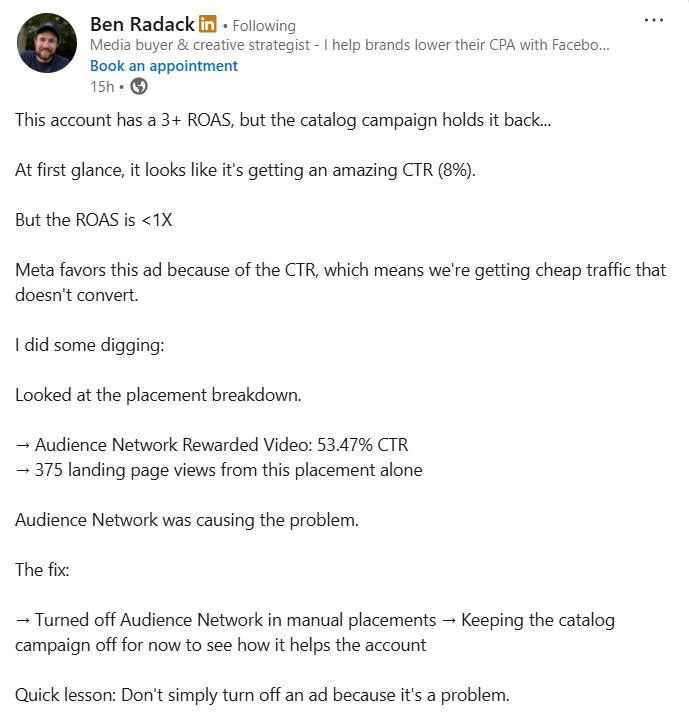
A catalog campaign can show an 8% CTR yet deliver under 1x ROAS because Meta rewards click signals, not buyer intent. Placement mix can inflate CTR with low-quality traffic. The fix is diagnosing where clicks come from, not killing the campaign blindly.
Why it works: Checking placement breakdown reveals where Meta is finding “easy clicks” that do not convert. Audience Network rewarded video often produces accidental or incentive-driven clicks, spiking CTR and landing page views while crushing purchase rate. Removing that placement improves traffic quality and ROAS without changing creative.
Where it needs balance: Disabling placements can reduce volume and raise CPMs, so track purchases, CPA, and conversion rate, not just ROAS. Catalog ads may still work for retargeting once traffic quality is fixed. Validate with add-to-cart and checkout rates by placement.
Together with Insense
Turn One Creator Drop Into Weeks of Q5 Ads
This is the week where every ad starts dying at the same time, and teams scramble for anything new to ship. Doing nothing means pouring budget into creatives that stopped converting yesterday.
This is exactly where Insense saves you. You get fast, affordable UGC at the volume Q5 demands without blowing up your team’s bandwidth.
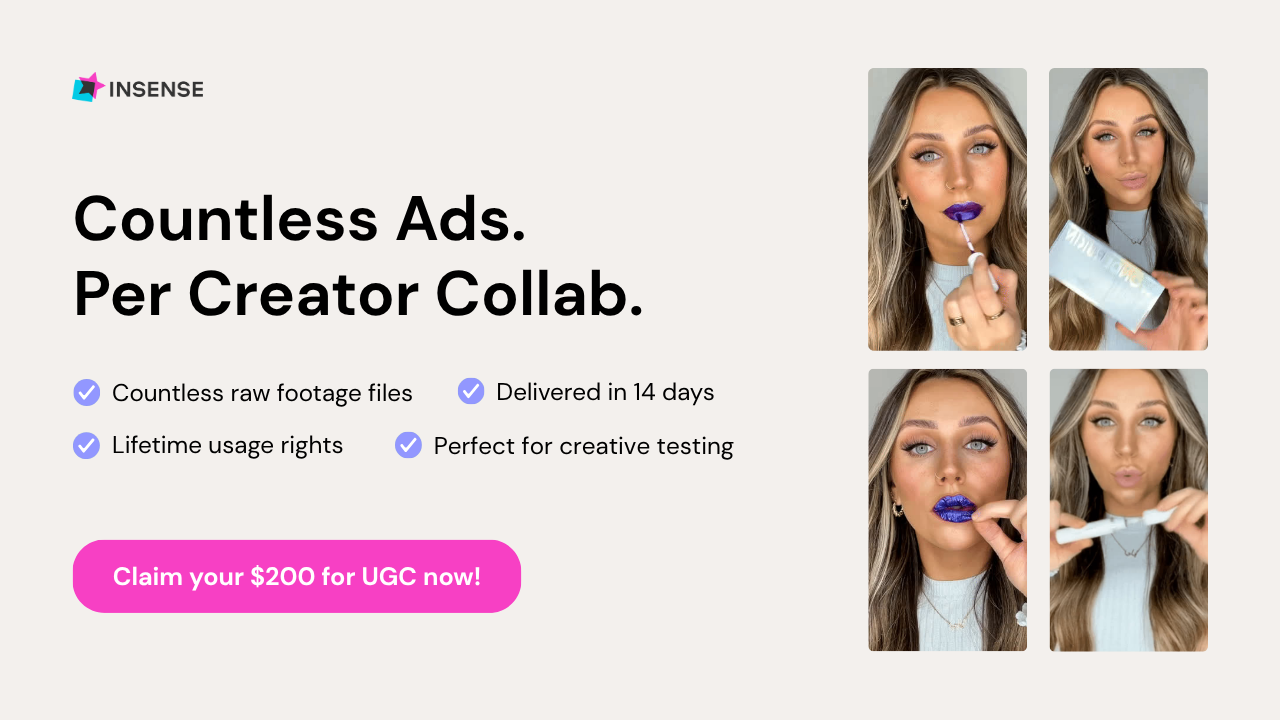
- 20+ raw assets from each creator you can spin into dozens of variations.
- 14-day turnaround so you never fall behind rising CPMs.
- Lifetime usage rights, so every winning cut keeps earning for months.
- Cost-efficient sourcing that lets you test aggressively
Over 2,000+ brands like Quip, Revolut, and Matys use Insense for one reason: it keeps creative supply high when everything else slows down.
Imagine finishing Q5 with a full folder of fresh ads ready to deploy instead of praying old winners magically revive.
Book a free strategy call by December 12th and get $200 for your first campaign!
🎥 Reel of the Day

What Works:
1. Expectation Gap - “What I wanted” vs “what I got” is a built-in story arc that finishes fast. Your brain instantly predicts disappointment, then gets a clean reversal. That surprise is why people watch to the end, then rewatch.
2. Low Friction - Big text, simple framing, and a 10-second runtime make it effortless to consume. Viewers can understand the claiM. Less thinking means more completion rate, and completion rate fuels reach.
3. Self-Insert - The desired look is a familiar beauty archetype, so viewers instantly map it onto themselves. The creator, pointing at details, guides your eye to the exact lash pattern. That reduces uncertainty, which reduces purchase hesitation.
This Reel wins because it turns a risky beauty purchase into a zero-guesswork match test, and the proof lands in seconds with a visual “before vs after” receipt that viewers trust immediately.
Thanks for reading this edition! Keep pushing boundaries, testing ideas, and staying inspired. See you in the next edition with more ways to ignite your marketing success. 🥰