Stop forcing funnel stages
😞 Funnel segmentation slows meta’s learning without you noticing, The 2-Minute test to see if you actually have a creative strategy, and more!
Welcome to a space where every edition delivers insights, strategies, and inspiration to fuel your advertising brilliance. 🤯
🛑Stop forcing funnel stages
Funnel segmentation feels responsible.
Top-of-funnel campaigns to introduce the brand.Mid-funnel campaigns to educate.Bottom-funnel campaigns to convert.
On paper, it looks organised. In practice, it often creates the exact problem teams are trying to avoid: slower learning and weaker performance at scale.
The issue isn’t that segmentation is wrong. It’s that Meta doesn’t learn in segments. It learns in paths.
When you split campaigns by funnel stage, each one only sees a fragment of the customer journey. The TOF campaign sees clicks and views but never learns who eventually converts.
The BOF campaign sees conversions but has no visibility into what actually warmed those buyers up days earlier. The system never gets to connect cause and effect.
That fragmentation matters more than most teams realise.
Meta’s optimisation engine weights recent interactions heavily. It looks for patterns across exposures, engagement, and outcomes over short time windows.
When those signals are scattered across multiple campaigns, learning slows down. You’re effectively forcing the system to relearn the same lessons in parallel, with less data in each place.
This is why accounts with clean segmentation often plateau early.
They look efficient on a per-campaign basis, but overall performance becomes brittle. Scale one segment and another weakens. Pause one layer, and downstream performance quietly erodes. Teams end up chasing balance instead of compounding results.
A single campaign without exclusions changes the math.
Instead of guessing which users belong in which stage, you let Meta observe how people naturally move from first touch to conversion.
The system can see that someone who watched a video, clicked a comparison ad two days later, and converted after a testimonial is a coherent path, not three unrelated events.
The common fear is wasted spend on existing customers.
In reality, Meta rarely pushes budget toward them unless you force it with heavy BOF creative. Without that pressure, the system prioritizes new users who show similar behavioral patterns to past converters. The “waste” most teams fear usually doesn’t materialize.
There is a tradeoff. You give up the comfort of clean reporting and neat labels. What you gain is learning speed and a model that understands the full journey instead of isolated steps.
If performance feels capped despite solid creative and spend, this is often why.
Segmentation didn’t break the account overnight. It just slowed the system enough that growth never fully took off.
Together with Insense
Scale UGC in Q1 Without Scaling Your Workload
Q1 is when teams reset budgets, launch new angles, and need fresh creative fast. The problem is that UGC production turns into spreadsheets, follow-ups, and bottlenecks right when you’re trying to move quickly.
Insense keeps your Q1 pipeline moving. Tap into a vetted marketplace of 75,000+ UGC creators and micro-influencers across 35+ countries. Collaborate with multiple creators at once across diverse campaign types.
Each creator delivers 20+ raw clips you can mix and match into multiple paid social variations, with lifetime usage rights. Everything is delivered in 14 days or less.
Over 2000+ brands like Beauty Pie, Bones Coffee, Flo Health, and Aceable scale UGC by sending one creator collab to dozens of creators at once, then remixing the raw clips into new ad variants.
Across the platform:
- Quip hit an 85% influencer activation rate with product seeding
- Revolut partnered with 140+ creators for 350+ assets
- Matys Health drove 12x reach with TikTok Spark Ads
Book a free discovery call by tomorrow, and get $200 toward your first campaign.
⚡The 2-Minute Test to See If You Actually Have a Creative Strategy
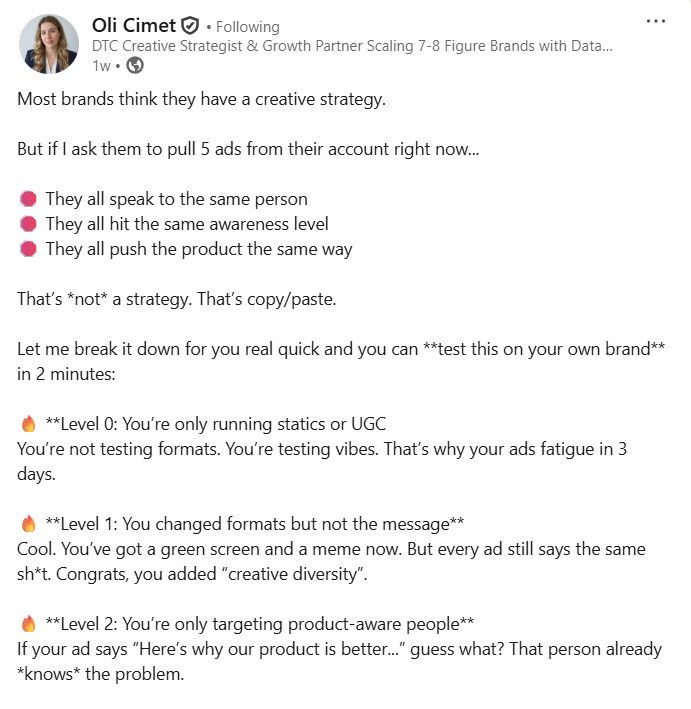
A real creative strategy shows up instantly inside your ad account. Pull five ads and look at them side by side. If they all talk to the same person, hit the same awareness level, and sell the same way, it’s not a strategy. It’s repetition with different outfits.
Why it works - This level system forces creatives to evolve from surface variety into real coverage. Formats matter, but messaging variety matters more. Scaling comes from hitting different awareness stages, tapping into desire instead of features, and building for different personas with different reasons to buy.
The real takeaway - Creative scale is not “more UGC.” It’s building a portfolio that covers the whole market. Different formats, different motivations, different stages, different buyer types. If five ads don’t feel like five different conversations, the account is leaving growth on the table.
Together with Fullcart
The one AI Operator your ecom stack’s been missing
You already have the data: Shopify, Meta, Klaviyo, but none of them talk. So you waste nights asking questions your tools can’t answer: Why did AOV dip last week? Which ad is burning cash? Who’s actually coming back to buy again?
Fullcart is the AI Operator that analyzes your data across every platform, surfaces what’s breaking, and tells you exactly what to fix before it hurts your P&L.
📊 Connect Shopify, Meta, and Klaviyo to see your real numbers in one clean, live view.
🤖 Ask anything like “Which campaign drove repeat buyers?” and get instant, reliable answers.
⚙️ Automate ops to pause bad ads, sync inventory, and issue refunds without leaving your screen.
Top operators are already saving 8+ hours a week and making faster, higher-margin decisions.
Imagine waking up to a single dashboard that knows your business better than you do and acts faster. That’s Fullcart.
Try Fullcart free today and see how your data can finally start working for you!
🎥 Reel of the Day

What Works:
1. The hook is a “barter storyline” - It’s not “here’s our food.” It’s “Should this kid get free food for content?” That tension is customer-centric, super niche to creator culture, and it forces retention because people want the outcome.
2. The visuals are premium, but they feel earned, not forced - The kid filming becomes the proof-of-work moment. Every smooth shot, transition, and plate close-up feels like value being created live, which makes the restaurant look high-end without screaming “luxury.”
3. It’s secretly a conversion funnel disguised as entertainment - You get story first, then product porn, then social proof through reactions. Viewers don’t feel sold to, they feel like they discovered a spot worth trying, which drives saves, tags, and real footfall.
29.5M views happen when a reel nails all three: retention hook, premium sensory visuals, and a comment-driving dilemma. It’s not a food video; it’s a creator economy story that sells the restaurant naturally.
Thanks for reading this edition! Keep pushing boundaries, testing ideas, and staying inspired. See you in the next edition with more ways to ignite your marketing success. 🥰