Stop Overexplaining Your Offers
😵💫Four offers on a pop-up look generous. It also quietly forces your visitor to think, What a truly mature DTC brand looks like, and more!
Welcome to a space where every edition delivers insights, strategies, and inspiration to fuel your advertising brilliance. 🤯
😵💫Stop Overexplaining Your Offers
Four offers on a pop-up look generous. It also quietly forces your visitor to think.
We’ve watched brands stack $7, $10, $15, and $20 tiers on the same screen, believing they were increasing perceived value. Opt-in rate slipped into double digits within weeks.
Nothing was wrong with traffic. Nothing broke in the email. The friction was cognitive.
When someone lands on your site, they’re operating on impulse bandwidth. The second you ask them to calculate thresholds or compare savings, you’ve shifted them into evaluation mode. Evaluation slows action. Slower action shrinks capture.
The fix isn’t a bigger discount. It’s sequencing.
Collapse the front-end promise into a single ceiling:
“Unlock up to $20 off your first pair.”
That line protects momentum because it removes math. You’re selling potential, not structure. The ladder comes later.
The Staged Reveal Is Your Trojan Horse
After email submission, introduce the tiers as a progression.
- Show the full breakdown only after commitment.
- Frame thresholds as distance to reward, not conditions to qualify.
- Visualize progress with “You’re $18 away from $20 off.”
This reframes complexity from friction into motivation. Now the user isn’t deciding whether to opt in. They’re optimizing how to maximize something they’ve already claimed. That shift increases average order value because the next tier becomes a target.
There is a constraint here. If your brand leans premium, aggressive discount ladders can erode perception. In those cases, stage perks or exclusives are used instead of raw dollar amounts. Same behavioral engine. Different wrapper.
Why this works comes down to attention economics. Front-end attention should be spent on commitment. Post-commitment attention can handle optimization. Mixing those jobs on one screen burns both.
If you want to treat this like an operator and not a copy experiment, measure it properly. Connect your store data inside Thesys Agent Builder and ask, “Compare opt-in rate and AOV between upfront discount breakdown and staged reveal.”
You’ll get visual reports showing whether sequencing lifts revenue or simply inflates low-intent signups. You can claim $10 free credits to try!
Same offers. Different order. Different outcome.
The brands that win here don’t argue about button colors. They engineer the moment when thinking begins.
Together with Section
Where AI Investment Gets Measured

On March 5, 2026, from 11 AM to 6 PM ET, the AI:ROI Conference is a one-day, ten-session virtual event built for leaders who are accountable for making AI show up in real numbers. This is about fast-following what already works inside large enterprises, not betting on shiny experiments.
If you own AI outcomes, this is what you will get:
- How teams design AI initiatives that survive budget cuts and scrutiny.
- How leaders drive real adoption so AI changes workflows, not slide decks.
- How AI investments tie directly to revenue lift, efficiency gains, and margin impact.
You will hear directly from Brice Challamel, Head of AI Strategy and Adoption at OpenAI, Diane Igoche, Director of Agentforce Governance at Salesforce, and DJ Sampath, SVP of AI Software and Platform at Cisco.
More than 20,000 AI leaders and operators will attend.
⚡What a truly mature DTC brand looks like
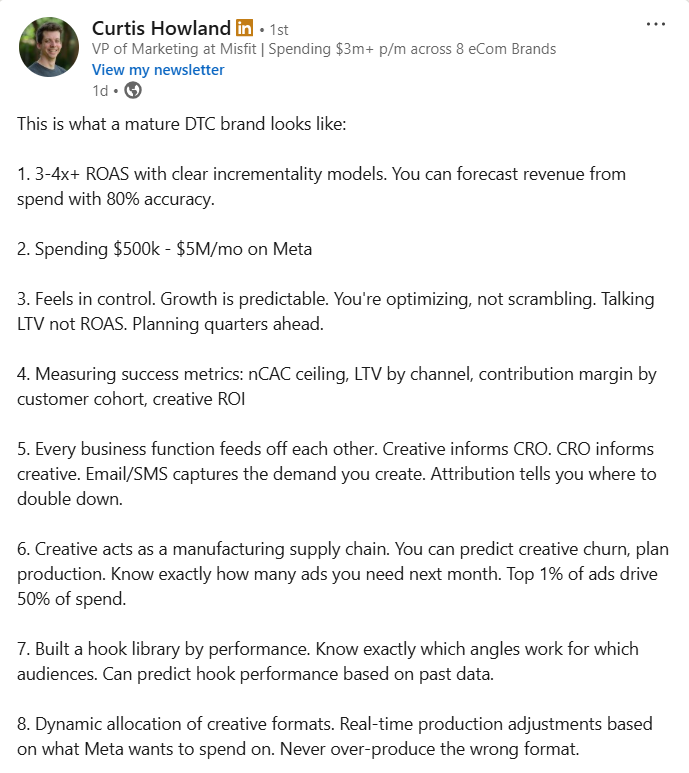
Maturity in DTC isn’t about big budgets or flashy ROAS screenshots. It’s about control. Revenue becomes forecastable, spend feels predictable, and decisions are driven by LTV, contribution margin, and incrementality instead of reacting to daily performance swings.
Why this works - Creative, media buying, CRO, retention, and data all operate as one system. Testing is structured, scaling is predictable, and incrementality is measured. Nothing runs in isolation, and spend decisions are tied directly to real profit.
The real takeaway: A mature brand feels calm. It plans quarters ahead, knows its ceilings, and avoids red-zone spend. The only real threat at this stage is complacency. Keep testing, keep measuring incrementality, and never assume the machine runs itself forever.
🎥 Reel of the Day
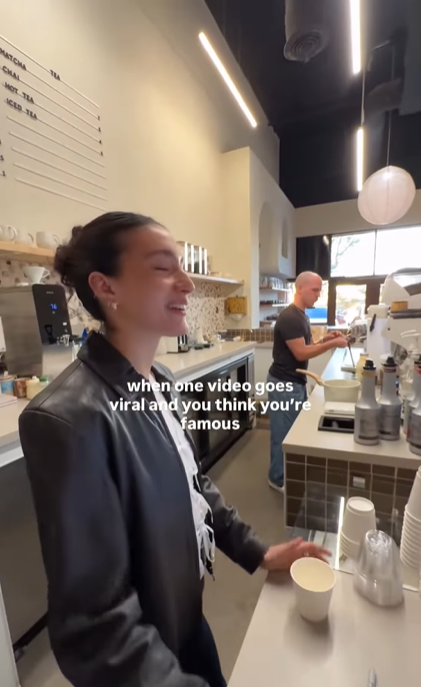
What Works:
1. It gently plays with “viral fame” energy - The hook feels familiar to anyone who has had one good post blow up. That soft self-awareness makes the reel relatable beyond coffee customers and pulls creators into the joke.
2. The simple twist makes it memorable - The build-up feels dramatic, then the question is just about banana pancakes. That small, human letdown creates a smile moment people comment on and rewatch.
3. The “Ikea video” reference builds continuity - Mentioning a past viral moment creates a subtle inside joke. Returning viewers feel included, and new viewers get curious enough to explore older content.
This reel works because it feels light, familiar, and self-aware. It builds warmth first, and that warmth is what turns views into real-world visits.
🪩Events
🎬 Stop Running Basic Sponsored Posts
February 26 | 11AM ET | Free Virtual Event
Audiences reward authenticity, yet most brands still brief creators like ad slots. In this free 60-minute Modash session, Gabriel Gomez, Head of Social and Creators at MCoBeauty, reveals how they co-create with creators to produce more original content at scale without heavy production.
👉 Register Now
Can’t make it live? Register anyway, and we’ll send you the replay
Thanks for reading this edition! Keep pushing boundaries, testing ideas, and staying inspired. See you in the next edition with more ways to ignite your marketing success. 🥰