The Index Ate Your Traffic
🤦♂️Indexing has replaced ranking as the primary bottleneck in organic search, Google Ads performance improves with fewer interventions, and more!
Welcome to a space where every edition delivers insights, strategies, and inspiration to fuel your advertising brilliance. 🤯
🤦♂️The Index Ate Your Traffic
Indexing has replaced ranking as the primary bottleneck in organic search. Crawl budget isn’t a backend cleanup task; it’s a revenue-gating metric that needs daily oversight, not quarterly audits.
Rankings still matter. But they’re secondary to a more urgent problem: whether Google indexes your pages at all.
Practitioners managing large sites are reporting tens of thousands of pages stuck in “Discovered, currently not indexed,” not penalized, not de-ranked, just absent.
Generating zero impressions regardless of content quality or on-page optimization. The bottleneck has moved upstream, and most SEO teams are still optimizing for the wrong constraint.
The Pipeline Has Three Compression Points
The organic visibility pipeline runs from crawl to index to rank to convert. For most of the last decade, the constraint lived at the ranking stage. It’s moved. Here’s where it’s breaking now:
Crawl competition is compressing Googlebot’s budget. Mid-size sites are logging 5,000+ LLM crawler visits per day, ChatGPT, Perplexity, Gemini, and Google’s new Google-Agent all drawing from the same server resources Googlebot depends on. Most sites have zero visibility into how this load is affecting indexing outcomes.
GSC isn’t a real-time diagnostic tool. A 1,000-URL sitemap sample cap and weekly update cadence means teams managing 30,000+ pages are working with 3% coverage that’s already five to seven days stale. Deindexing events accumulate before you even know they started.
Standard recovery playbooks are failing. Resubmitting sitemaps and requesting indexing via GSC used to restore visibility within days. Teams now report recovery timelines stretching to months.
Getting indexed is only half the problem. The other half is whether AI systems retrieve your content at all, and that requires a different framework.
Eli Schwartz, who has generated billions in organic revenue for companies like Coinbase, LinkedIn, and Tinder, is breaking down his exact 4-pillar AI search framework live with AirOps on April 15th at 2 PM EST. You can register for free. If you can attend live, register anyway, and you’ll get recordings in 24 hours.
Treat Indexing Like a Conversion Metric
The fix isn’t technical, it’s operational. Three things need to change:
- Track indexing coverage daily, not weekly
- Segment bot traffic by type using server log analysis to identify crawl budget compression
- Add indexing rate to your core SEO dashboard alongside rankings and traffic
Every dollar spent on content and links assumes the pages are visible. The ones sitting in “Discovered, currently not indexed” are content spend with a zero next to it. Crawl budget was the last thing you optimized. It’s now the first thing that breaks.
Together with Galactic Fed
The team behind $300M in ad spend just freed up 20 minutes for you.

You're not losing because your product is worse. You're losing because someone else got a better read on their numbers first, and now they're outspending you on the channels that actually convert.
That gap compounds fast.
Galactic Fed audits your site and marketing, then hands you a custom growth plan built from managing millions in spend across 600+ brands. Real people. Real research. Not a template.
- Rustic Dime cut cost-per-purchase by 53% and grew purchases 305% with Meta Ads
- Slatkin + Co. hit a 43x increase in sales and 3,605% revenue growth through email
- Crowd Cow grew revenue 137% and customer acquisition 122% through email
Your 20-minute session includes a full channel audit, competitor breakdown, conversion fixes, and a growth roadmap built for your store.
It's free, personalized, and slots are limited to 10.
⚡ Google ads performance improves with fewer interventions
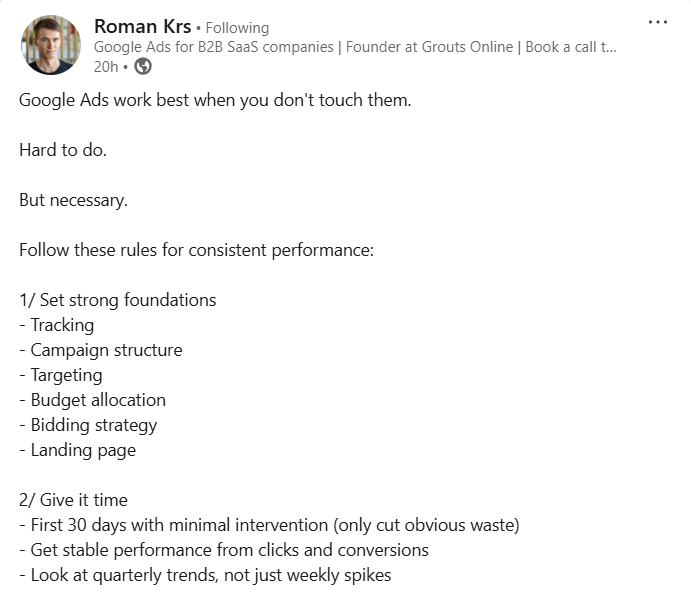
This approach emphasizes restraint over constant optimization. Instead of frequent tweaks, it prioritizes a strong initial setup, allowing campaigns to stabilize and making fewer, more deliberate changes. The focus shifts from reactive adjustments to structured experimentation and long-term performance trends.
Why it works: Google’s algorithms need stable data to optimize effectively. Frequent changes reset learning and distort performance signals. Consistency allows better pattern recognition, improving efficiency and reducing volatility in campaign outcomes.
Where it needs balance: Blind patience can waste spend if fundamentals are flawed. Poor tracking, weak creatives, or bad landing pages won’t fix themselves. Active monitoring is still required to catch issues early without overreacting to normal fluctuations.
🚀 Reel of the Day
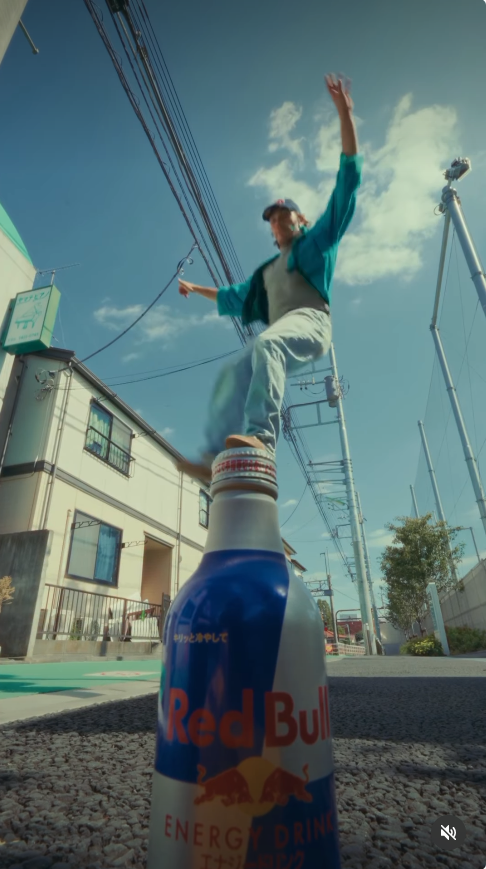
What Works:
1. Instant Pattern Break - The opening frame instantly disrupts scrolling behavior by presenting an impossible scale illusion. This cognitive dissonance forces attention, triggering curiosity and increasing thumb-stop rate within the first critical seconds.
2. Micro Storytelling Loop - The reel delivers a complete narrative in seconds, creating a satisfying start-to-finish experience. This tight structure boosts retention, completion rate, and makes the content highly digestible for fast-paced social feeds.
3. High Replay Value Engine - The illusion invites rewatching as viewers try to decode how it works. This increases loops, watch time, and engagement signals, helping the content perform stronger within platform algorithms.
Create content that feels physically real but slightly impossible, so viewers pause, rewatch, and engage. Design ideas where the product is revealed through the action, not introduced upfront, driving curiosity and retention.
Thanks for reading this edition! Keep pushing boundaries, testing ideas, and staying inspired. See you in the next edition with more ways to ignite your marketing success. 🥰