The only personalization take you need
👎It’s a beautiful, dashboard-friendly con you keep paying for, Retail media works only after you max owned channels, and more!
Welcome to a space where every edition delivers insights, strategies, and inspiration to fuel your advertising brilliance. 🤯
Together with Omnisend
150,000 brands can't be wrong about email marketing
Your email tool should be making money. Right now, it's probably just making work.
Omnisend changes that. Campaigns that actually pay off, a platform so intuitive it feels like you built it, and a real support team on call around the clock - brands average $79 back for every $1 spent on Omnisend.
Here's what that looks like in practice:
- Dukier grew revenue 525%, with 55% of it coming from automations they set once
- Kate Backdrop hit a 1:300 ROI across omnichannel campaigns
- Vagari Bags pulled a 1:121 ROI from SMS alone
Over 150,000 brands already trust Omnisend - and 69% of their revenue runs on autopilot through automations they set once, with 17.3% higher CTRs to show for it.
You're up and running in 30 minutes. Fully migrated in 5 days.
👎 Personalization Is a Con. A Beautiful, Dashboard-Friendly Con You Keep Paying For.
Let's start with what nobody in the room will say out loud.
Your agency knows personalization doesn't fix the real problem. They recommended it anyway. Not because they're incompetent. Because a working journey is a one-time fix and a personalization stack is a recurring revenue stream. Every new segment, every new flow, every new data requirement is another month of retainer justified by complexity they helped create.
The lift was real. The diagnosis was wrong. And the gap between those two things is costing more than the retainer every single month.
Here's where it gets dark.
When a personalized flow dramatically outperforms for a specific customer type, Nobody asks the question that would unravel everything: why did any targeted intervention produce results that dramatic?
The answer is sitting in the data, quiet and damning:
- The default journey was failing that segment so catastrophically that the baseline for improvement was essentially zero
- The personalization didn't create the lift, it stumbled onto a structural wound bleeding conversion for months
- Every report called it an audience quality problem while the real diagnosis went unasked
The win wasn't the flow. It was the broken journey the flow accidentally autopsied. Then everyone built three more flows on top of the corpse.
The buyers hiding inside your conversion rate.
There's a customer type in your analytics right now that should terrify you. They're converting. The dashboard counts them. But they're not converting because the journey worked, they're converting despite the friction, despite wrong proof points, despite messaging calibrated for a completely different buyer.
These determined buyers are masking the real conversion rate for their entire segment. Every one who pushes through a broken journey makes the problem invisible for ten who didn't make it.
Find them by cross-referencing high-intent traffic sources against conversion rates that should be higher given the intent coming in.
That gap isn't an audience problem. It's a structural indictment of every journey decision made for that segment, compounding silently inside metrics that look healthy from the outside.
The audit that replaces the next build.
Before another flow gets scoped, map the current journey for the three highest-volume customer types from entry to purchase. Count every moment each type hits an experience built for someone else, wrong proof point, wrong pacing, wrong messaging register.
That count is personalization debt. Paying it down with journey fixes compounds permanently across every visitor in that segment. Layering more personalization on top produces diminishing returns while the structural failure keeps running underneath.
Personalization on top of a working journey is leverage.
Personalization instead of one is the most elegant distraction in marketing, optimizing the 20% heading toward yes while the other 80% walk out a door nobody thought to close.
⚡Retail media works only after you max owned channels
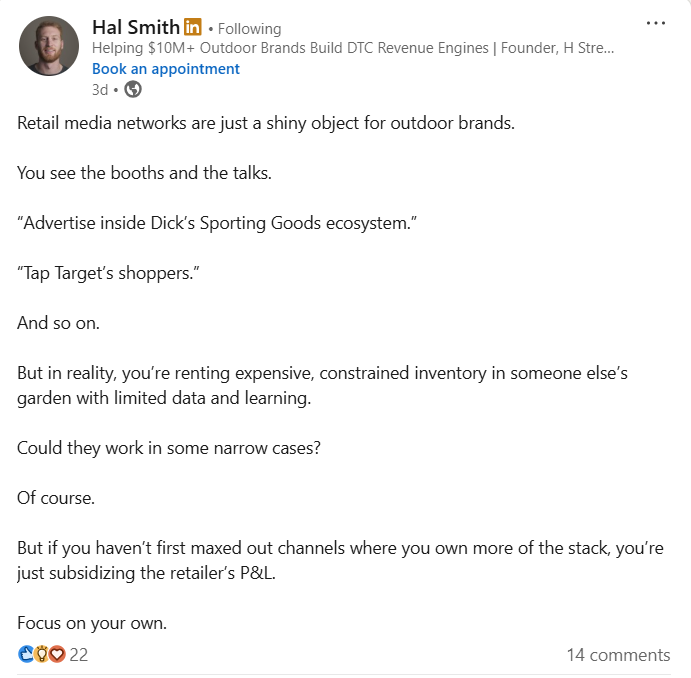
This view argues that retail media networks often look attractive but offer limited control and learning compared to owned channels. Brands are effectively paying to access constrained inventory within retailer ecosystems. The priority should be scaling channels where data, optimization, and margins are more controllable.
Why it works: Owned channels provide better data visibility, optimization flexibility, and compounding learnings. This improves efficiency and long-term returns. Retail media often limits these advantages, making it less effective unless core channels are already saturated.
Where it needs balance: Retail media can unlock high-intent shoppers already in buying environments. Ignoring it entirely may limit incremental revenue. The key is sequencing, using it after core channels are optimized, not as a primary growth lever.
Together with Norton Neo
AI That Lives In Your Browser. Not In The Cloud.
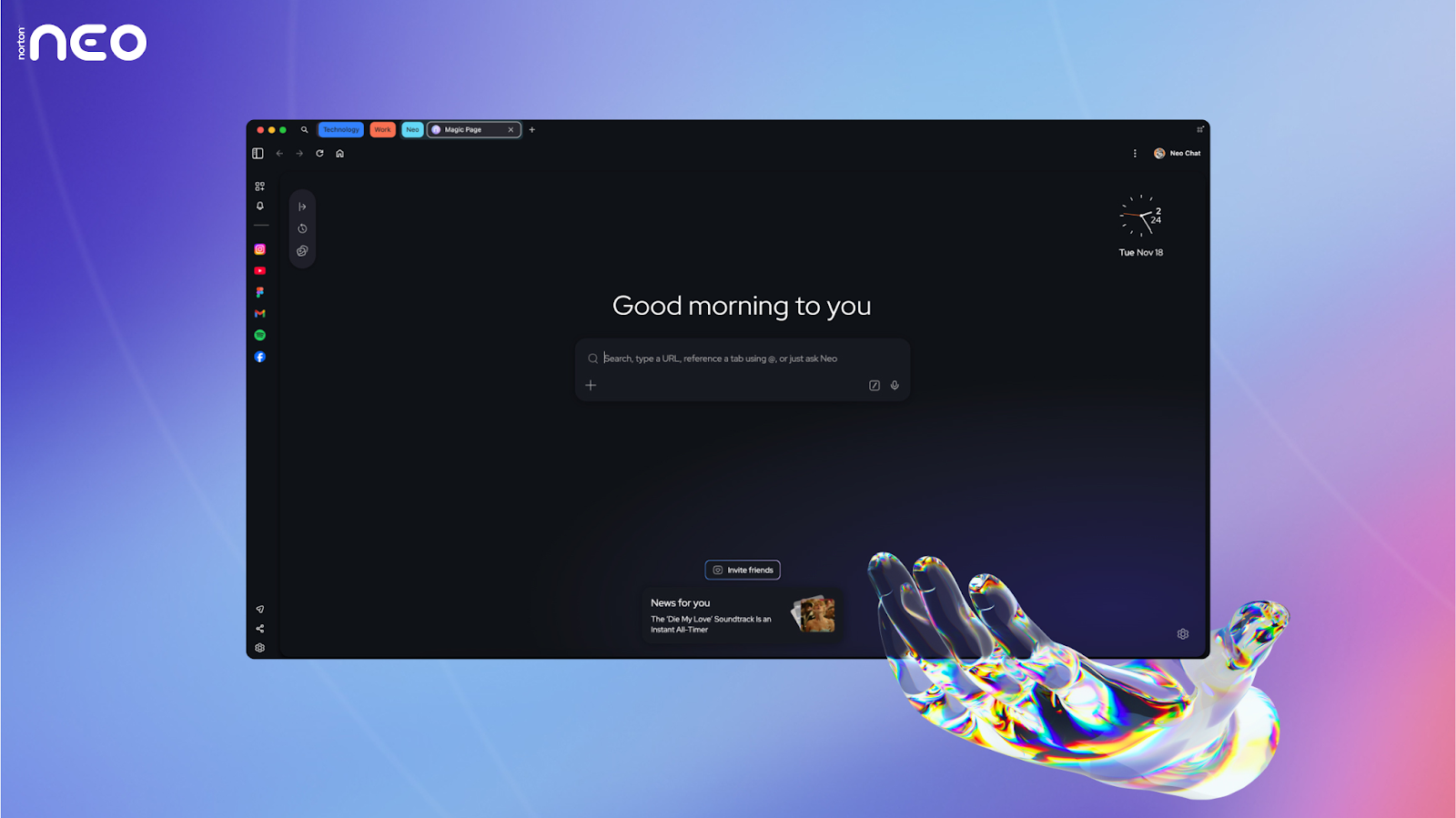
You had exactly what you needed open. Then your browser crashed and took all 23 tabs with it. The research, the doc, the three reference pages, gone.
Now you're spending 20 minutes rebuilding a session that took two hours to build.
Norton Neo is the world's first AI-native browser, meaning the AI isn't an extension you installed; it lives inside the browser itself.
It tracks your open tabs, understands how you're working, and keeps your context safe so when something goes wrong, you're not starting from zero.
- Recover full sessions across any device instead of rebuilding from scratch
- Tabs are organized by context, not the order you opened them
- Keep browsing history local so sensitive research never leaves your machine
- Block phishing and malicious sites before they compromise payments or logins
No extra extensions stacking up. No AI tools floating in separate tabs. Just a browser built for how people actually use the web today.
If you want early access to what’s coming next, join the Norton Neo Discord and connect directly with the team building it.
🚀 Reel of the Day

What Works:
1. Seamless Loop Trap - The sneeze isn’t just humor, it’s a reset trigger that blends the ending into the beginning so cleanly that viewers don’t detect completion, forcing unconscious rewatch cycles and boosting retention massively.
2. Visual Payoff Memory - The brain locks onto the flowers appearing on the green top as a satisfying visual payoff, so viewers subconsciously rewatch to relive that exact transformation moment again.
3. Aesthetic Consistency Hack - The matching green tones across characters and wardrobe subtly unify the scene, making the flower transfer feel visually “correct,” even though the logic is absurd, reinforcing believability through color harmony.
Looped Satisfaction - Design content where the ending visually or emotionally mirrors the beginning so perfectly that viewers don’t feel closure; they feel continuation, which drives infinite loops without forcing replay cues.
Thanks for reading this edition! Keep pushing boundaries, testing ideas, and staying inspired. See you in the next edition with more ways to ignite your marketing success. 🥰