The Scaling Rule You Misunderstand
💰 CAC Ceiling vs ROAS Obsession is the fight you’re losing because, When scaling becomes ad spend laundering, and more!
Welcome to a space where every edition delivers insights, strategies, and inspiration to fuel your advertising brilliance. 🤯
💰 The Scaling Rule You Misunderstand
Everyone treats ROAS like a safety signal. It dips, they pull spend. It holds; they scale cautiously.
It feels responsible. It’s actually a growth cap in disguise.
ROAS is a ratio. CAC is a line in the sand.
ROAS moves with discounts, seasonality, creative fatigue, and audience size. It’s reactive by nature.
CAC is different; it’s a threshold you define based on your contribution margin and payback window. As long as you’re acquiring customers below that number, you scale even if ROAS compresses.
The question stops being “does this look good?” and becomes “is this still profitable at volume?”
Expansion compresses ROAS. That’s not a problem.
A skincare brand converting warm retargeting audiences at 5x ROAS pushes into colder traffic. ROAS drops to 2.7x. Most teams panic and pull back.
But if their allowable CAC is $60 and they’re acquiring at $52, they’re fine. Pulling spend because a ratio dropped means leaving scalable, profitable demand untouched.
ROAS shrinkage is often a sign you’re reaching more people, not that something broke. This only works if your financials are airtight
CAC ceiling thinking requires you to actually know your contribution margin, blended CAC, cash flow tolerance, and payback window. It forces operator thinking, not channel manager thinking.
And your ceiling is only as safe as your backend can support. In B2B, especially, if enterprise deals stall due to compliance friction, your payback window stretches, and your allowable CAC quietly shrinks.
That’s where Delve comes in, an AI-native compliance platform that auto-collects evidence from AWS, GitHub, and your stack, cutting audit busywork so enterprise deals close faster without adding headcount.
When compliance stops being a bottleneck, revenue velocity stabilizes, and your CAC ceiling becomes something you can actually scale against. You can book a demo and trigger a migration, and get $2,000 sent to your inbox once you’re onboarded.
Volume beats vanity
A SaaS company with $1,200 gross profit per customer sets a CAC ceiling of $400. They acquire at $310, and they scale. CAC creeps to $375; they still scale. They only slow down when it breaches $400.
No dashboard obsession. Just profitable customers bought up to a defined economic limit. The real question isn’t whether ROAS dipped. It’s whether you’re still buying customers below your ceiling.
Together with Cloudways
You Might Be Optimising the Wrong Variable

You can have solid speed scores and still lose performance when traffic increases. It happens when paid volume rises, and the site behaves differently than it did in testing.
Nothing crashes, but conversion rate slips and teams keep adjusting ads because there’s no obvious failure to point to.
Cloudways Performance Bootcamp on March 10-11 is a live, free event focused on what actually changes once traffic scales. You’ll see production environments analyzed in real time and watch where performance starts slipping under load.
- How AI is being used to debug performance issues faster
- Why global delivery setup changes what users in different regions actually experience
- Why performance that feels fine at low traffic weaken once budgets increase
8 live sessions. 20+ expert speakers. 1500+ marketers already registered.
If you’re scaling spend without testing how your site behaves under load, you’re optimizing in the dark.
Can’t make it live? Register anyway, and we’ll send you the replay
⚡When scaling becomes ad spend laundering
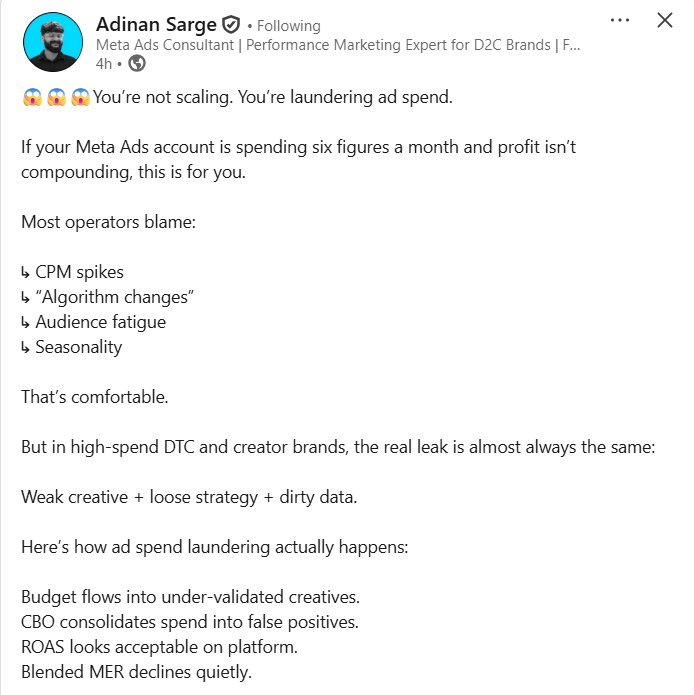
Rising spend with flat profit usually signals structural leaks, not platform issues. Weak creative validation, loose scaling logic, and messy attribution let CBO amplify false positives, inflating platform ROAS while blended MER quietly declines.
Why it works: Meta optimizes whatever signal it receives. When creatives pass structured validation and tracking is clean, the budget expands around proven assets. Blended ROAS and MER anchor decisions to contribution margin, preventing wasteful capital allocation.
Where it needs balance: Too much validation can slow creative velocity and limit exploration. Not all MER drops come from ads alone; retention, inventory, and offer shifts matter. Diagnose holistically before cutting spending aggressively.
🎥 Reel of the Day

What Works:
Native Storytelling Disguised as Chaos - The brand never "sells" once. The entire reel is a comedy sketch that happens to take place inside their restaurant. That's native storytelling at its purest, content first, brand ambient. Most QSR brands ruin this by forcing a product shot.
The Send Ratio Tells the Real Story - 9,517 sends against 97.2K likes. That's a send-to-like ratio of roughly 1:10. Most brand reels sit at 1:50 or worse. High send velocity means this was forwarded as a meme, not just consumed.
The Calculator Frame is Genius - Showing "5–2" on a calculator screen mid-reel is a visual punchline delivered without dialogue. Pure comedic composition. It earns the laugh before the voice line lands, which means you've doubled the emotional payoff in under two seconds.
Script your staff reels around a universal relatable moment, not your product. The brand is the setting, not the story. Payoff with a twist that earns a replay. One rewatch loop compounds your watch-time signal, more than doubling your posting frequency ever will.
🪩Events
🎯 The Private Testing Framework That Separates Top 1% Creative Teams From Everyone Else
Starts March 17 | Tuesdays at 1 PM EST | Virtual Bootcamp
Most teams run tests. Very few run controlled learning cycles. Motion’s free Creative Strategy Bootcamp walks you through the exact testing architecture used inside high-growth brands, how they validate angles, scale winners, and extract insights that compound. This is normally locked inside internal strategy docs.
🤖 From AI Hype to Board-Level Results
March 5 | 11 AM - 6 PM ET | Virtual Event
If AI can’t show up in real numbers, it won’t survive 2026. At the AI:ROI Conference, DJ Sampath, SVP of AI Software and Platform at Cisco, joins Brice Challamel of OpenAI to share how leaders tie AI directly to adoption, efficiency gains, and margin growth.
Thanks for reading this edition! Keep pushing boundaries, testing ideas, and staying inspired. See you in the next edition with more ways to ignite your marketing success. 🥰