This SEO Problem is bleeding your site
🍂 Invisible in most audits but expensive when ignored, CBO testing lets Meta allocate budget to winners faster, and more!
Welcome to a space where every edition delivers insights, strategies, and inspiration to fuel your advertising brilliance. 🤯
🍂Two SEO problems bleeding your site dry
Your traffic numbers look fine. Your rankings are holding. But when someone asks which pages are actually driving revenue, the answer gets uncomfortable fast.
Two structural problems cause this more than anything else, crawl budget waste and blended revenue tracking. They're invisible in most audits and expensive when ignored.
Here's how to fix both.
Clean up what Googlebot is crawling
Your site gets a fixed crawl budget. When thin pages consume it, revenue pages get crawled less frequently, update more slowly in the index, and rank below their potential.
Find the waste first. Run a crawl audit in SEMrush's Site Audit and filter by page depth and crawl frequency. Look specifically for:
- Paginated URLs beyond page two with no unique content
- Filtered product or category URLs are creating duplicate variations
- Tag and archive pages with under 300 words of unique content
- Orphaned pages with zero internal links pointing to them
Once identified, address each category deliberately. Paginated and filtered URLs get canonicalized back to the root page. Tag and archive pages get noindexed. Orphaned pages either get internal links added or get consolidated into existing content. You can try SEMrush free for 7 days.
The goal is a learner index where crawl budget concentrates on pages that convert.
Separate your revenue traffic from everything else
Blended organic traffic is a vanity metric. A blog post pulling 5,000 monthly visitors and a pricing page pulling 300 look very different when you track revenue, but identical when you don't.
Set up a dedicated segment in GA4 for commercial-intent pages only. Include product pages, service pages, pricing pages, and any landing page with a direct conversion path. Exclude informational content entirely.
Track three things for this segment independently:
- Organic sessions
- Conversion rate
- Revenue or leads attributed
Now you have a number that tells you something. When overall organic traffic rises but commercial-intent traffic stays flat, you know the growth is coming from content that doesn't convert, and you can act on it before it becomes a reporting problem.
What to do with both signals together
Once your crawl is clean and your tracking is separated, compare the two datasets. Pages sitting deep in the crawl queue that also show strong commercial intent are your immediate priority for internal linking and architecture fixes. These are the pages being starved of both crawl equity and visibility.
Fix the crawl structure. Separate the metrics. Prioritize the overlap. Everything else is noise until those three steps are done.
Together with Galactic Fed
You've tried everything. You haven't tried this.

If you've tried everything and growth still isn't happening, there's probably one blind spot hiding in plain sight.
Galactic Fed finds it. Their team audits your site and channels, then hands you a custom blueprint built from managing millions in spend across 600+ eCommerce brands. Real people spend hours on your account before you even get on the call.
Here's what's inside:
- A channel audit showing exactly where your budget is underperforming
- A custom growth plan built from 600+ brands worth of real data
- Competitor breakdown with the specific moves to get ahead
HVMN grew organic site visitors 583% through a targeted SEO strategy. Ruby Love generated $600k in sales and grew revenue 300% through email. Both were built the same way your plan will be.
It's free, personalized, and slots are limited to 10.
⚡ CBO testing lets meta allocate budget to winners faster
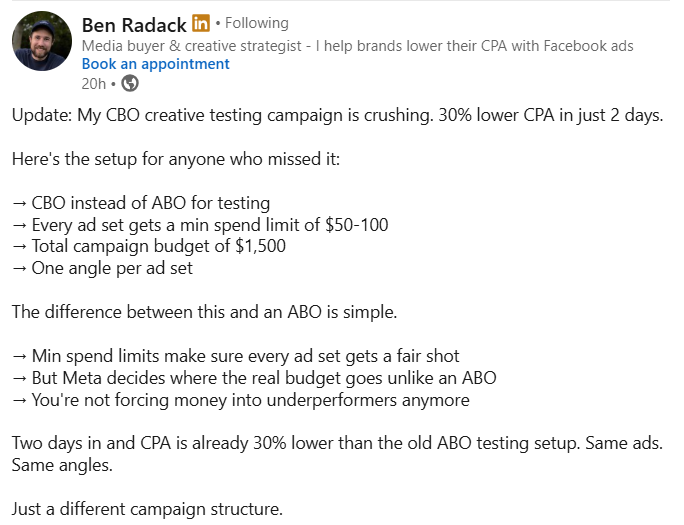
This setup replaces ABO testing with CBO while still controlling spend using minimums per ad set. Each angle gets a fair initial budget, but Meta dynamically shifts spend toward top performers. The structure removes manual budget bias and lets the algorithm prioritize efficiency earlier.
Why it works: CBO uses real-time performance signals to allocate budget efficiently. Minimum spend ensures testing coverage, while dynamic scaling concentrates spend on winners. This accelerates learning and reduces wasted spend on underperforming ad sets.
Where it needs balance: Early winners may get over-allocated before true statistical significance. Smaller budgets can still limit proper testing depth. Without enough creative diversity, CBO may optimize within a narrow range instead of finding better performers.
🚀 Reel of the Day

What Works:
1. Sensory Overload Simulation - This works because it doesn’t just show tiredness, it makes you feel it. The blur, chaos, and noise replicate cognitive fatigue, so viewers don’t watch the reel, they experience it physically.
2. Relatability Density Hack - Instead of one relatable moment, this stacks multiple pain points fast. Sleep deprivation, long shifts, noise, and pressure hit together, making almost anyone in service roles instantly feel seen.
3. Comment Magnet Design - This isn’t just funny, it’s socially activating. People tag coworkers, share war stories, and validate each other’s struggles, turning the reel into a conversation hub instead of passive entertainment.
Don’t create content people watch, create moments people recognize themselves in instantly. Stack multiple real-life frustrations into one tight scene so viewers feel exposed, triggering shares, tags, and repeat views organically.
Thanks for reading this edition! Keep pushing boundaries, testing ideas, and staying inspired. See you in the next edition with more ways to ignite your marketing success. 🥰