Turn their fumbles into you Ads
😮Your competitor's worst moments are your best ad placements, Imperfect reviews convert better than polished praise, and more!
Welcome to a space where every edition delivers insights, strategies, and inspiration to fuel your advertising brilliance. 🤯
😲Your Competitor's Worst Moments Are Your Best Ad Placements
Brands treat competitor research as a quarterly exercise. Pull a report, note the gaps, file it away. Meanwhile, their audience is googling that competitor's error messages, complaints, and failure states in real time, and nobody's showing up to meet them.
That's not a research problem. That's a revenue opportunity sitting unclaimed.
The intent signal hiding in your competitor's bad days
When someone searches a competitor's bug, outage, or limitation, they're not in discovery mode. They're frustrated, already using the product, and actively looking for a way out. That's the highest-quality traffic you can buy, and because nobody's bidding on it, you're often paying a fraction of standard category CPCs.
The Anthropic playbook made this famous in dev circles. Bid on the exact error strings your competitor's users copy-paste into Google when something breaks. Show up with a direct offer. The search query does the emotional heavy lifting. Your ad just needs to say yes.
How to find the moments worth targeting
This is where most brands stop at surface level, bidding on a competitor's brand name and calling it done. The real inventory is deeper:
- G2 and Capterra one-star reviews: filter by competitor, read for recurring failure language. These are exact keyword phrases waiting to be bid on.
- Reddit and community forums: search "[competitor] not working" or "[competitor] keeps crashing." Thread titles are your keyword list.
- Competitor status pages and changelogs: recurring outages and known unfixed bugs are permanent placement opportunities
- Support forums and help docs: the questions users ask publicly reveal the gaps the product never solved
SEMrush One accelerates this entire process. Its technical crawl access surfaces competitor content gaps and site-level weaknesses at scale, while the brand entity layer shows you exactly how competitors are positioned in search, and where their authority breaks down.
Instead of manually mining forums, you're working from a structured intelligence picture that tells you where the cracks are before you start building your keyword list. You can try it for free for 7 days
What the ad needs to say
Generic brand messaging fails completely against pain-state searches. The copy needs to match the frustration directly:
- Lead with the problem, not your product
- Headline should promise a specific resolution, "Switch in 30 minutes" beats "Try us free"
- No taglines, no positioning language, no feature lists
One CTA. Land them on a page built for this exact moment, not your homepage.
The competitive moat this builds
Brands running this well aren't just capturing switching traffic. They're mapping their competitor's weakness profile in real time. Every search trend that spikes around a competitor outage, every new complaint thread that emerges, becomes a targeting signal.
Your competitor's worst day is your best acquisition window. The brands paying attention are already in the auction.
Together with Grapevine
📉 Consumers Are More Media-Savvy Than Ever. Here's What Still Converts.
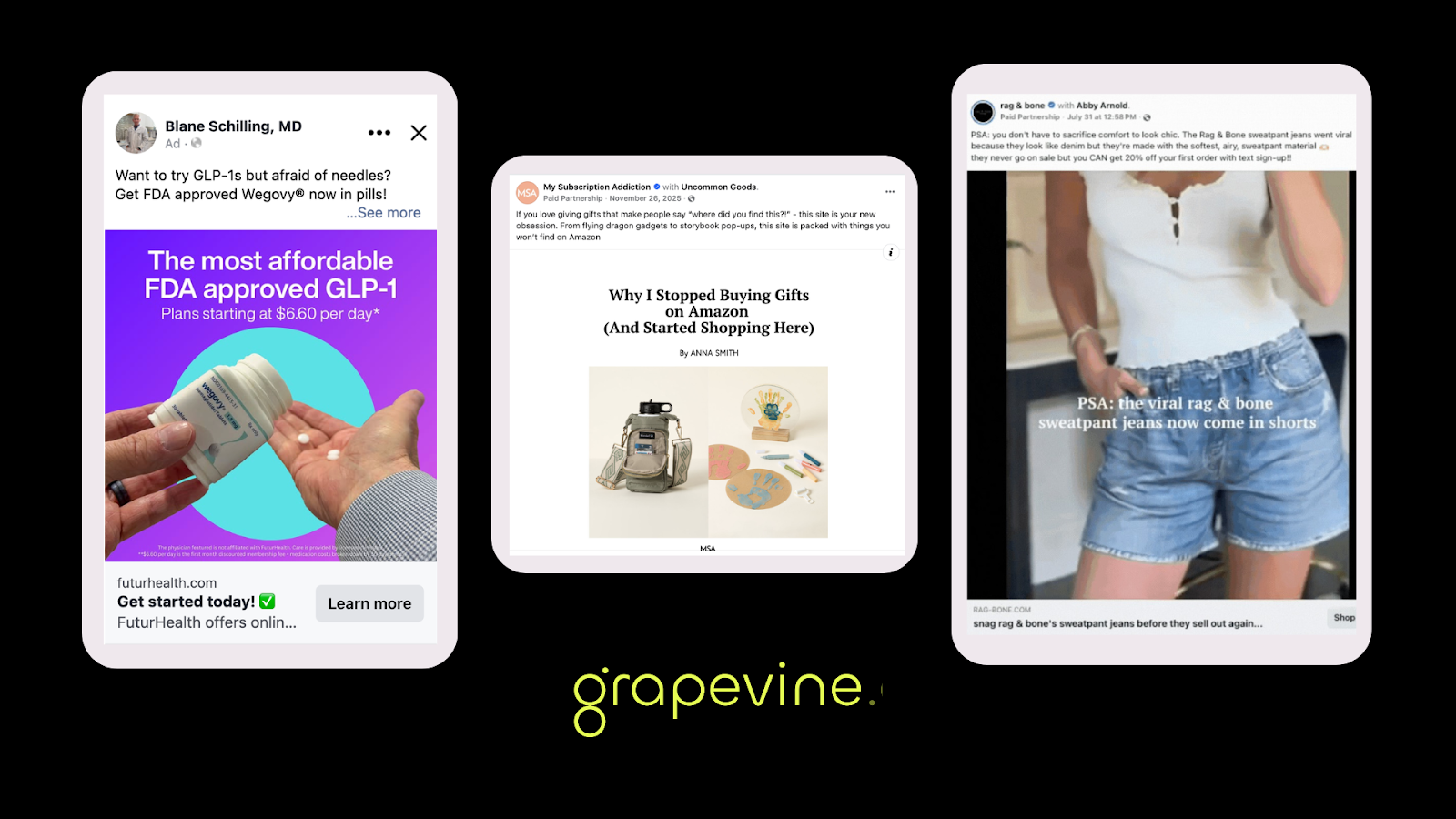
Today's buyer knows the difference between a brand speaking for itself and a credible voice speaking independently. Ads from branded handles are easy to discount.
A clinical pharmacist reviewing scrubs. A veterinarian recommending a supplement. A makeup artist breaking down an ingredient. That's harder to scroll past.
Grapevine works across some of the most trust-dependent categories - GLP-1s (Futurhealth), telehealth (Alloy), finserve (Better), and DTC (Fabletics, Particle for Men, Arrae) precisely because expert creator voice and publisher advertorial move audiences that branded creative can't.
- Just Food for Dogs scaled Grapevine assets from 15% to 45% of paid media in 6 months
- Madison Reed unlocked 20% efficiencies over Target CPA and 50% higher LTV
- Mathnasium cut Meta CPL by 33% in under 30 days
The brands winning right now are running both creator whitelisting and publisher advertorial whitelisting at the same shop, as one fully managed service.
No platform juggling. No separate agency relationships. Brief to launch, handled.
👉 Book a free strategy call for your first campaign strategy session - no commitment required.
⚡ Imperfect reviews convert better than polished praise
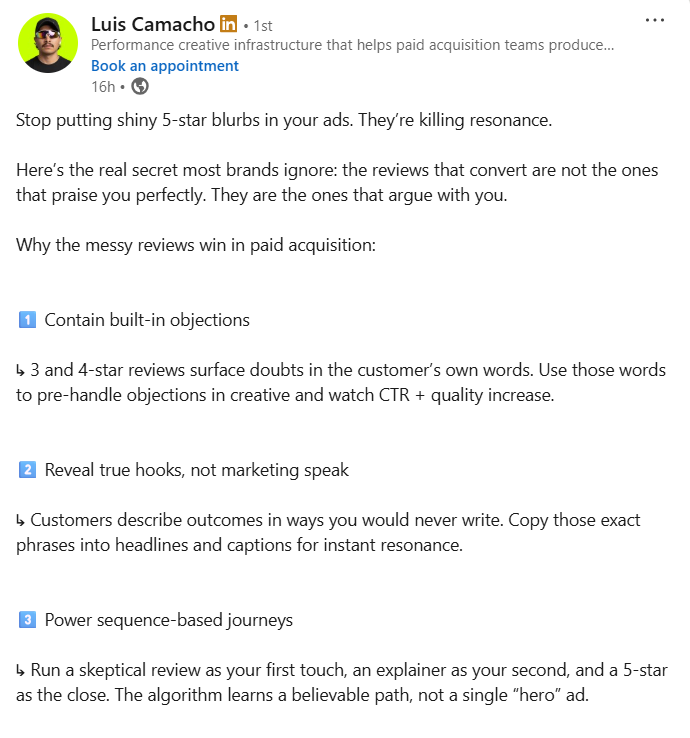
This strategy suggests using 3–4 star reviews instead of perfect testimonials in ads. These reviews include doubts, real language, and nuanced experiences that mirror how customers actually think. By structuring creatives around scepticism, explanation, and proof, brands build a more believable and persuasive journey.
Why it works: Buyers trust content that reflects their own doubts. Imperfect reviews feel authentic and reduce resistance by addressing objections upfront. This increases relevance, improves click quality, and builds credibility faster than overly polished testimonials.
Where it needs balance: Too much skepticism can weaken brand perception if not resolved clearly. Reviews must still reinforce product value. Without strong follow-up proof, highlighting objections alone may reduce confidence instead of increasing conversions.
🎥 Reel of the Day

What Works:
1. Reference bait loop - They’re not explaining the Grand Budapest reference at all, and that’s the whole game. People who get it feel smart, people who don’t ask. That tension drives comments hard.
2. Testing becomes theatre - This isn’t product testing, it’s performance. The exaggerated smashing, slicing, and revealing create a rhythm. You’re not watching durability; you’re watching a scene, which lifts retention way beyond utility content.
3. Product feels indestructible - Without saying a word about quality, they imply it. No specs, no claims, just visual proof through absurd testing. That’s perceived value being built without sounding like a sales pitch.
Build your content around a cultural reference, but don’t explain it. Let people figure it out, argue in comments, and stay longer just to feel “in on it.”
Thanks for reading this edition! Keep pushing boundaries, testing ideas, and staying inspired. See you in the next edition with more ways to ignite your marketing success. 🥰