When Creator Growth Turns Slippery
🫣 Performance holds while meaning quietly starts to drift. If ads won’t scale, it’s usually not the media buyer, and more!
Welcome to a space where every edition delivers insights, strategies, and inspiration to fuel your advertising brilliance. 🤯
🫣 When Creator Growth Turns Slippery
There’s a moment in creator-led growth where the brand starts to feel slippery.
People are still talking about the product. Videos keep showing up. New angles appear every day. But if you read the comments closely, the reasons for buying start to scatter.
One person thinks it’s a shortcut.
Another treats it like a flex. Another frames it as a cheaper alternative. Another isn’t sure what it’s meant to replace.
That’s not diversity. That’s dilution. This is where platforms like Insense quietly earn their keep by helping teams scale creator output without handing brand interpretation to the algorithm. You can book your free demo by January 23 to get $200 toward your first campaign!
Before crossing it, creators compress understanding. Different voices explain the product in slightly different ways, but they point in the same direction. The buyer learns faster. Decisions feel easier.
After crossing it, creators begin stretching the product to fit their own audiences. Each video works in isolation. Together, they pull the brand apart.
Nothing is technically wrong with the content. That’s what makes this dangerous.
Saturation doesn’t break performance first. It breaks meaning.
Some products can survive that drift. Simple, habitual, low-consideration products often benefit from repetition alone. Familiarity matters more than nuance.
Other products can’t afford it.
Anything where the buyer is making a judgment call, not a reflex purchase, breaks faster when meaning fragments. This includes higher-priced items, health and wellness products, ingestibles, products tied to routines or outcomes, and categories where trust and correct usage matter. In these cases, the brand isn’t just a label. It’s the explanation.
When one creator positions the product as a hack, another as a luxury, and another as a budget substitute, the buyer has to do extra work to decide. That work rarely shows up as backlash. It shows up as hesitation.
Hesitation is expensive.
Pricing power softens. Comparison shopping increases. The product still sells, but it sells to a narrower, more price-sensitive audience. Conviction erodes long before volume does.
This is why the real question isn’t whether to scale creators.
It’s how much interpretive freedom the brand can tolerate before it stops standing for something specific.
Teams often try to fix this by tightening scripts or adding more rules. That misses the point. The issue isn’t a lack of control. It’s excess exposure.
The brands that scale cleanly aren’t choosing between volume and polish. They’re choosing when to flood the feed and when to protect coherence.
Because reach is easy to buy. Meaning is not. And once a brand stops sounding like itself, getting that clarity back is far harder than it looks.
Together with Insense
Find your perfect influencers in 48hrs - who actually follow the brief!
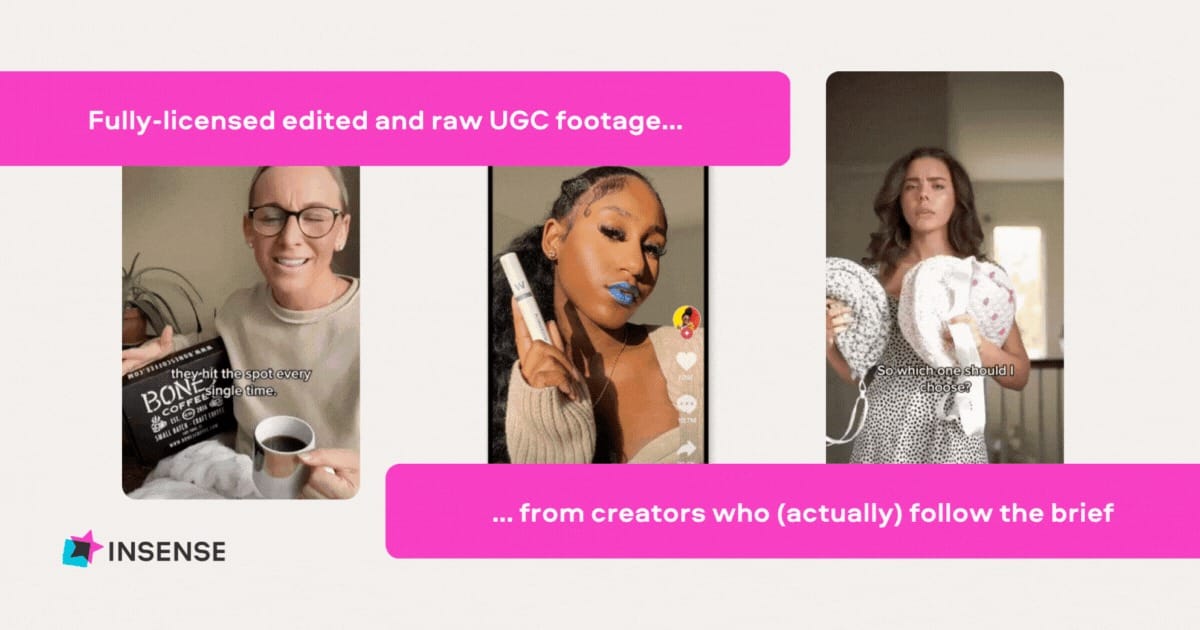
The right UGC cuts acquisition costs in half and 4× your ad CTRs, but only if the creators follow the playbook.
Trying to manage that manually? Burnout guaranteed.
Insense gives you instant access to a global pool of 68,500+ micro-influencers and UGC specialists, pre-vetted, pre-briefed, and performance-proven across 35+ countries.
Top brands use Insense to run seamless campaigns from product seeding and gifting to TikTok Shop and affiliate campaigns, and whitelisted ads.
- Nurture Life cut turnaround time from 2 months to 2 weeks using just one marketer and Insense
- Solawave received 180+ ad-ready assets in a single month by simply shipping products
- Matys Health achieved 12× reach through Spark Ads on TikTok
Want to skip sourcing chaos and launch faster?
Book a free discovery call by January 23rd, and get $200 toward your first campaign.
⚡If Ads Won’t Scale, It’s Usually Not the Media Buyer
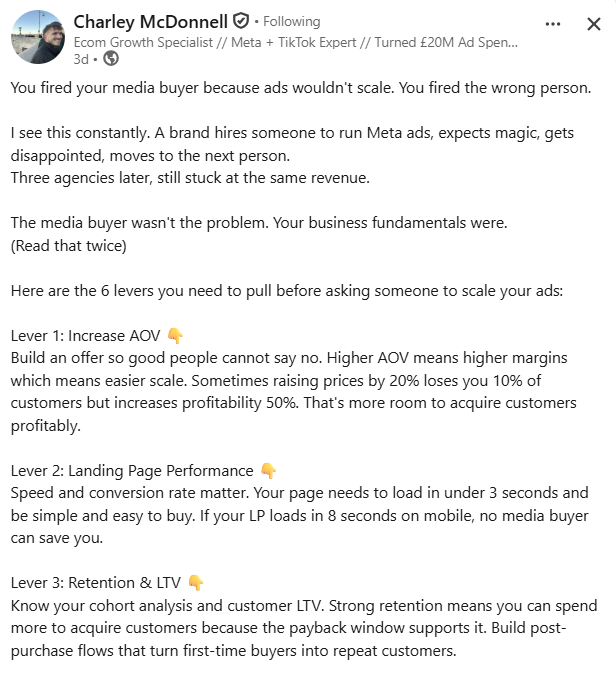
When brands hit a ceiling, the default move is to blame the person running ads. Swap the media buyer, swap the agency, try again. But if the business fundamentals are weak, the next person just hits the same wall, only with a different dashboard setup.
Why it works: Meta scales way easier when the fundamentals aren’t fighting you. Higher AOV gives you breathing room. Fast pages stop the leak. Retention makes CAC less scary. Multi-channel demand warms the audience. And fresh creativity keeps performance from flatlining.
The real takeaway: Ads don’t scale businesses; they scale systems. If the offer, site, retention, and creative pipeline aren’t strong, performance will always feel capped. Fix the six levers first, then paid media becomes a multiplier instead of a blame game.
🎥 Reel of the Day

What Works:
1. The hook is “is this illegal?” not “buy this tee” - That “wtf this dude doing 😳” text is pure curiosity bait. It triggers pattern break, forces a rewatch, and instantly boosts retention because your brain needs closure.
2. POV filming makes the viewer feel like the witness - The shaky follow-cam and low angles feel like you’re inside the chase. That “I’m there” energy creates adrenaline, which drives watch time and shares way harder than clean product shots.
3. The brand turns product delivery into a mini heist story - He jumps fences, runs through traffic, then it’s just a simple handoff. That contrast is the payoff. It makes the reveal satisfying, so people stay till the last second.
This reel sells because it disguises the product as a moment. The suspense earns attention, the POV earns emotion, and the reveal earns trust. It’s not a t-shirt ad, it’s a dopamine loop with a logo.
Thanks for reading this edition! Keep pushing boundaries, testing ideas, and staying inspired. See you in the next edition with more ways to ignite your marketing success. 🥰