When optimization breaks trust
😬 Nothing fails yet customers hesitate to reorder, When to kill an ad vs let it run, and more!
Welcome to a space where every edition delivers insights, strategies, and inspiration to fuel your advertising brilliance. 🤯
😬 When Optimization Breaks Trust
Efficiency is supposed to be invisible. When it works, customers never notice it. When it doesn’t, they feel it immediately. Most fulfillment problems don’t come from failure. They come from optimization.
Inside the business, decisions are made to reduce cost and increase throughput. Orders get routed to whichever warehouse has inventory. Shipments get split to improve internal timelines.
Carriers are selected based on margin targets. From an operations dashboard, everything looks controlled.
From the customer’s side, the experience fractures.
One order becomes multiple tracking numbers. Delivery dates shift after checkout. Packages arrive days apart with no explanation. The brand stops feeling deliberate and starts feeling improvised.
Nothing is technically broken. Trust still erodes.
Customers do not evaluate fulfillment the way operators do.
They don’t care which warehouse shipped the product. They don’t care about zone optimization or carrier mix. They care about certainty. Did the brand do what it implied it would do at checkout.
When internal efficiency decisions create visible inconsistency, customers learn something subtle but damaging. The brand optimizes for itself first.
That lesson carries forward into the next purchase decision.
This is why efficiency can quietly increase churn. Split shipments might save money. Longer routing might improve utilization. But every visible deviation introduces doubt. Doubt slows reorders. Hesitation replaces momentum.
The cost doesn’t show up immediately. It shows up later as silence.
This becomes obvious when fulfillment is examined from the customer’s point of view.
Shipfusion ordered from five leading clear protein brands within the same hour to compare real post-checkout experiences. The products weren’t the differentiator. Fulfillment was.
One order traveled over 2,000 miles, 57 percent farther than average, adding unnecessary days and cost. Other brands set clear delivery expectations and shipped predictably. The difference wasn’t speed. It was certainty.
Clear protein was just the test case, but the same problems show up across every DTC brand that ships. If you ship physical products, you need to see this.
You can download your DTC Delivery Files here.
Efficiency should support trust, not compete with it.
When fulfillment systems optimize without considering what the customer can see, they train people to question future promises. That doubt rarely becomes a complaint. It becomes a decision not to reorder.
The brands that scale sustainably understand this tradeoff.
They design operations so efficiency disappears from the experience. They optimize for predictability before cost. They recognize that every visible shortcut teaches behavior.
And the behavior customers learn is whether to come back.
Together with Belay
Is your back office leaking profit?

Scaling a brand or agency is ultimately a math problem. But when you hit $50k+ a month, the math gets messy.
Most founders and executives spend 40% of their week on manual billing, inventory reconciliation, and chasing invoices. That is time stolen from the high-level strategy that actually drives your revenue.
True leverage isn't about working more hours; it is about moving to a fractional finance model. BELAY matches you with U.S.-based experts who offload the ledger and deliver the data-driven clarity you need to protect your margins.
Reclaim your bandwidth and lead like a CEO again. Belay’s latest guide shows you exactly how to transition your accounting from a bottleneck into a growth engine.
Download your Guide to Outsourced Accounting!
⚡ When to Kill an Ad vs Let It Run
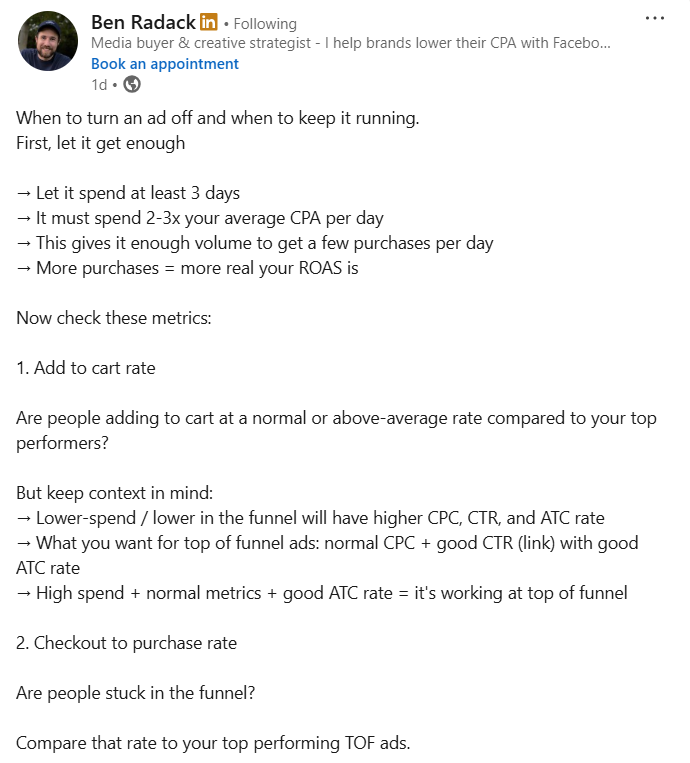
Too many ads are shut down the moment ROAS dips, even though the data isn’t settled yet. Before making any call, the ad needs enough data to be judged fairly. That means letting it run for at least three days and spending roughly two to three times your average CPA per day so results aren’t just noise.
How to read the signals: Start with the add-to-cart rate. If people are adding to cart at a normal or better rate compared to your winners, the ad is doing its job, especially at top of funnel. High spend with normal CPC and CTR plus healthy ATCs usually means the ad is working, even if purchases lag. Then check the checkout-to-purchase rate. If people drop there, the issue is likely the funnel, not the ad.
The decision rule: If ATC rate is bad and ROAS is bad, turn it off. If ATCs look good but ROAS is weak and checkout-to-purchase is low, give it more time and fix friction. ROAS alone is a lagging signal. Killing ads without context is how good tests die early.
🎥 Reel of the Day

What Works:
1. The hook hijacks an existing mental loop - “I asked the universe for a sign” is already a meme format people recognize. Zero cognitive load. Your niche, coffee drinkers, are already primed to agree before the brand even appears.
2. It frames coffee as permission, not a product - The sign isn’t “buy coffee.” It’s “you’re justified.” That’s customer-centric framing. It removes guilt, which is the real friction for repeat purchases, especially in habitual categories like coffee.
3. Simplicity boosts completion rate, not creativity - This reel works because it’s 10 seconds, one joke, one payoff. High completion rate feeds the algorithm, which feeds distribution. It’s not trying to impress, it’s trying to land.
This reel wins by being emotionally obvious, algorithm-friendly, and culturally native. It doesn’t sell coffee, it validates a habit. That’s why people watch, smile, and subconsciously remember where to go next.
Thanks for reading this edition! Keep pushing boundaries, testing ideas, and staying inspired. See you in the next edition with more ways to ignite your marketing success. 🥰