Your blog outranks your business
🧐 You have an information architecture problem. When your blog beats your product pages in search, High-Converting homepages follow a structured persuasion sequence, and more!
Welcome to a space where every edition delivers insights, strategies, and inspiration to fuel your advertising brilliance. 🤯
😤Your blog outranks your business
A lot of the sites we audit have the same issue hiding in plain sight.
Type their brand name plus a core service into Google. A blog post ranks. The actual product or service page? Nowhere on page one.
That's not a content win. That's your site working against itself.
Why this happens
Blog content tends to accumulate links naturally. It gets shared, referenced, and cited. Commercial pages don't get that same treatment; they're harder to link to organically, so they rely almost entirely on internal signals to compete.
When you publish blog content that targets the same keywords as your revenue pages without a clear hierarchy telling Google which one to prioritize, the blog post wins by default. More links, more engagement signals, more crawl frequency.
Your commercial page loses to your own content.
What does it cost you
A blog post ranking for a commercial keyword sends the wrong traffic. Informational visitors read and leave. They're not in buying mode. You're getting impressions without conversions, and the page that could actually close someone isn't in the picture.
At scale, this creates an entire category of keywords where your site ranks, technically, but generates no revenue from the visibility.
How to fix the hierarchy
Three things that need to be true:
- Commercial pages target transactional and bottom-funnel keywords. Blog content targets informational queries that feed into it.
- Internal links from blog posts point back to the relevant commercial page with descriptive anchor text, not generic "learn more" links.
- Canonical signals are clean. No ambiguity about which page owns which keyword cluster.
If a blog post is outranking a commercial page for a revenue keyword, either consolidate the content or restructure the internal linking so equity flows toward the page that converts.
Planable's 2026 Agency Profitability Report found that high-margin agencies optimize their operational model before adding more output, same logic applies here. Fix the architecture before publishing more content into a broken hierarchy. You can get the report for free
The test
Pull your top commercial keywords. Check what's actually ranking. If the answer is a blog post more than once, you don't have a content volume problem. You have a structure problem.
More publishing won't fix it. A cleaner hierarchy will.
Together with Grapevine
Consumers trust experts. They tolerate brands.
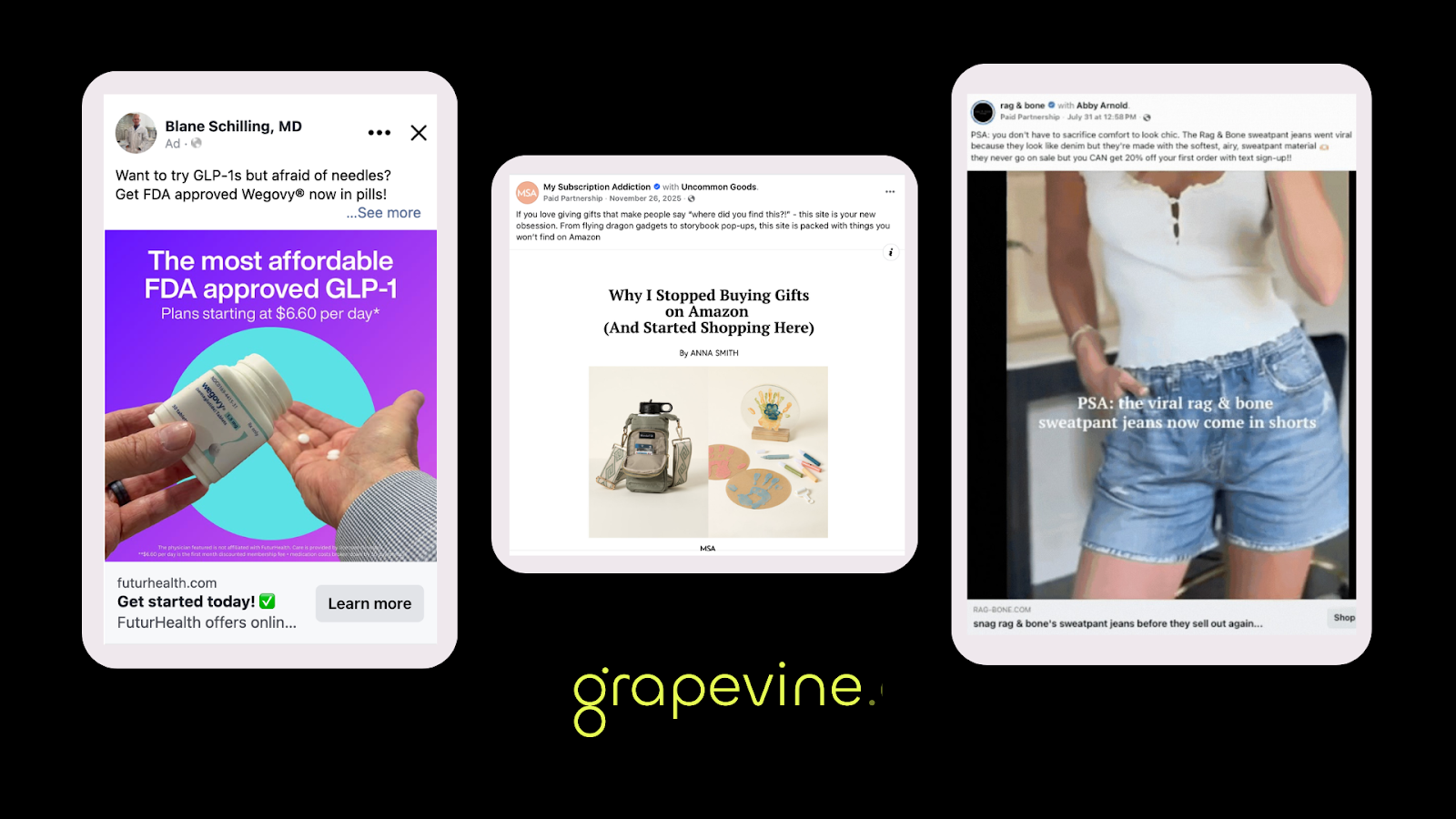
Consumers can smell a brand talking about itself. They scroll past it automatically, it doesn't matter how good the creative is.
What they don't scroll past: a registered dietitian recommending a protein bar. A dermatologist breaking down a skincare routine on camera. A running coach reviewing a shoe mid-run.
Your branded handle is working against you. Not because the creative is bad, but because the source is discounted before anyone reads the first line.
Grapevine runs creator whitelisting and publisher advertorial as one fully managed service. Brief to launch, no platform juggling, no separate agency relationships.
- Nood hit 4× ROAS while scaling spend using whitelisted creator ads
- Honeylove cut CPAs by over 20%, combining creator and publisher handles
- Mathnasium cut Meta CPL by 33% in under 30 days
Grapevine ads outperform branded creative by 25%+ across platforms. Consistently, not occasionally.
👉 Book a free strategy call for your first campaign strategy session - no commitment required.
⚡ High-Converting homepages follow a structured persuasion sequence
This framework breaks the homepage into five jobs: clarify value, build trust, show empathy, surface pain, and drive action. Instead of treating a homepage like a brochure, it treats it like a guided conversion path. Each section moves the visitor closer to belief and next-step intent.
Why it works: Strong homepages reduce ambiguity fast. They combine clarity, proof, emotional relevance, and direction in one sequence. That structure helps visitors understand, trust, and act without needing to hunt for reasons.
Where it needs balance: A fixed formula can oversimplify different buying journeys. Not every business needs equal emphasis on all five elements. The best homepage structure still depends on traffic source, customer awareness, and sales complexity.
🚀 Reel of the Day

What Works:
1. Beat Builds Breadth - This reel sells range without feeling like a brochure. Every beat reveals a new revenue layer, so the audience absorbs food, vibe, events, and identity as one seamless hospitality ecosystem.
2. Music Replaces Copy - They use rhythm as an information architecture tool. Instead of explaining each offering, the edit lets tempo organize the message, which makes the reel feel lighter, smarter, and much easier to retain.
3. Density Without Chaos - What is clever here is content compression without confusion. They pack multiple selling points into seconds, but because each cut lands on beat, the brain reads it as pleasure, not overload.
Stop selling one reason to visit. Design your reel so every second reveals a new experience layer, making your brand feel like a destination, not a single-product stop.
Thanks for reading this edition! Keep pushing boundaries, testing ideas, and staying inspired. See you in the next edition with more ways to ignite your marketing success. 🥰