Your Content Library is Killing You
🔥How AI search rewards brands with fewer pages and stronger narrative density, why viral organic content can become your most profitable ad, and more!
Welcome to a space where every edition delivers insights, strategies, and inspiration to fuel your advertising brilliance. 🤯
🔥 Your Content Library Is Killing YouMost brands don’t lose AI visibility because they lack content.
They lose it because they’ve published so much fragmented, redundant content that their brand meaning collapses when AI tries to compress it.
AI doesn’t evaluate your blog posts. It compresses your entire site into a single narrative fingerprint; the tighter that fingerprint, the more confidently AI recommends you inside purchase flows.
This is the shift no one is talking about:
AI search isn’t a ranking system. It’s a brand-coherence detector.
1. AI Converts Your Entire Website Into One Sentence, So Every Page Must Strengthen It
When ChatGPT suggests a sunscreen, a supplement, a moisturizer, or a candle brand, it’s not recalling individual URLs.
It’s recalling the “compressed brand object” formed from your content, your reviews, your education layer, your product explanations, and your category POV.
This is why bloated content libraries destroy DTC visibility:
- If you have 11 hydrating routine guides, the model blends them into mush.
- If two pages contradict each other on ingredient benefits, the model lowers confidence.
- If your how-to guides look like everyone else’s, AI tags you as generic.
The model must compress you. Your job is to give it something worth compressing. This is where Semrush One becomes a crucial diagnostic layer:
It shows which pages AI engines actually use when reconstructing your brand, which ones dilute your topical meaning, and where your story fractures.
It keeps you from accidentally erasing your authority. You can use the 14-day free trial here to see your AI footprint.
2. Thin Content Doesn’t Hurt Rankings, It Hurts Recommendation Probability
In traditional SEO, weak pages just didn’t rank.
In AI search, weak pages pollute the “brand vector” that models rely on.
This is why some mid-sized DTC brands, despite having massive content libraries, are being skipped entirely in AI shopping guides, while smaller, newer players with disciplined clusters show up as:
- “Top pick for dry skin”
- “Best budget-friendly ceramide serum”
- “Most reliable electrolyte blend”
AI rewards coherence, not quantity.
3. The New Architecture for DTC: Meaning Density Over Page Count
Here’s the modern blueprint used by the DTC brands quietly dominating AI recommendation flows:
One flagship “category-defining” guide per pain
Not ten SEO pages, one impossible-to-ignore asset.
3–6 supporting depth pieces
Each clarifies a different dimension of shopper doubt:
- one for ingredients
- one for routine fit
- one for comparisons
- one for troubleshooting
Remove every redundant SKU-like page
If two pages answer the same anxiety, merge them.
Create a conversion spine, not a content warehouse
Your guides should act like a salesperson, a scientist, a category librarian, a buyer ally
All reinforcing a single message: “This brand knows this category better than anyone.”
AI amplifies the brands with the clearest signals, not the most signals.
Together with Stack Influence
How Lenny & Larry’s 11X’d Amazon Sales Without Spending More on Ads

You know that sinking feeling when a new product just doesn’t move? Ads burning cash, clicks dying out, and the Amazon algorithm ignoring you completely. That’s exactly where Lenny & Larry’s was when their Protein Pretzels tanked until they flipped the script.
They stopped buying attention and started earning it. Through Stack Influence, they turned 1,560 real customers into micro-influencers.
Buyers who actually posted, reviewed, and drove organic visibility. Within weeks, momentum snowballed.
🚀 Sales exploded 11X from 1K to 11K units per month
💬 500+ verified reviews boosted trust and rankings
💰 $2M+ in revenue with zero increase in ad spend
Stack Influence helped brands like Unilever, P&G, and Magic Spoon quietly scale the same way by turning customers into content creators and paying them only with products.
The faster you start, the faster your next launch compounds.
⚡ Why Viral Organic Content Can Become Your Most Profitable Ad
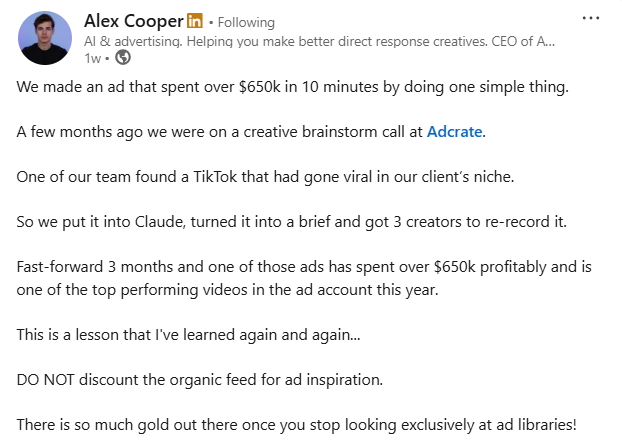
This example shows how a single organic TikTok idea, not a polished ad, not a complex concept, became a $650K+ profitable ad after being re-recorded by creators. The team didn’t reinvent anything. They simply spotted a viral pattern, turned it into a structured brief, and recreated it with relevance and clarity for their client.
Why this works: Organic content is a live testing ground where consumers already show you what they’re responding to. A viral TikTok proves the hook, pacing, and emotional triggers before you spend a dollar on ads. When you recreate it with your product baked in, you’re borrowing a validated pattern and giving Meta or TikTok a head start on optimization.
Where it needs balance: Not every viral clip translates into an ad. Some concepts go viral because they’re random, controversial, or personality-driven in ways a brand can’t replicate. It’s also easy to cross the line into low-quality knockoffs if the recreation loses the charm or authenticity of the original.
🎥 Reel of the Day
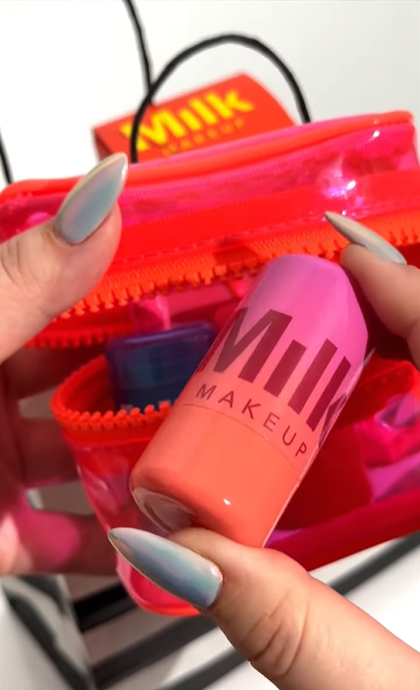
What Works:
1. The “Unbagging” Hook Creates Instant Curiosity - Opening with a Sephora bag being lifted is a built-in dopamine cue because viewers anticipate a reveal. Sephora’s branding acts as a credibility shortcut. This primes viewers to watch longer before any product even appears.
2. One-by-One Product Pullouts Drive Micro-Replays - Every item is revealed sequentially, which creates a predictable rhythm the brain finds satisfying. This pattern triggers small dopamine spikes with every new product shown. Many viewers replay to re-check colors, packaging, or specific products.
3. “Limited Edition” + “These go fast” = Urgency Layer - Scarcity language activates fear of missing out, giving meaning to every product shown. Instead of a passive haul, it becomes a decision-making reel. Viewers stay until the end to see all options before choosing what to buy.
This reel works because it blends color psychology, sequential reveals, and scarcity messaging to create a fast, satisfying mini-unboxing that viewers naturally replay. It keeps the brain in reward mode, making the product feel exciting and urgent at the same time.
Thanks for reading this edition! Keep pushing boundaries, testing ideas, and staying inspired. See you in the next edition with more ways to ignite your marketing success. 🥰