Your PDP is costing you sales
🧐 You’re delaying commitment without realizing, Why retargeting ads quietly underperform, and more!
Welcome to a space where every edition delivers insights, strategies, and inspiration to fuel your advertising brilliance. 🤯
🧐Your PDP is costing you sales
Every product page asks a question the moment it loads. Not in words.
In structure.
“How much of this should I buy?”
Most brands let the customer answer that question themselves. That sounds reasonable. It’s also where revenue quietly dies. Because customers don’t like deciding quantities. They tolerate it.
When someone lands on a PDP, they are already mentally overloaded. They’ve evaluated trust, price, shipping, legitimacy, and timing. Asking them to now calculate how many units they’ll need is not empowering; it’s friction disguised as choice.
Here’s the part most teams miss: quantity decisions are rarely intentional. People don’t think, “One unit is optimal.”
They think, “I’ll take what’s there and move on.”
Whatever you pre-select becomes the implied norm. That’s why the default quantity is not a UI detail. It’s a behavioral instruction.
Why “One Unit” Is a Terrible Instruction
When a product defaults to a single unit, the page is sending three messages at once:
- This is probably a trial.
- Most people buy it occasionally.
- Reordering is expected later.
None of those are neutral assumptions.
They delay commitment, weaken habit formation, and push the real decision into the future, where comparison shopping lives.
Now flip the instruction.
When the default is multiple units, the product stops feeling like a test and starts feeling like a solution. The buyer no longer thinks about trying the product. They think about being done with the problem.
That shift happens without persuasion. No copy rewrite. No discount. No urgency timer. Just a different starting point.
The Real Reason This Works (It’s Not Bundles)
This isn’t about deals or savings psychology. It works because humans prefer fewer future decisions. Buying more upfront compresses time:
- Fewer reorders
- Fewer stock-out moments
- Fewer reminders that the problem exists
That’s why bulk buying exists offline. Not because people love spending more, but because finishing decisions feels good.
Digital brands often forget that.
How Smart Defaults Are Built (Without Tanking Conversion)
High-performing teams don’t guess quantities. They reverse-engineer usage.
They ask:
- How long does one unit realistically last?
- When does reordering become annoying?
- At what point does ownership feel “handled”?
That number becomes the lead option.
Single units stay available, but they stop being the headline. Large packs exist, but they don’t overwhelm. The page quietly says, “This is what most people do.”
And most people follow.
When This Backfires (And Why That’s Important)
Defaults fail when usage is unpredictable or when storage, spoilage, or customization creates anxiety. In those cases, forcing volume feels reckless, and customers resist.
The rule is simple: Only default what feels responsible.
The Bigger Lesson
Most brands think revenue is unlocked by convincing harder. It isn’t.
Revenue often comes from removing decisions customers never wanted to make.
When you stop asking people how much they want and start showing them what makes sense, buying becomes easier. And easy decisions scale.
Together with Lindy
You are not behind on ideas. You are behind on speed.
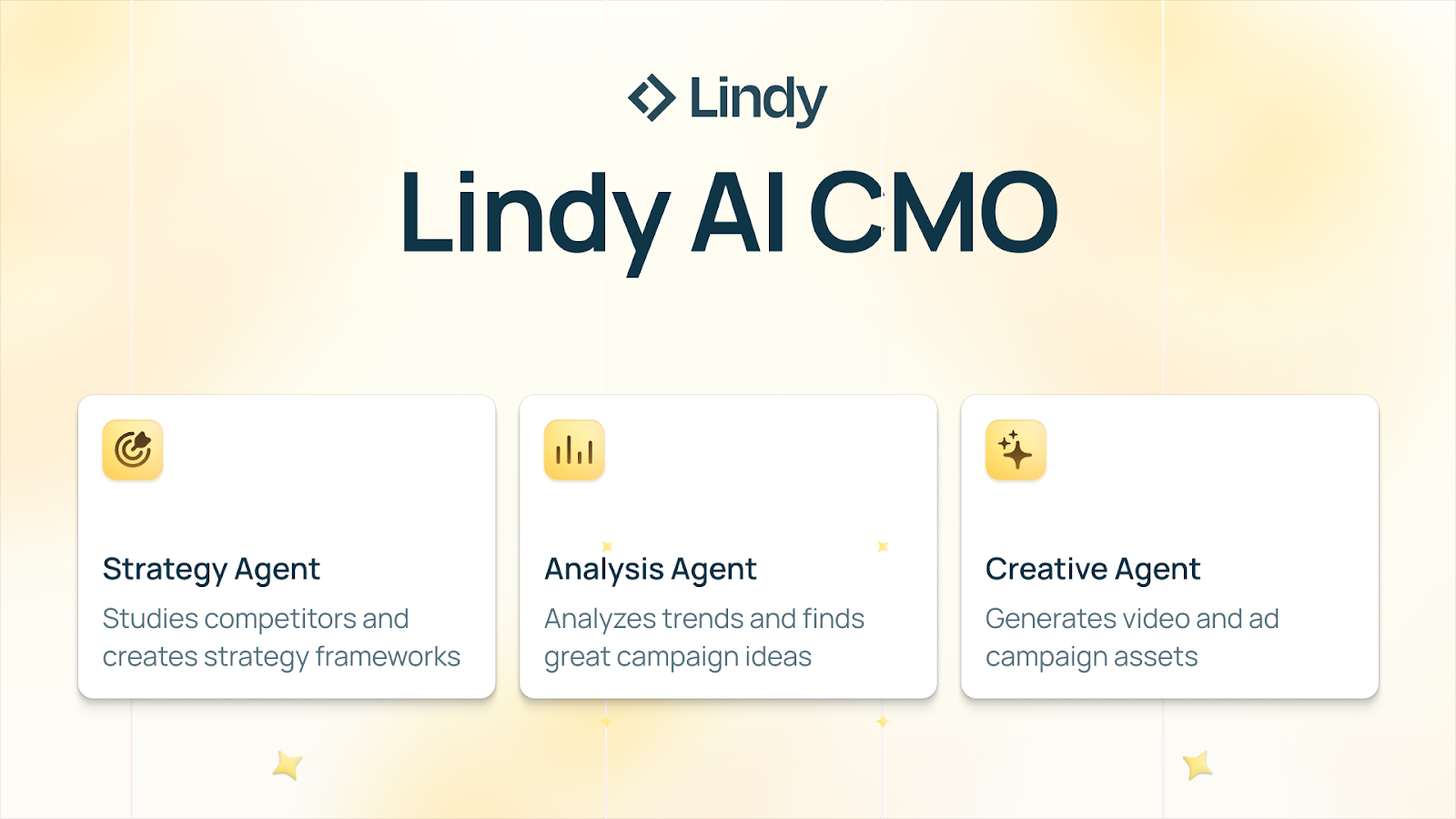
You know the drill. Competitor research scattered across tabs, unfinished messaging docs, late briefs, and creative that misses the angle. That chaos is not annoying; it is expensive.
Lindy AI CMO is a suite of powerful agents that ship beautiful marketing campaigns quickly.
Drop in your website, and agents study your competitors, extract angles, draft messaging, create briefs, and generate launch-ready assets, then organize everything in Airtable for a clean approval flow.
- Cut campaign prep from 10 to 14 days down to 1 to 2 days.
- Generate 30 to 80 on-brief variants per angle to accelerate testing.
- Reduce rework and increase weekly experiment volume without extra headcount.
Teams running agent-led workflows consistently ship 2 to 3 times more weekly tests with the same headcount.
⚡ Why Retargeting Ads Quietly Underperform
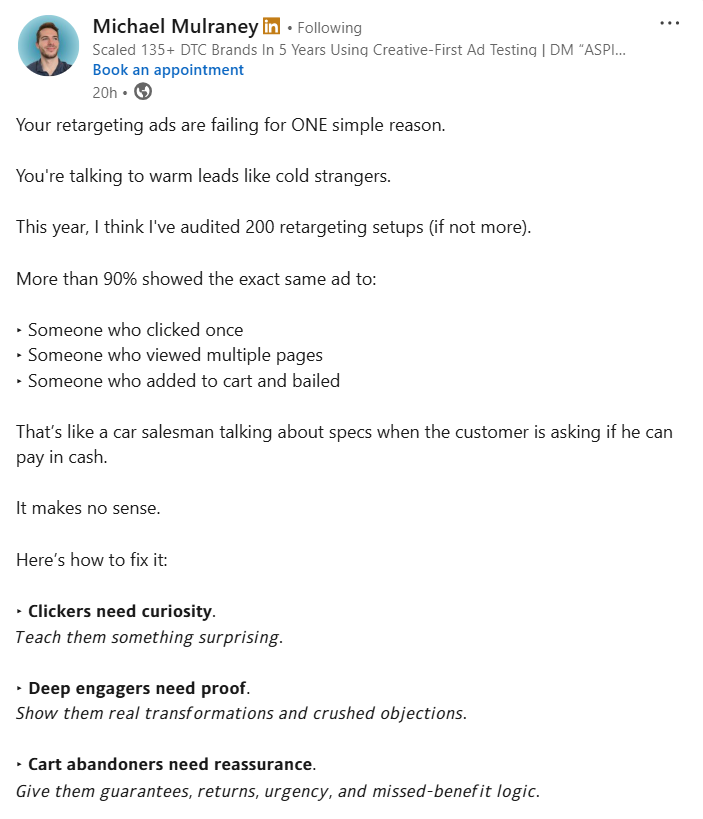
Most retargeting fails because warm users are treated like first-time visitors. Clickers, deep engagers, and cart abandoners all see the same message, even though they’re in completely different mindsets.
Why it works: Segmenting by intent aligns the message with what the user actually needs next. Clickers respond to curiosity and education, deep engagers need proof and objection handling, and cart abandoners need reassurance and risk removal. Using the same core assets with shifted emphasis boosts conversions without extra production.
Where it needs balance: Over-segmentation can add complexity without enough volume to support it. Messaging still needs consistency so users don’t feel confused across touchpoints. If the core offer is weak, no amount of retargeting nuance will save it.
🎥 Reel of the Day

What Works:
1. You stop because it feels like you’re spying - The REC frame makes it feel like you’re watching something you’re not supposed to see. That curiosity keeps you locked in before you even realize it’s a brand.
2. The drink feels earned, not placed - It’s just sitting there like a little prize waiting to be taken. That makes it feel special, like a treat, not like something trying to be sold.
3. The ending makes you want to stay close - “New flavor incoming” lands after the fun, not before. By then you’re already in, so following feels natural instead of forced.
This reel works because it feels like a tiny holiday moment you stumbled into. It earns attention first, then gently turns that feeling into curiosity for the brand.
Thanks for reading this edition! Keep pushing boundaries, testing ideas, and staying inspired. See you in the next edition with more ways to ignite your marketing success. 🥰