Your ROAS is Shrinking Audience
📊 Your ROAS target is quietly shrinking your audience, CPL optimizes for leads, not profit, and more!
Welcome to a space where every edition delivers insights, strategies, and inspiration to fuel your advertising brilliance. 🤯
Together with Omnisend
Email Marketing That Doesn't Need Your Attention.
You're spending more time managing your email tool than it's spending making you money. That's the wrong way around.
Omnisend handles email, SMS, and web push from one dashboard. AI builds your segments from plain language descriptions, pre-built workflows recover carts, reactivate lapsed customers, and welcome new subscribers without you touching a thing.
Here's what that looks like at scale:
- 150,000+ ecommerce brands trust it, averaging $79 back for every $1 spent.
- 69% of their revenue runs on automations set once and never touched again.
- 17.3% higher CTRs across automated sends versus manual campaigns.
You're up and running in 30 minutes. Fully migrated in 5 days. 24/7 support whenever you need it.
Your next best-performing campaign is already built. You just haven't turned it on yet.
📊 Your ROAS Target Is Quietly Shrinking Your Audience
You hit your ROAS target. The algorithm rewarded you for it. And somewhere in the background, your reachable market got a little smaller.
That's the part nobody explains when they teach you to optimize for efficiency. ROAS targets don't just measure performance, they function as audience filters. And the tighter the filter, the narrower the pool Meta is training itself to find on your behalf.
Run it long enough and you're not running a scaling campaign anymore. You're running an extraction campaign on an audience the algorithm has already learned to shrink.
How ROAS Targets Filter Your Audience
Meta's algorithm is a prediction engine. It finds people most likely to produce the outcome you've defined, in this case, a purchase at or above your ROAS threshold.
The higher that threshold, the smaller the group of people who qualify. Not because they wouldn't buy from you. Because they wouldn't buy from you fast enough, at a high enough order value, to clear the efficiency bar you've set.
Over time, the algorithm deposits that learning. It builds a tighter and tighter model of who your "profitable customer" looks like, and stops testing outside it. The audience isn't exhausted in the traditional sense. It's been filtered into a corner by the metric you used to define success.
Three Things to Do Before the Pool Gets Any Smaller
1. Separate acquisition ROAS from retention ROAS. New customer purchases and repeat purchases have completely different cost structures. Blending them into a single ROAS target trains the algorithm on a mixed signal, and inflates your apparent efficiency while masking how hard new customer acquisition is actually becoming. Split them. Measure them separately. Optimize them separately.
2. Introduce a secondary audience expansion signal. Run a parallel campaign optimized toward Add to Cart or Initiate Checkout rather than Purchase. Lower efficiency threshold, broader audience signal, different slice of your addressable market. Don't scale it aggressively, use it to keep the algorithm's model of your customer from calcifying around the narrowest possible definition of who converts.
3. Redefine what efficiency means across the funnel. A customer acquired at 2.8x ROAS who returns three times is worth more than a customer acquired at 4x who never comes back. If your ROAS target doesn't account for downstream value, you're optimizing the entry point while ignoring the economics that actually determine whether the business scales.
The algorithm learns what you teach it. A ROAS target that's too tight doesn't protect your margins, it trains Meta to find fewer and fewer people who clear that bar.
Efficiency compounds. So does its cost.
⚡CPL Optimizes for Leads, Not Profit
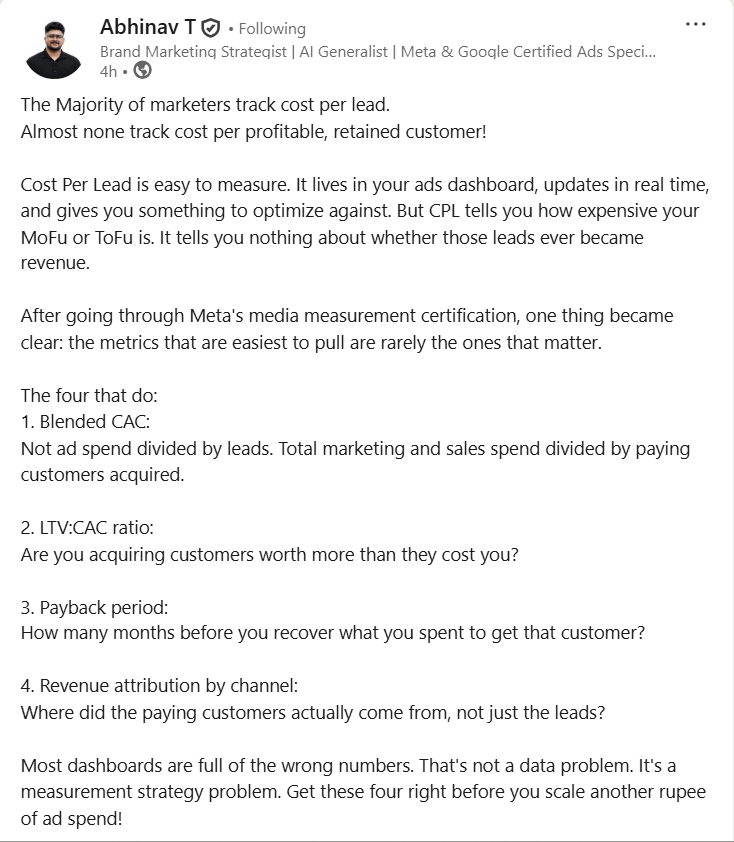
This post highlights how most marketers optimize for cost per lead, which measures activity but not actual business outcomes. Instead, it shifts focus to metrics that track real growth: customer acquisition cost, lifetime value, payback period, and true revenue attribution. The goal is to align measurement with profitability, not just pipeline volume.
Why it works: Profitability depends on customers, not leads. Metrics like blended CAC and LTV reveal true acquisition efficiency. Focusing on revenue and retention ensures marketing spend drives sustainable growth, not just cheap lead generation.
Where it needs balance: Lead metrics still matter for early funnel optimization and testing speed. Full revenue attribution can be complex and delayed. Balancing short-term lead signals with long-term profitability metrics is key for effective decision-making.
Together with The Shift
Stop Reading About AI. Start Getting Results From It.
AI is everywhere, but results are not.
That’s because most newsletters tell you what AI can do, not how to use it.
The Shift focuses on a single topic per edition. A real problem AI can solve today.
You’ll see real examples, short workflows, and proven prompts that help you work faster, think better, and automate intelligently.
Once you subscribe, you get access to 3,000+ curated AI tools, 500+ prompts, and free AI Courses so nothing stays theoretical.
If you want AI to pay you back in time and leverage, not just ideas, you’ll like this.
Subscribe to The Shift for free.
🚀 Reel of the Day
What Works:
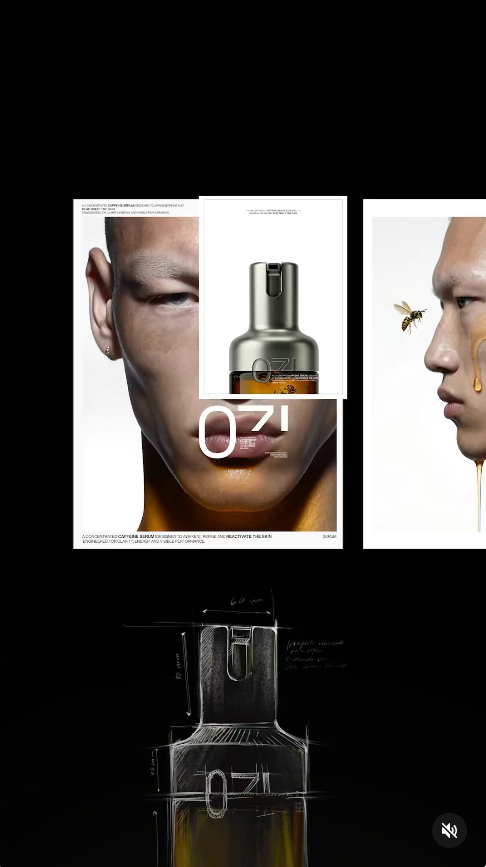
1. Hyper-Stimulation Through Contrast - The reel uses extreme visual contrast, black and white, texture, liquid, skin, to overload attention instantly. This creates a pattern break that forces immediate focus in the first second.
2. Sensory Illusion as Proof - Honey, skin texture, bubbles, and micro details simulate touch and feel, not just visuals. This makes viewers almost “feel” the product, turning passive watching into a sensory experience.
3. Science + Beauty Fusion - Blueprint overlays and ingredient visuals signal scientific credibility while staying aesthetic. This duality builds trust and desire simultaneously, making the product feel both advanced and luxurious.
Turn Products Into Sensory Worlds - Don’t just show your product, build a multi-sensory illusion around it. When viewers feel texture, science, and emotion in seconds, perceived value skyrockets without saying a word.
Thanks for reading this edition! Keep pushing boundaries, testing ideas, and staying inspired. See you in the next edition with more ways to ignite your marketing success. 🥰