Your USP doesn’t matter
🌝Set the narrative so nothing else matters, and you’re the obvious choice, Why Google Ads structure separates 6x ROAS from 2.5x, and more!
Welcome to a space where every edition delivers insights, strategies, and inspiration to fuel your advertising brilliance. 🤯
Together with Share Local Media
What Happens When Premium Brands Share The Mailbox
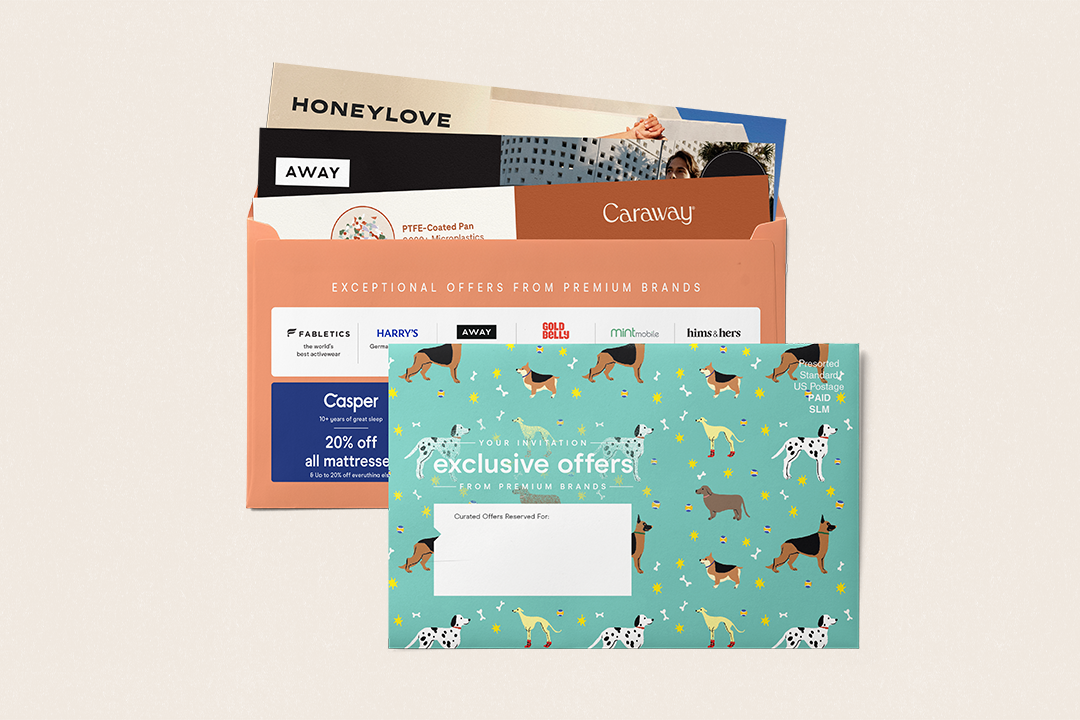
Direct mail continues to be a reliable driver of customer acquisition. But for many brands, getting started can feel complex - long setup timelines, high minimums, and limited flexibility when it comes to testing.
That friction often delays experimentation, even as acquisition costs rise across other channels.
Shared Mail from Share Local Media removes that barrier. Your brand plugs into a premium shared envelope alongside other trusted brands, giving you mass prospecting reach with minimal spend and effort.
No long setup, no operational drag, and no big upfront commitment required. That is why Shared Mail has become an excellent entry point for brands curious about direct mail.Here’s what brands are actually seeing:
- Manscaped achieved 521% ROAS from shared mail prospecting
- DIME Beauty saw $20–$40 CPAs while scaling to 2.8MM circulation, driving 7–9x ROAS
With nearly a billion mailings delivered over the past decade, SLM’s Shared Mail Program is a proven, measurable channel trusted by brands like Away, Joybird, and HelloFresh, at an all-in cost as low as $0.06 per piece.
April Shared Mailings close on 3/2. Secure your spot now!
🔢 The Day Your Best Feature Became a Commodity
At some point in every category, your best feature stops being an advantage and starts being the cost of entry.
You didn’t lose it. It didn’t get worse. Everyone else just caught up.
And when everyone says the same thing, Meta turns it into math.
Here’s what actually happens:
- One brand finds a working angle.
- Others copy it because it converts.
- The claim saturates the feed.
- CTRs normalize.
- CPMs rise because everyone is bidding on the same converting pool.
- Margins compress.
When you run only conversion campaigns, you’re forcing yourself into real-time comparison mode. Every impression is evaluated against competitors making similar claims at the same moment. If the creative feels interchangeable, price becomes the tie-breaker.
And price is a brutal place to compete in a paid auction.
The brands that escape this don’t have better USPs. They reduce direct comparability. They build preference before the auction moment.
That means:
- Creative that isn’t asking for the sale
- POV that reframes the category
- Narrative that makes them the default
- Repetition that builds familiarity before intent exists
By the time the conversion ad appears, the decision isn’t analytical anymore. It’s confirmational. And that changes everything for your metrics.Your best feature didn’t stop working. You just relied on it too late in the funnel.
The question isn’t: “What do we have that competitors don’t?”
It’s: “What must someone already believe about us so price stops being the filter?”
If that belief doesn’t exist before the auction, you’re fighting inside it, and auctions reward sameness with margin compression.
The angle isn’t the problem. The timing of it is. And timing is strategy.
⚡ Why Google Ads structure separates 6x ROAS from 2.5x
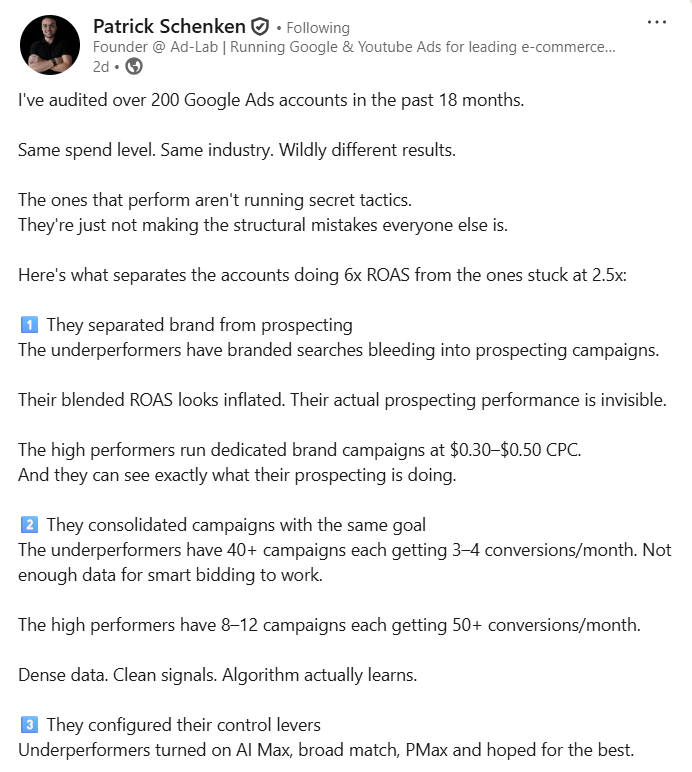
Most underperforming accounts are not underfunded; they are misstructured. Brand and prospecting are blended, data is fragmented across too many campaigns, and AI tools run without guardrails. The winners simply fix architecture before chasing tactics.
Why it works: Separating brand from prospecting reveals true acquisition performance. Consolidating campaigns concentrates conversions so smart bidding actually learns. Clear control levers and intent-based structuring give Google clean signals, which improve optimization efficiency and stabilize ROAS at scale.
Where it needs balance: Over-consolidation can limit testing flexibility and creative variation. Too many restrictions can also choke exploration and block new demand. The goal is structured clarity, not rigidity, clean separation, dense data, and controlled expansion.
🪩Events
🔥 The Creative Playbooks Top Brands Use But Never Publish
Starts March 17 | Tuesdays at 1 PM EST | Virtual Bootcamp
Every brand you admire is running a structured, repeatable creative system behind the scenes, and most marketers never see it. Motion’s free 8-week Creative Strategy Bootcamp pulls back the curtain: real hooks broken down, real angles dissected, real testing cycles mapped out. If you’ve ever wondered how the top 1% consistently produce winners, this is the first time those systems are being taught live.
📊 Where AI Gets Tied to the P&L
March 5 | 11 AM - 6 PM ET | Virtual Event
If AI is not moving revenue or margin, it becomes overhead. Hear Diane Igoche, Director of Agentforce Governance at Salesforce, and Brice Challamel, Head of AI Strategy and Adoption at OpenAI, break down how teams design initiatives that drive adoption and measurable business impact.
🎥 Reel of the Day

What Works:
They Turn a Boring Product Into a Party Accessory - Hand sanitizer is usually practical and forgettable. Here, it’s styled like a cocktail companion, which instantly makes it feel fun instead of functional.
They Borrow From Beauty, Not Health: The hand styling, nails, and glassware make it feel like a beauty campaign. That’s intentional; it shifts the category from necessity to lifestyle.
The Scent Is the Star: “Confetti cake” reframes sanitizer as a treat. It taps into nostalgia and sweetness, which is the opposite of the sterile, clinical vibe people expect.
If your product is dull, re-stage it in a new context. Change the environment, and you change how people value it.
Thanks for reading this edition! Keep pushing boundaries, testing ideas, and staying inspired. See you in the next edition with more ways to ignite your marketing success. 🥰