Liked ads can sell rivals
🎬 An ad people love can still fail if viewers can't say whose ad it was, so test brand recall before you spend, Amazon negative keywords need different levels of control, and more!
Welcome to a space where every edition delivers insights, strategies, and inspiration to fuel your advertising brilliance. 🤯
🎬 Your most-liked ad might be selling for someone else
Creative tests usually ask whether people like an ad. Liking matters, but a second score says more about wasted spend: whether viewers can name the brand afterward.
An ad that's enjoyed and then credited to a competitor, or to nobody, builds the category while you pay for it.
ClickUp tested its Super Bowl ad with more than 5,000 people in under a week before deciding which version to air, and you can run the same kind of check at a fraction of that scale. SurveyMonkey recruits the audience, scores your creative against industry benchmarks and analyzes up to 10 versions at once. You can get started for free.
Set up the test
Show each person one ad only, about 150 people per version. Then ask in this order:
- "What was the main thing this ad was telling you?" (open text)
- Two unrelated questions, as a short distraction
- "Which brand was that ad for?" (open text, no list to pick from)
- "How much did you like the ad?" (five-point scale)
Asking about the brand before liking keeps the answer honest. A pick list would hand people the answer.
Score three numbers
- Linkage: the share who name your brand correctly
- Takeaway: the share whose answer matches your intended message
- Liking: the share in the top two boxes
Read the grid
Plot each ad on liking and linkage.
High liking, high linkage: scale it.
High liking, low linkage: the most expensive pattern, and the most fixable. Show the product or logo in the first three seconds, say the brand name out loud and use your most recognizable visual, such as a signature color or character. Retest the edit.
Low liking, high linkage: it works for people who already know you. Use it in retargeting and test a new opening hook for cold audiences.
Low on both: kill it, however much the team loves it.
Check the takeaway
If fewer than half of viewers name your intended message, rewrite the script before touching visuals. That cutoff is my judgment.
Read benchmarks carefully
Industry benchmarks tell you where an ad sits against the category. Also compare each new ad with your own past winners. An ad that beats the category but trails your best performer still isn't ready.
At 150 per version, two scores need to differ by about 11 points before you trust the gap.
Run your highest-spend ad through the linkage question this week. If fewer than half name your brand, you've found budget to recover.
Together with Omnisend
What Happened to Everyone Who Bought Last Black Friday?
Before you spend more bringing new shoppers in, what happened to the people who bought last Black Friday? Some haven’t returned. Your next campaign could give them a reason to.
Omnisend’s BFCM AI playbook shows you how to turn customer and campaign data into work you can use this season:
- Find past BFCM buyers who haven’t purchased again and build a dedicated audience.
- Identify the offers behind your strongest campaigns to inform this year’s calendar.
- Check welcome and abandoned-cart emails for weak spots before holiday traffic arrives.
With Omnisend connected to Claude or ChatGPT, you can create segments and editable email templates from the conversation. Review them in Omnisend before sending.
The email and SMS platform serves 150,000+ brands, and you can start free without a credit card.
Use the prompts now, while there’s time to address what you find before your busiest selling weekend.
⚡ Amazon negative keywords need different levels of control
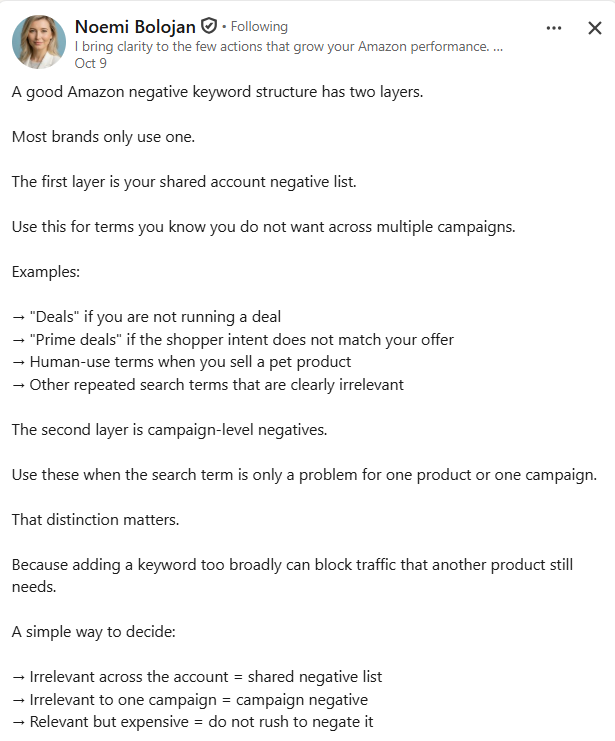
This framework separates negative keywords into shared account-level lists and campaign-specific exclusions. The goal is to eliminate consistently irrelevant searches without accidentally blocking valuable traffic for other products.
Why it works: Shared negative lists reduce repeated irrelevant spend across campaigns, while campaign-level negatives allow more precise control. This helps brands protect relevant search coverage while improving traffic quality and budget efficiency.
Where it needs balance: Expensive or low-converting keywords aren't automatically irrelevant. Some may need bid adjustments, better listings, or more conversion data rather than exclusion. Negative targeting should follow actual search intent and performance, not cost alone.
🎥 Reel of the Day

What Works:
1. Lead With Cuteness - “The sweetest little jewelry storage idea” immediately positions the candy-shaped cases as an adorable discovery. The miniature design creates curiosity before viewers even learn what the product does.
2. Make Small Details Satisfying - Extreme close-ups of the tiny jewelry pieces, clear casing and delicate hand movements make the product visually engaging. The miniature scale encourages viewers to watch closely and appreciate its design.
3. Turn Curiosity Into Comments - The caption asks viewers to comment “CANDY” for the product link, turning interest into a simple action. The keyword CTA creates an opportunity to deliver shopping links directly while encouraging engagement.
For small accessories and Amazon finds, lead with an unexpected design, demonstrate its practical function through satisfying close-ups, and use a simple comment keyword to capture purchase interest.
Advertise with Us
Wanna put out your message in front of over 40,000 best marketers and decision makers?
Thanks for reading this edition! Keep pushing boundaries, testing ideas, and staying inspired. See you in the next edition with more ways to ignite your marketing success. 🥰