Linear still carries reach
📡 A new multiscreen report says linear TV still supplies most unique reach, with streaming filling the gaps around it, Channel expansion should follow operational strength, and more!
Welcome to a space where every edition delivers insights, strategies, and inspiration to fuel your advertising brilliance. 🤯
📡 Linear still brings the reach. budget streaming around it
A cable seller's multiscreen report, released October 1, split the unique reach of combined TV campaigns in the first half of 2026. Linear supplied 71%, streaming added 21%, and only 8% came from households reached by both.
Treat that as a planning shape rather than gospel, because it's one seller's footprint. But it raises a budgeting question that is easy to skip: what does each screen pay for every new household it adds?
Give each screen one job
With so little overlap, linear and streaming mostly reach different homes. So stop briefing them the same way.
- Linear's job: broad reach in the dayparts and networks your buyers already watch.
- Streaming's job: the homes linear misses, such as cord-cutters, light TV viewers and younger households.
- Online video's job: frequency top-ups for people who've already seen a TV spot.
Write one sentence per screen describing who it should reach that the others can't. If two sentences describe the same people, you're double-buying.
Find your real overlap
The 8% is a seller-wide average. Yours depends on your buys.
Pull household-level exposure logs from every streaming partner, match them against linear airings in the same markets and weeks, and count households seen by both.
Your own overlap is the number that matters, and separate seller reports rarely add up to it.
Tatari plans, buys and measures streaming, linear and online video on one platform through direct supply relationships, tying results to actual conversions instead of each vendor's own report. Calm, Ro and Magic Spoon run their TV there, from a self-serve first flight up to nine-figure full-service programs. You can book the demo.
Budget on cost per new household
Cost per thousand impressions hides duplication. Use this instead:
Cost per new household = screen spend ÷ households only that screen reached
Here's a worked example on a $200,000 flight:
- Linear: $120,000 reaching 400,000 households only it touched, so $0.30 each
- Streaming: $80,000 reaching 100,000 households only it touched, so $0.80 each
Streaming costs more per new home here. If those homes convert at a higher rate or skew toward first-time buyers, the premium can pay for itself. If they don't, move budget back toward linear until the two costs line up with what each home is worth to you.
Recalculate after every flight, since the overlap shifts as you add partners.
Pull last quarter's exposure logs this week and work out your cost per new household for each screen.
Together with SurveyMonkey
Make the Next Decision With Real Feedback

You need to know why customers aren’t buying. But commissioning research takes budget, and running it yourself adds work to a team already chasing targets.
SurveyMonkey does the research work for you. You choose what to test and who to reach. It recruits respondents through its paid panel and analyzes their answers, giving you findings to guide your next decision.
Here’s what that looks like:
- Tweezerman validated 10 product ideas with SurveyMonkey Audience, gathering consumer feedback in days to guide product launches.
- Greyhound reduced weekly customer-feedback analysis from 3 hours to 3 minutes, freeing station managers to act on the findings.
- Helix Sleep cut product-development time by 50% using survey insights. Its resulting pillow sold out in the first month.
Put your next product idea or pricing decision through customer research. You’ll have evidence to decide what needs changing before committing to the rollout.
⚡ Channel expansion should follow operational strength
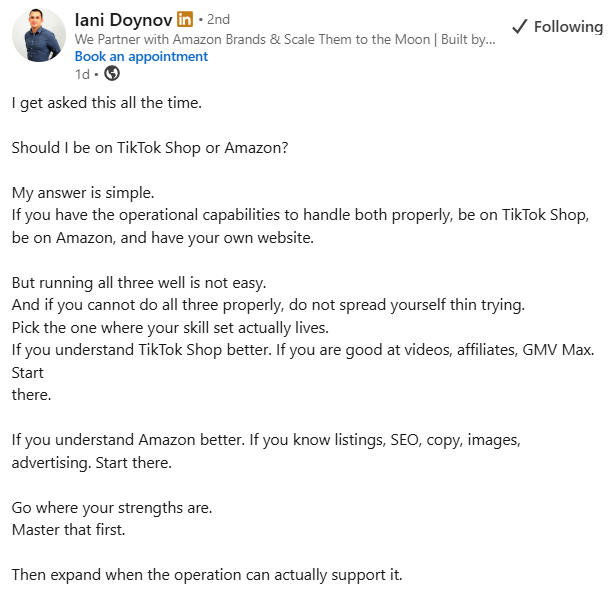
This framework argues that brands don't necessarily need to choose permanently between TikTok Shop, Amazon, and their own website. The better starting point is whichever channel best matches the team’s existing skills and can be executed properly.
Why it works: Each platform requires different capabilities. TikTok Shop rewards content, affiliates, and social commerce execution, while Amazon demands strong listings, search optimization, advertising, and marketplace management. Focus allows teams to build competence before adding complexity.
Where it needs balance: Existing strengths shouldn't be the only factor deciding channel strategy. Customer behavior, margins, category fit, competition, and channel economics also matter. Sometimes the biggest opportunity may justify developing capabilities the team doesn't currently have.
🎥 Reel of the Day

What Works:
1. Make the Product the Entire Day - Instead of one try-on, the creator wears four different Aerie looks across different moments of the day. It demonstrates wardrobe versatility while keeping the partnership lifestyle-first.
2. Show Clothes in Context - Coffee at home, heading outside and changing outfits makes each piece feel naturally integrated into an actual routine. Viewers see how the clothes fit into everyday life, not just how they photograph.
3. Keep the Partnership Creator-Led - The casual apartment shots, coffee moments and personal styling make the paid partnership resemble the creator’s normal “everything I wore today” content, rather than a traditional fashion ad.
For apparel partnerships, build the Reel around “everything I wore today” and show multiple products in real situations, with sizing on screen so viewers can judge both styling and fit.
Advertise with Us
Wanna put out your message in front of over 40,000 best marketers and decision makers?
Thanks for reading this edition! Keep pushing boundaries, testing ideas, and staying inspired. See you in the next edition with more ways to ignite your marketing success. 🥰