One Number Two Problems
🫣 Your repeat purchase rate is one number hiding two different problems, and most brands are fixing the wrong one, TikTok Shop brands often sample too heavily for too long unnecessarily, and more!
Welcome to a space where every edition delivers insights, strategies, and inspiration to fuel your advertising brilliance. 🤯
Together with Pounce
Your ads are being mislabeled. And you'd never know.
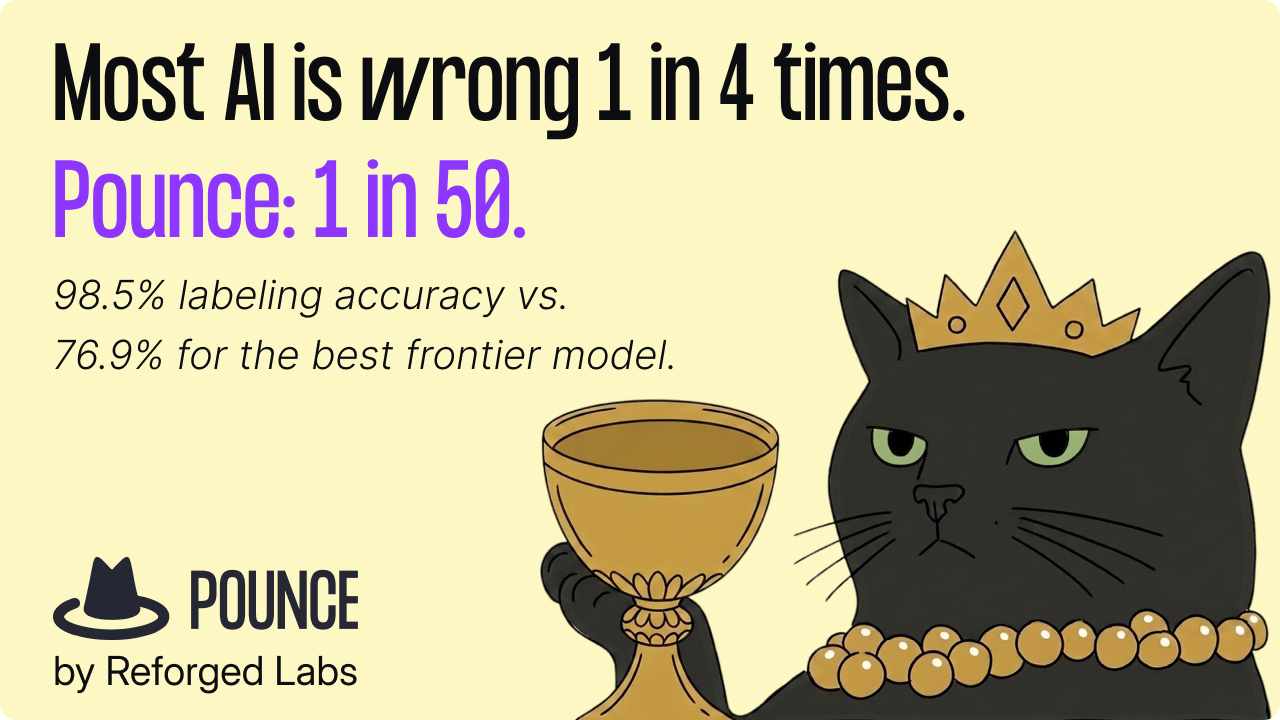
When AI mislabels your creative, it reads a humor angle as emotional, a gameplay hook as a tutorial. Your analytics treats those as real signals. Everything built on top is off.
Wrong patterns. Wrong briefs. The budget behind ads that were never working.
Pounce uses real human judgment baked into every label. 98.5% accuracy on the April 2026 Mobile Gaming Video Ads Understanding Benchmark, versus 76.9% for the best frontier model.
From there, Pounce runs your creative strategy, brief generation, competitor intelligence, and performance optimization autonomously. The work a full performance team does, without the headcount.
This intelligence was built for Supercell, Wildlife Studios, and DeNA. Studios. 4 in 5 ads beat control, and it takes 80% less time on creative research.
Pounce is the first time that the same system is available to any brand that runs ads.
Get started for free with Pounce today.
🫣One Number Two Problems
The repeat purchase rate on your dashboard collapses two completely different metrics into one. First-to-second purchase rate measures whether your activation is working. Second-to-third purchase rate measures whether your retention is working.
These are different problems with different fixes, and most brands treat them as the same problem because the dashboard never separates them. The result is retention investment going to the wrong stage, and the actual leak compounds untouched.
Decompose Your Repeat Rate Into Two Distinct Metrics
Pull the last 12 months of order data and calculate two numbers separately.
- First-to-second: of all customers who placed a first order, what percentage placed a second order within 90 days?
- Second-to-third: of customers who placed a second order, what percentage placed a third order within 90 days? The two numbers look superficially similar but tell completely different stories.
A healthy DTC brand typically sees first-to-second at 25-35% and second-to-third at 50-65%. The gap matters as much as either number on its own.
Read The Gap To Diagnose Which Problem You Have
If first-to-second is low but second-to-third is healthy, you have an activation problem. Customers who get past the first repeat are loyal, but most don't get past it because the activation experience is failing.
If first-to-second is healthy but second-to-third is low, you have a retention problem. Customers are activating but not building habit, which usually means the product experience or the value-over-time is breaking down somewhere between the second and third use.
If both are low, you have an acquisition quality problem. The customers coming in aren't the right fit for the product, and no amount of activation or retention investment will save them.
Direct Retention Investment To The Stage That's Actually Broken
The wrong fix for an activation problem is a loyalty program. The wrong fix for a retention problem is post-purchase email tuning. The wrong fix for an acquisition quality problem is anything downstream of acquisition.
Match the investment to the diagnosis. Activation problems get post-purchase sequence work. Retention problems get product experience and value-add work. Acquisition quality problems get sent back upstream to creative and targeting.
One number is hiding three different problems. The decomposition is the diagnostic.
⚡TikTok Shop Sampling Works Best in Waves, Not Permanently
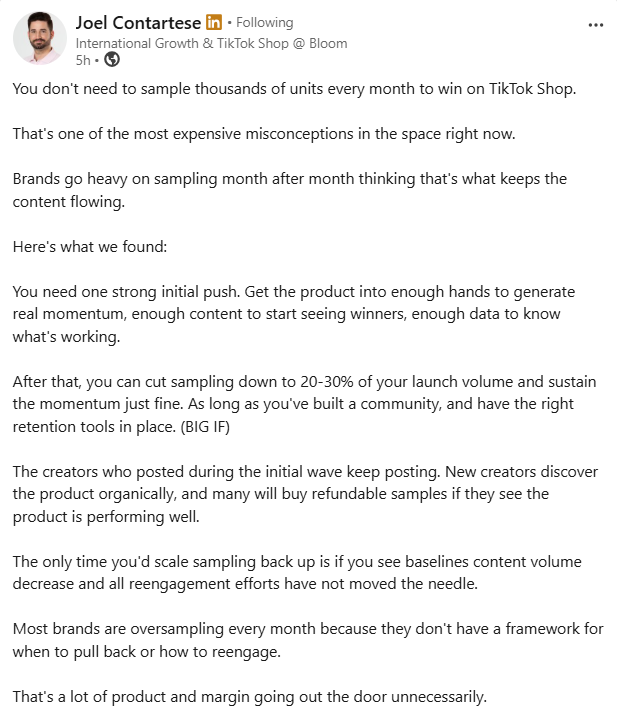
This strategy argues that most brands overspend on continuous product sampling. Instead of maintaining heavy monthly seeding, the goal is to create a strong initial content wave, then sustain momentum with lighter sampling and creator retention systems. Sampling becomes a scaling lever, not a permanent operating model.
Why it works: A large initial push creates enough content, data, and social proof for organic momentum to take over. Once creators and buyers validate the product publicly, additional creator participation becomes easier and cheaper.
Where it needs balance: Reducing sampling too early can slow content velocity and discovery. Some categories require constant creator refreshes to maintain relevance. Success depends heavily on product quality, creator relationships, and retention infrastructure.
Together with The Shift
Stop googling AI tools at midnight.
There are over 3,000 of them in The Shift’s vault, already vetted, ready to explore.
Subscribe and get instant access to the tool vault, a 500+ prompt library, and free AI courses built for people with actual work to do.
Plus, the daily newsletter that keeps you sharp on everything moving in AI in under 5 minutes a day.
They’re also giving away a free 1-year Claude Pro subscription to 3 subscribers.
Subscribe for free to enter. All free. All in one place.
🎥 Reel of the Day

What Works:
Pattern Interrupt Hook Architecture - Opening with abandoned cash instantly hijacks viewer attention because audiences subconsciously anticipate theft, scams, or confrontation before narrative resolution appears completely.
Forced Hospitality Exaggeration - Instead of politely upselling products, the brand hyperbolizes hospitality into comedic “kidnapping,” creating memorable absurdity that differentiates instantly from standard restaurant content.
Hospitality Funnel Gamification - The reel turns customer acquisition into a game mechanic. Picking up money unknowingly activates entry into the restaurant’s comedic conversion funnel instantly.
The future of hospitality marketing belongs to brands engineering “watchable scenarios,” not brands endlessly filming aesthetic drinks, interiors, or transactional customer moments.
Advertise with Us
Wanna put out your message in front of over 40,000 best marketers and decision makers?
Thanks for reading this edition! Keep pushing boundaries, testing ideas, and staying inspired. See you in the next edition with more ways to ignite your marketing success. 🥰