Find your discount-only buyers
🏷️ Some customers only ever buy on sale while others never wait for one, and your BFCM emails should treat them differently, Amazon promotions should match category demand, and more!
Welcome to a space where every edition delivers insights, strategies, and inspiration to fuel your advertising brilliance. 🤯
Together with AirOps
Getting cited by AI is not the finish line. Getting chosen is.

Most teams now track citations like a rankings report. But a citation is a mention, and a mention does not build a pipeline.
Buyers use AI to research, shortlist, and decide, so the brands that win give them a reason to pick them.
Three recent AirOps Growth Leader webinars point to the same shift.
- Kevin Indig’s data shows that ranking #1 for your key fan-out queries earns 58% of citations, four times more than rank #10.
- Ross Simmonds found that Google’s AI surfaces lean on Reddit and YouTube, while the assistants favor off-site product and comparison pages.
- Eli Schwartz argues that every asset still needs a conversion path.
You’ll leave with practical tips on which pages to prioritize and how to give AI-referred buyers a clear next step.
Read the full takeaways to see where your content and off-site effort should go next.
🏷️ Separate the customers who wait for sales from the ones who never do
Every list holds two very different kinds of buyers. One group only purchases when there's a discount. The other buys at full price whenever it needs something.
Send both the same Black Friday email, and you train the second group to wait, while giving the first group exactly what it was going to buy anyway.
Step 1: Score discount dependence
For each customer with at least two orders, calculate:
Discount share = orders with a discount code or sale item ÷ total orders
Then sort into three groups:
- Deal-driven: above 80%
- Mixed: 30% to 80%
- Full-price: below 30%
Those cutoffs are my judgment.
Step 2: Give each group a different BFCM
Deal-driven buyers get your sale, clearly and early in the week. They're waiting for it, and they're the group most likely to buy on day one.
Mixed buyers get the standard sale sequence.
Full-price buyers get something other than a price cut: first access to limited stock, a gift with purchase or a bundle sold only by email. They were never price-sensitive, so a percentage off mostly gives away margin.
Agency Enflow Digital built its BFCM plan for a skincare client the same way, starting from purchase behavior. Using Omnisend's segmentation and AI connection to read order patterns in minutes, the team sent one plain-text, email-only offer to customers with four or more orders, combining a gift with a spend threshold.
Those 1,676 emails produced nearly $18,000, more than the previous month's broad-audience campaigns combined. You can read or watch how they did it.
Step 3: Watch the full-price group after the sale
The real test comes in January. If full-price buyers who received the deep discount start waiting for promotions, their discount share will rise in the following months. Track it monthly for the group.
Step 4: Size the margin at stake
Say your full-price group places 2,000 orders during BFCM week with an $80 average. A 25% discount on those orders costs $40,000 in margin. Giving a $12 gift instead costs $24,000, saving $16,000 while still rewarding them. These figures are illustrative.
Step 5: Keep the groups fresh
Recalculate discount share each quarter. People move between groups, especially new customers after their second or third order.
Omnisend is an email and SMS platform for ecommerce used by more than 150,000 brands, generating an average of $79 for every $1 spent. Migration is free and takes up to five business days. You can check out Omnisend here.
Today
Pull order history and calculate discount share for every repeat customer. The full-price group is the one to protect this Black Friday.
⚡Amazon promotions should match category demand
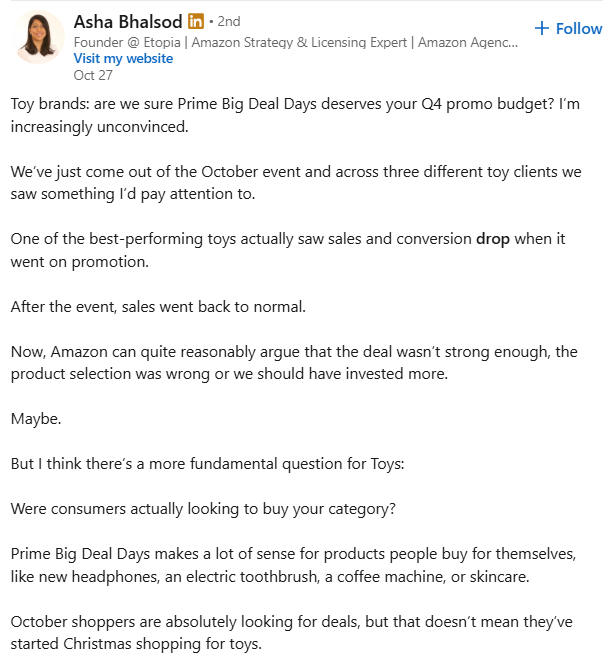
This framework questions whether Prime Big Deal Days is the right promotional window for toy brands. Strong deal-seeking activity doesn't necessarily translate into toy purchases if shoppers haven't started their holiday gift shopping.
Why it works: Aligning promotions with actual buying intent helps brands avoid spending heavily during low-demand periods. Comparing October event performance with Prime Day and BFCM can reveal when discounts and advertising budgets generate the strongest returns.
Where it needs balance: Results from three toy brands aren't enough to establish a category-wide trend. Product selection, discount depth, competition, and promotional visibility can influence performance. Brands should evaluate incremental sales, contribution margin, and historical demand before shifting budgets away from October events.
Together with Omnisend
Imagine beating a month’s email revenue with one send
You’d probably double-check the numbers.
Enflow Digital did exactly that for a skincare client ahead of BFCM. One plain-text email sent through Omnisend to 1,676 recipients generated nearly $18,000, beating the previous month’s broad-audience campaigns combined.
Omnisend helped the team find the right customers to send it to. Its segmentation and MCP capabilities let them uncover purchase patterns in minutes.
Co-founder Karolina shares how they pulled it off with Omnisend, from choosing the audience to making the offer worth opening. Worth a read (or a watch) before you hit send on your own BFCM campaigns.
New to Omnisend? It's an email and SMS marketing platform for ecommerce used by more than 150,000 brands, generating an average of $79 for every $1 spent. Migration is free and takes up to five business days.
🎥 Reel of the Day

What Works:
1. Problem vs. Solution Hook - The reel opens with an uncomfortable sleeping position, then reveals a cozy car pillow setup. This immediate before-and-after contrast makes the product’s value obvious without lengthy explanations.
2. Visual Transformation Drives Retention - The transition from struggling to sleep to relaxing comfortably creates a satisfying payoff. Viewers stay to see how the problem gets solved, making the demonstration both engaging and persuasive.
3. Tagging and Comment Conversion - “Tag your driver” encourages viewers to share the reel with someone they travel with, while commenting “HUG” creates a direct path to product discovery. The visible 190K+ likes suggest strong audience interest.
Show a relatable everyday discomfort, then deliver an exaggeratedly satisfying transformation. Let the visual contrast sell the benefit and use a natural tagging prompt to encourage sharing.
Advertise with Us
Wanna put out your message in front of over 40,000 best marketers and decision makers?
Thanks for reading this edition! Keep pushing boundaries, testing ideas, and staying inspired. See you in the next edition with more ways to ignite your marketing success. 🥰