Safari blocks email-based tracking
🧭 Apple's next Safari blocks third parties that turn email addresses into tracking IDs, so audit which tools in your stack do that, TikTok can create demand that Amazon converts, and more!
Welcome to a space where every edition delivers insights, strategies, and inspiration to fuel your advertising brilliance. 🤯
🧭 Safari 27 blocks email-based tracking ids. audit your stack before it ships
On October 19, Apple's WebKit team published a post titled "Blocking Identity Resolution Infrastructure." According to coverage from PPC Land, Safari and WebKit in iOS, iPadOS, macOS and visionOS 27 will block network access to third parties that collect email addresses at login or newsletter signup and turn them into persistent tracking IDs.
The block works at the domain level, so the email address is never sent and no ID is created. WebKit hasn't published the list of affected domains.
For stores that rely on email-based identity to retarget or measure shoppers across sites, that's a change to plan around.
What WebKit says it targets
Third-party "identity resolution" services: tools that take an email from a signup form and match it to a profile used for tracking across sites.
WebKit also says first-party personalization is not what it aims to prevent. Using a customer's email inside your own store, such as for order history or your own email program, is a different thing.
What's still unclear
According to the same coverage, WebKit doesn't name companies, doesn't say how domains are chosen and doesn't mention major ad platforms' own pixels. It also says a central resolver remains a third party even if it only handles one company's data, and that moving the call to a server doesn't change that status.
Step 1: List every tool that sees signup emails
Open your site's signup form and checkout, and list every script that loads there. Mark any tool that receives the email address, other than your own email platform and order system.
Step 2: Ask each vendor directly
For each one, ask: "Do you convert email addresses into an identifier used across other sites?" If the answer is yes, ask what happens in Safari 27.
Step 3: Size your Safari exposure
Check what share of your sessions and revenue come from Safari. For many stores with mobile-heavy traffic, that share is large. The bigger it is, the more this matters.
Step 4: Lean on what you own
Your email list, purchase history and logged-in customer accounts are first-party data. Encourage account creation with useful perks, such as order tracking and saved sizes, so more shoppers are known to you directly.
Step 5: Watch the numbers after release
Once Safari 27 ships, compare match rates, retargeting audience sizes and attributed conversions for Safari users against other browsers.
List every third-party script on your signup form. Any tool you can't explain is the first one to ask about.
Together with Omnisend
One Plain-Text Email Outearned a Month of Campaigns
Before you send everyone the same BFCM discount, check who keeps coming back. Your repeat buyers could justify an offer of their own.
For one skincare brand, 36% of customers had ordered more than six times. Enflow Digital used Omnisend to turn that loyalty into nearly $18,000 from one plain-text email.
Omnisend helped the team:
- Find purchase patterns in minutes, cutting out hours of manual analysis.
- Build a VIP audience of customers with four or more orders, ready for a separate promotion.
- Keep the VIP offer focused on engaged buyers by filtering out contacts inactive for 180 days.
The offer was available only through email: a higher discount plus a gift above a higher spend threshold. It increased order value while helping clear slower-selling stock.
Co-founder Karolina shares how it came together so you can apply the approach to your own repeat buyers before your BFCM offers are locked in.
⚡TikTok can create demand that Amazon converts
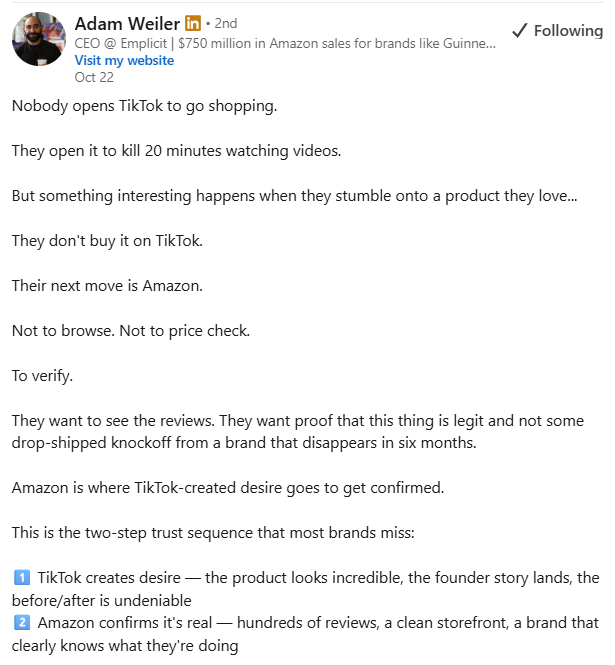
This framework positions TikTok as a discovery channel and Amazon as a place where shoppers validate purchase decisions. Content generates interest, while Amazon reviews, listings, and brand presence can help turn that interest into sales.
Why it works: Shoppers exposed to products on social media may search for additional proof before purchasing. A strong Amazon presence captures that existing intent, builds credibility through reviews, and reduces the risk of losing interested buyers to competitors.
Where it needs balance: Not every TikTok shopper moves to Amazon. Many purchase directly through TikTok Shop or a brand's website. Amazon also introduces fees and potential channel conflicts. Brands should measure cross-channel demand and profitability before assuming marketplace expansion is necessary.
🎥 Reel of the Day

What Works:
1. Curiosity Drives Millions - The reel asks viewers to identify which drink is matcha without revealing the answer. This simple guessing game creates an immediate curiosity gap that encourages viewers to watch, speculate, and comment.
2. Comments Become Content - The caption asks viewers to leave their best guess, while competing answers spark discussions. Every viewer has an opinion, making participation effortless and helping generate engagement without complicated prompts.
3. The Unfinished Story - By withholding the answer until the next reel, Jack's turns a single guessing game into a two-part experience. Viewers have a reason to return, follow, and check whether their prediction was correct.
Turn an ordinary product demonstration into a guessing game, remove an obvious visual clue, and reveal the answer in a follow-up reel. Make participation effortless and curiosity strong enough to bring viewers back.
Advertise with Us
Wanna put out your message in front of over 40,000 best marketers and decision makers?
Thanks for reading this edition! Keep pushing boundaries, testing ideas, and staying inspired. See you in the next edition with more ways to ignite your marketing success. 🥰