Know when meta is actually maxed out
👀Four Signals That Tell You a Meta Ceiling Is Real, Not a Fixable Problem, and more!
Welcome to a space where every edition delivers insights, strategies, and inspiration to fuel your advertising brilliance. 🤯
👀Four Signals That Tell You a Meta Ceiling Is Real, Not a Fixable Problem
Across 230+ brands tracked from February 2024 to April 2026, average Meta acquisition ROAS fell from 2.57x to 1.56x, a 39% decline, while CAC climbed from $40.27 to $52.86, a 31% increase. Some of that is a fixable account problem. Some of it is a structural ceiling no amount of optimization removes. Telling the two apart is the actual skill.
Prospecting frequency above 3.0. Meta's own delivery data treats frequency above 3.0 on cold audiences as saturation, the algorithm running out of new people to show the ad to profitably. Below that threshold with rising CAC, the problem is usually creative or offer. At or above it, more spend just buys repeated impressions to the same shrinking pool.
CPM rising more than 25% week over week with no creative change. A CPM spike tied to a fresh creative launch is normal auction behavior. A CPM spike with nothing new in the account is the auction itself getting more expensive, industry-wide CPMs now sit roughly 89% above 2020 levels, and no account-level fix reverses a market-wide shift.
ROAS declining for three or more consecutive days despite adequate volume. Below 50 purchase events a week, Meta's algorithm can't optimize reliably, so a decline there is a data problem, not a ceiling. Above that threshold, a sustained multi-day decline with stable spend is the real signal.
Blended CAC rising even as Meta-reported ROAS holds steady. Platform-reported ROAS consistently over-attributes conversions that would have happened anyway. When the account's own dashboard looks fine but blended CAC across all channels is climbing, the ceiling is real even if Meta's own reporting hasn't caught up to it yet.
Two or more of these signals present at once means the ceiling isn't a Meta problem to solve inside Meta. It's a channel-concentration problem, and the fix is a channel most competitors haven't fully tapped yet.
Tatari runs linear TV, streaming, and direct publisher buys from one platform, with every dollar tied to actual site visits, signups, and revenue instead of impressions that look good and prove nothing. Aroma360 cut CPA by 80% and doubled ROAS from a $14K linear pilot; Fiverr slashed CAC 75% retargeting streaming viewers. You can book a free demo and get a launch-ready TV plan built around your numbers.
Together with AirOps
You're Still Fighting for Rank 1. That Fight Ended.
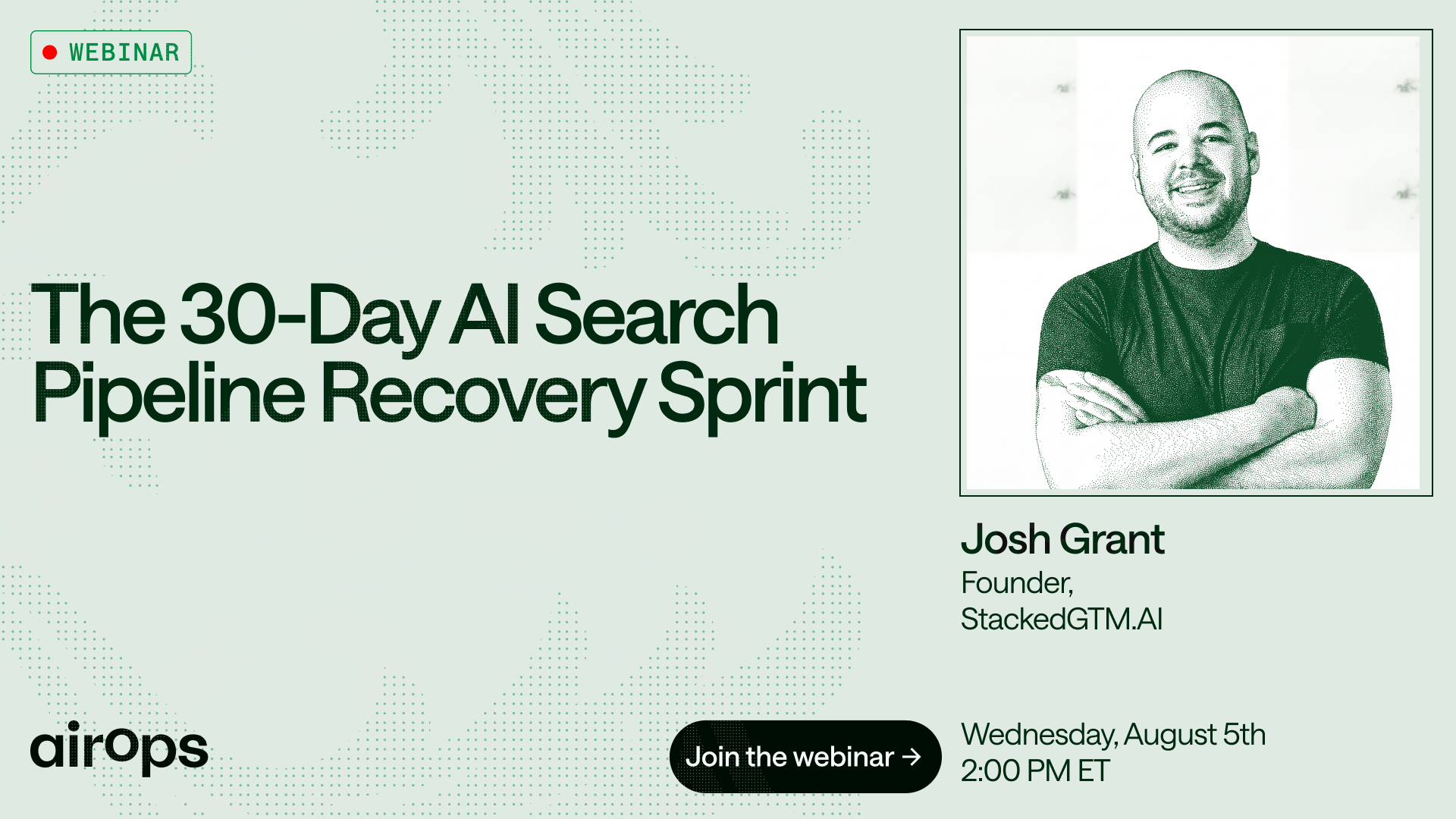
Buyers ask ChatGPT before they ever hit your site. If it can't find you there, you don't exist to them.
This isn't a future-proofing project. It's one live session that hands you a 30-day plan to run the next month, and Josh Grant (founder of StackedGTM, former VP of Growth at Webflow) walks through exactly how on August 5 at 2pm ET.
- Take home the exact changes that make your comparison pages the ones AI quotes
- Get a checklist for making your pricing page the one AI trusts enough to cite word for word
- Leave with a measurement framework that finally shows leadership what AI search is worth
Run your own pages through Josh's AEO framework live, and leave knowing precisely why AI is or isn't citing you.
Can't make it live? Register anyway and get the recording in your inbox within 24 hours.
⚡ Sometimes ROAS Drops Because the Account Structure Breaks
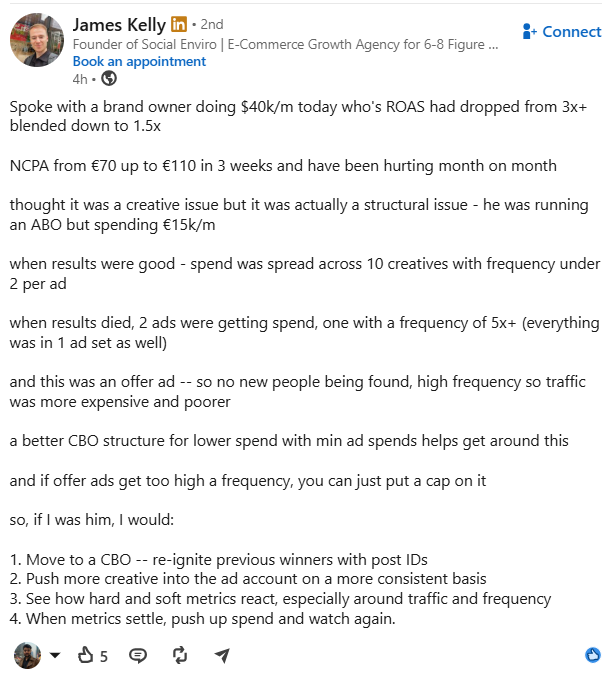
This framework argues that declining ad performance isn't always caused by weak creatives. As budgets grow, campaign structure can become the bottleneck, concentrating spend into a few ads, increasing frequency, and reducing the platform's ability to find new customers efficiently.
Why it works: Using a campaign structure that distributes budget effectively, reintroducing proven creatives, and consistently adding fresh assets helps control frequency and maintain audience reach. Monitoring both delivery metrics and business outcomes enables more informed scaling decisions.
Where it needs balance: Campaign structure is only one part of the equation. Creative quality, audience saturation, offer strength, seasonality, and market demand can all contribute to performance declines. The best approach is to diagnose multiple variables before making structural changes.
🎥 Reel of the Day
What Works:
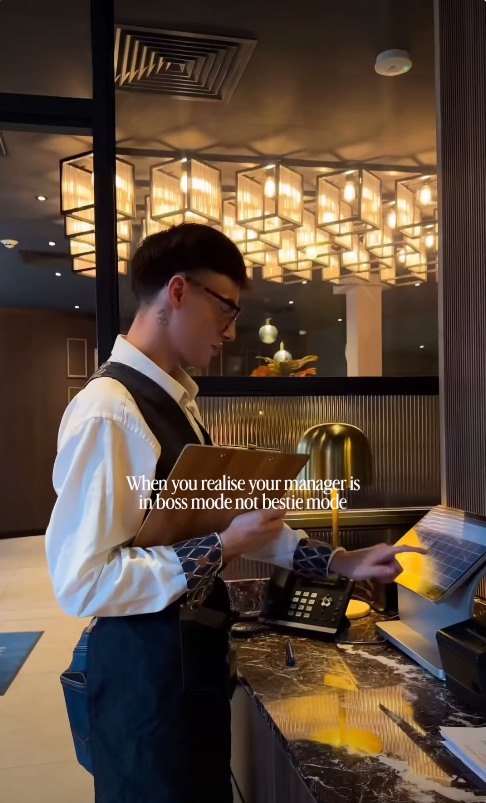
Instant Relatable Hook - The text hook lands immediately because every hospitality worker recognizes the situation. Zero setup is needed, so viewers instantly project themselves into the joke and keep watching.
Visual Punchline Timing - The sprint toward the manager followed by the deadpan stare delivers the punchline in seconds. The quick payoff creates a high completion rate because there's no wasted motion.
Employee Personality Wins - Instead of promoting the venue directly, the brand showcases staff humor and workplace culture. That human-first approach feels native to Instagram and makes the business more memorable than a polished ad.
Turn everyday employee moments into short skits using trending workplace scenarios. They're inexpensive to produce, highly shareable among coworkers, and subtly build employer and customer affinity simultaneously.
Advertise with Us
Wanna put out your message in front of over 40,000 best marketers and decision makers?
Thanks for reading this edition! Keep pushing boundaries, testing ideas, and staying inspired. See you in the next edition with more ways to ignite your marketing success. 🥰