You're overpaying for exclusivity
🔒 Exclusivity carries a 30-50% price premium. Most brands default to blanket terms without checking if narrower, cheaper protection would cover it, Competitor keywords can be expensive amazon traffic, and more!
Welcome to a space where every edition delivers insights, strategies, and inspiration to fuel your advertising brilliance. 🤯
🔒 You're probably paying a 30% premium for exclusivity you don't need
Exclusivity clauses carry a real, quantifiable price: deals that block a creator from working with competitors tend to pay 30 to 50% more than the same deal without that restriction.
That premium is the creator being compensated for real lost opportunity, and it's reasonable when a brand genuinely needs that protection.
The problem is how often exclusivity gets written into a deal by default, at whatever scope a contract template specifies, without anyone on the brand side asking whether the actual business need justifies the premium at all.
Most exclusivity clauses default to broad terms, blocking a creator from an entire category or a full account, when the brand's actual concern is usually much narrower, typically a handful of direct competitors, not every adjacent brand in the space.
Paying the 30 to 50% premium for blanket protection when category-specific or named-competitor exclusivity would fully cover the real risk is money spent on protection the deal never needed.
Define the actual competitive threat before defaulting to broad exclusivity
Broad exclusivity language is easy to write and expensive to pay for, and most contracts default to it simply because nobody stopped to define the narrower scope that would genuinely protect the brand's real interest.
Before the next creator negotiation, name the specific competitors or narrow category you actually need protection from, rather than accepting a template's default blanket exclusivity language. A named-competitor or tight category restriction is usually far cheaper than a full-account block and covers the actual risk just as completely.
Calculate what the premium is actually buying across your current roster
A brand running exclusivity clauses across a full roster of creators is paying that 30 to 50% premium repeatedly, and the aggregate cost across a roster is worth seeing as one number rather than absorbed silently into each individual deal.
Pull your current creator agreements and total the estimated premium being paid for exclusivity terms, then compare it against what the same protection would cost scoped more narrowly.
The gap is real budget either protecting something worth protecting or sitting unexamined in a template nobody revisited.
Negotiate exclusivity scope as its own line item, not an afterthought bundled into rate
Treating exclusivity as a fixed part of "the deal" rather than a specific, priced term makes it harder to negotiate down to what's actually needed, since it never gets isolated as its own decision.
Building that kind of deliberate, scoped negotiation into a creator program at roster scale, rather than accepting default contract terms deal by deal, is part of what Insense helps ecommerce brands scaling past $2M execute, trusted by Il Makiage, Quince, Huda Beauty, and Monster Energy. You can book a free strategy call to map creator availability in your niche and get $200 toward your first campaign.
Exclusivity is worth paying for when it protects something real. It's an expensive default when nobody checked whether it needed to be there at all.
Together with AirOps
How Stripe and OpenAI Built Marketing From Scratch
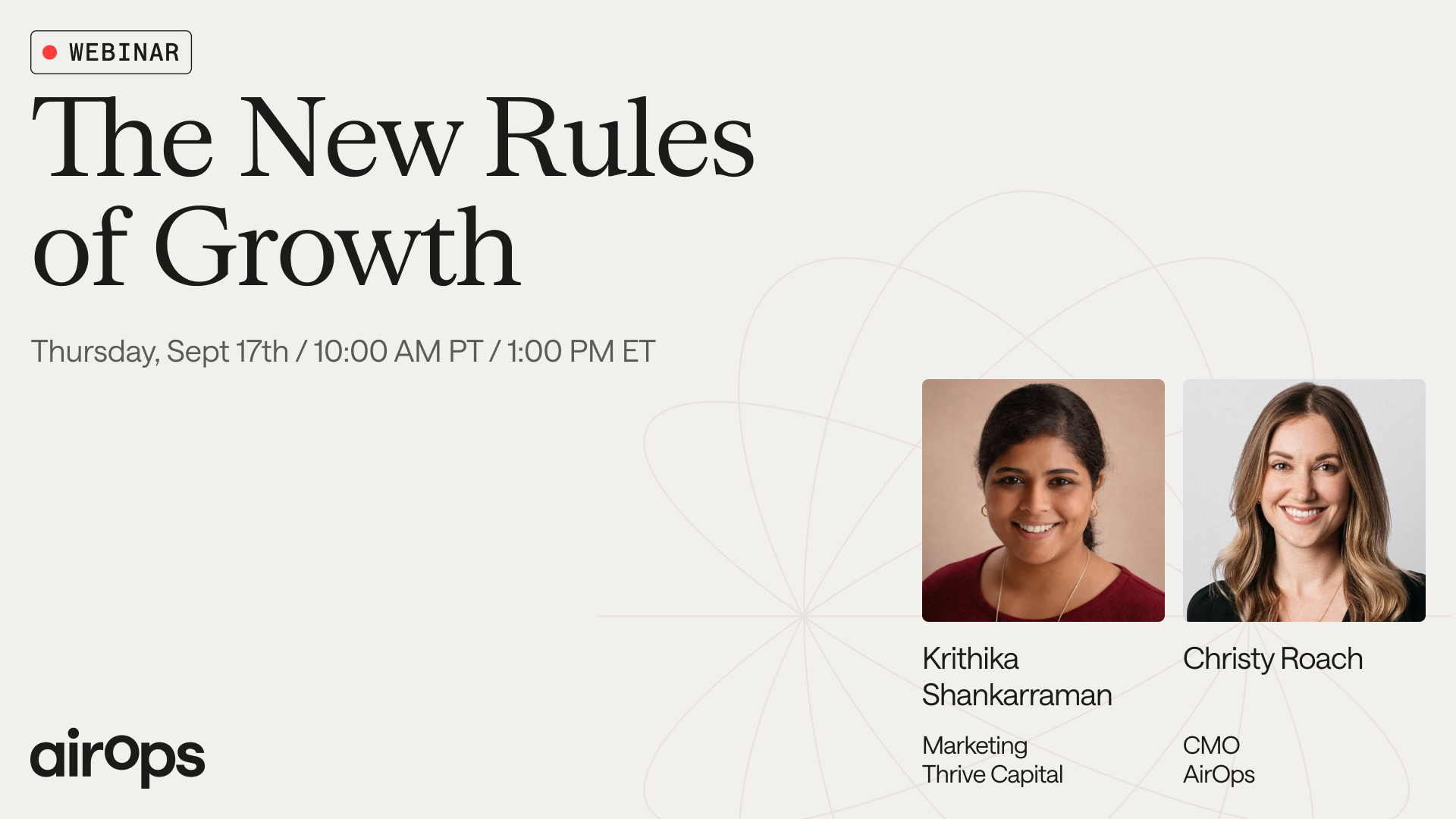
Higher growth targets are landing on teams that already feel stretched. Without sharper priorities and reporting, every new request creates pressure without improving performance.
On September 17 join AirOps CMO Christy Roach and Krithika Shankarraman to show how faster-growing marketing teams operate, using findings from 300+ marketing leaders.
You’ll learn how to:
- Prioritize your biggest growth constraints without letting reactive work take over
- Report performance clearly and build leadership confidence in channels like AI Search
- Align with the wider business so promising marketing investments move faster
Krithika was the first marketing hire at Stripe and OpenAI. Christy’s experience spans AirOps, AssemblyAI, Airtable, Asana, and Gusto.
You’ll walk away with operating principles you can immediately use to tighten priorities and make clearer investment decisions.
Can't attend the session live? Register anyway, and you’ll get the recording in 24 hours.
⚡ Competitor keywords can be expensive amazon traffic
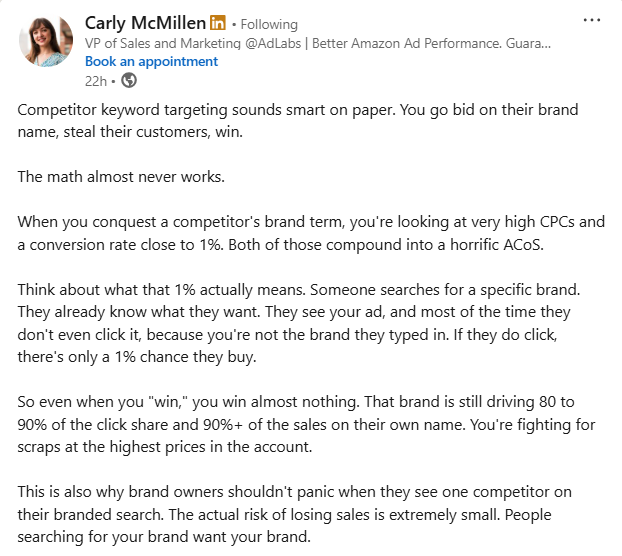
This framework argues that bidding directly on competitor brand terms often produces poor economics. Shoppers searching a specific brand already have strong purchase intent, making them harder and more expensive to convert to an alternative.
Why it works: Competitor product targeting can capture shoppers evaluating specific ASINs while also exposing your product across broader non-branded searches those products rank for. This can create more useful conquest opportunities without relying entirely on expensive branded auctions.
Where it needs balance: Competitor keyword targeting isn't universally unprofitable. Strong differentiation, aggressive pricing, or high customer value can make conquesting worthwhile. The decision should follow actual CPC, conversion rate, and incremental sales data rather than assuming competitor terms should always be avoided.
🎥 Reel of the Day
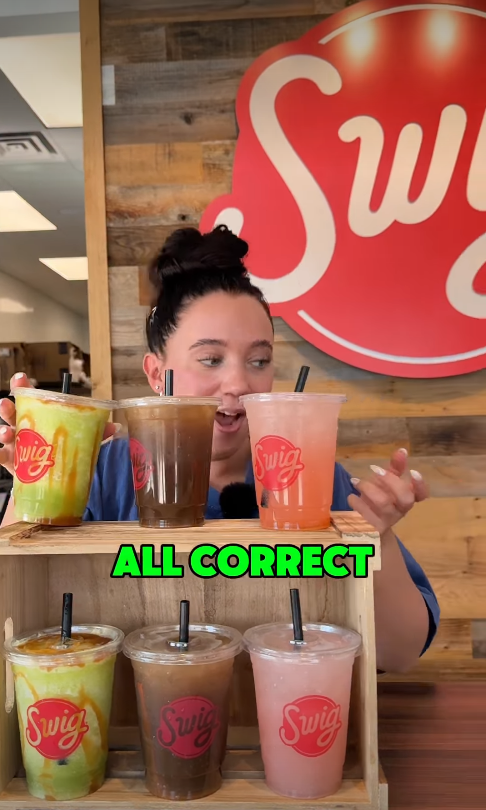
What Works:
1. Turn Products Into A Game - Instead of simply introducing drinks, Swig turns flavor discovery into a matching challenge. Viewers understand the rules instantly and naturally start guessing alongside each participant.
2. Make Packaging Unmissable - Six colorful drinks dominate nearly every frame while the oversized Swig logo anchors the background. The products get constant exposure without interrupting the entertainment for dedicated beauty shots.
3. Engineer Comments Into The Concept - “Who do you think’s winning this time?” extends the competition beyond the video. Because viewers can play along, compare scores and pick contestants, engagement feels native rather than explicitly requested.
When showcasing multiple products, create one simple challenge that forces people to compare them repeatedly. The audience learns the range while watching for scores, mistakes and reactions instead of sitting through a product demo.
Advertise with Us
Wanna put out your message in front of over 40,000 best marketers and decision makers?
Thanks for reading this edition! Keep pushing boundaries, testing ideas, and staying inspired. See you in the next edition with more ways to ignite your marketing success. 🥰