Google dropped the 50 rule
📉 Google no longer cites 50 conversions for bid learning, so the clock that matters now is your own conversion cycle, Revenue growth can hide zero contribution profit, and more!
Welcome to a space where every edition delivers insights, strategies, and inspiration to fuel your advertising brilliance. 🤯
📉 Stop Counting to 50. Start Timing Your Conversion Cycle
On October 4, PPC watchers spotted a quiet edit to Google's help page on the bid strategy learning period. The old line about needing up to 50 conversion events is gone.
The page now says it "can take a few conversion cycles (1-2 typically)" for a strategy to calibrate. A conversion cycle is the time between a click and the purchase it leads to.
That sounds minor, but it rewires how you should judge every campaign this quarter.
"Don't judge a campaign until it hits 50 conversions."
Reality: Google now measures calibration in time, through your own buying lag.
Fix: Find that lag before you judge anything.
- In Google Ads, segment conversions by Days to conversion for the last 90 days.
- Find the day by which roughly 80% of conversions have landed. That's your working cycle, by my judgment.
- Double it. That's your minimum window before calling a result.
A skincare brand might find 3 days and judge after a week. A sofa brand might find 19 days and need closer to six weeks.
"Small tweaks don't reset anything."
Reality: Google lists setting changes and composition changes as learning triggers. Composition means adding or removing campaigns, ad groups or keywords.
Fix: Run a change freeze around peak days.
- Batch edits into one weekly window instead of daily nudges.
- Count back two cycles from Black Friday, November 27. With a 6-day cycle, your last structural change lands around November 15.
- Leave October deal days alone too. Edits made mid-event restart learning when traffic is most valuable.
"Low-volume accounts are stuck in learning forever."
Reality: Google says conversion data from previous campaigns can speed up the learning period.
Fix: Protect your history instead of restarting it.
If a campaign is underperforming, edit it in place rather than launching a fresh copy, so it keeps its data.
If several small campaigns chase the same goal, consolidate them so one strategy sees more conversions per cycle.
If your cycle runs past 30 days, judge on leading signals such as cost per add-to-cart while you wait, and confirm on purchases later.
Close: Measure your cycle today
Pull the Days to conversion report this afternoon and write your cycle length at the top of your Q4 plan. Every judgment call after that gets easier.
Together with AirOps
Are You Judging AI Search by the Wrong Numbers?
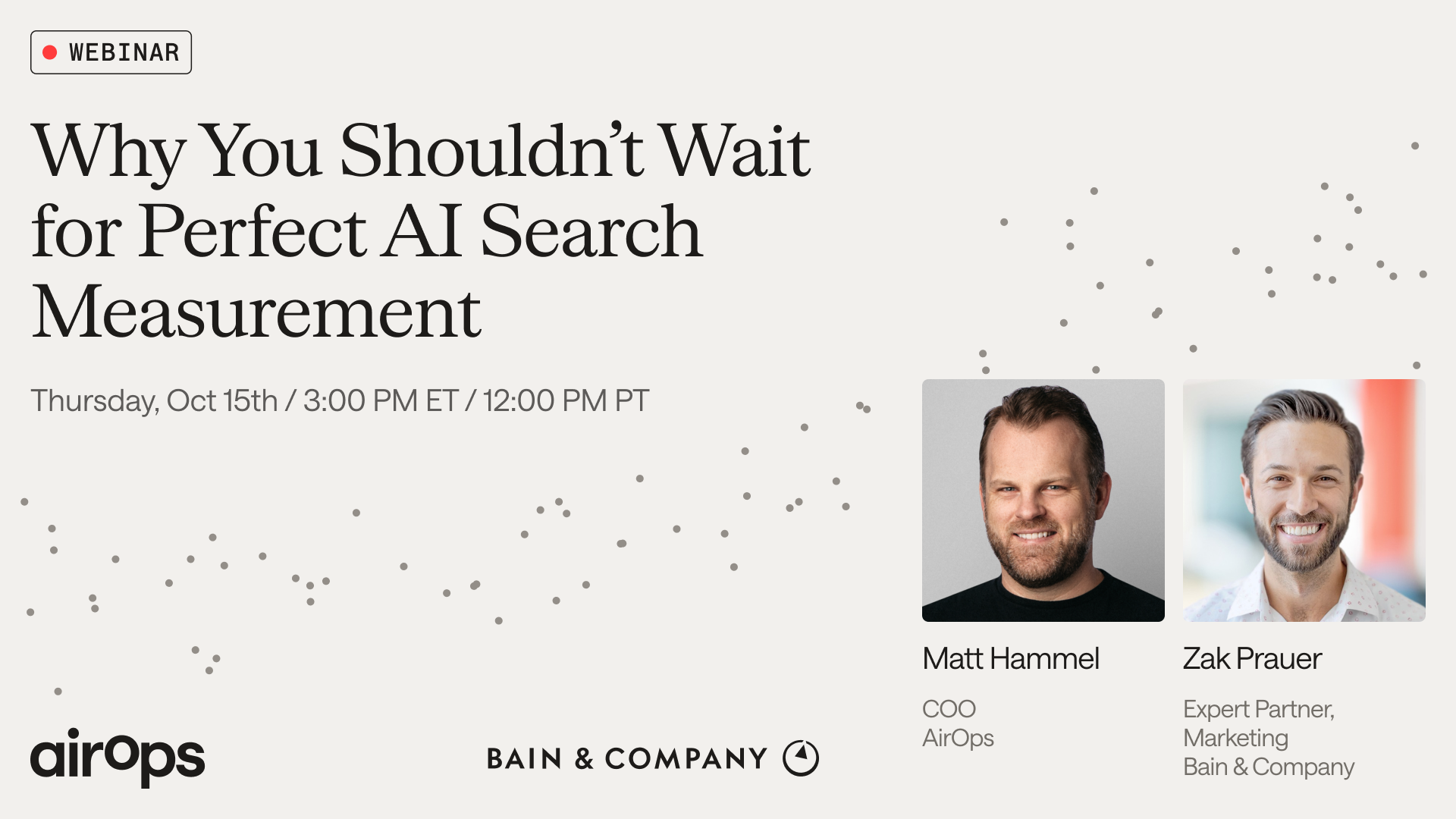
You wouldn’t judge a brand campaign only by last-click sales. Yet AI search is being asked to prove itself against paid-channel attribution standards. You risk cutting the budget that helped win a customer because another channel got credit for the sale.
On October 15, join Matt Hammel, COO of AirOps, and Zak Prauer, Expert Partner at Bain & Company, to rethink how you evaluate AI search:
- Use findings from Bain’s Marketing Leaders Reality Index to understand why paid-channel measurement sets the wrong expectations.
- Look beyond citations to whether AI recommends your brand when buyers are weighing their options.
- Discover what AI search conversations reveal about customer needs that survey responses can miss.
You’ll leave with a clearer view of what your reporting overlooks, so the next investment decision accounts for how buyers actually choose.
Can't attend the session live? Register anyway, and you’ll get the recordings in 24 hours.
⚡ Revenue growth can hide zero contribution profit
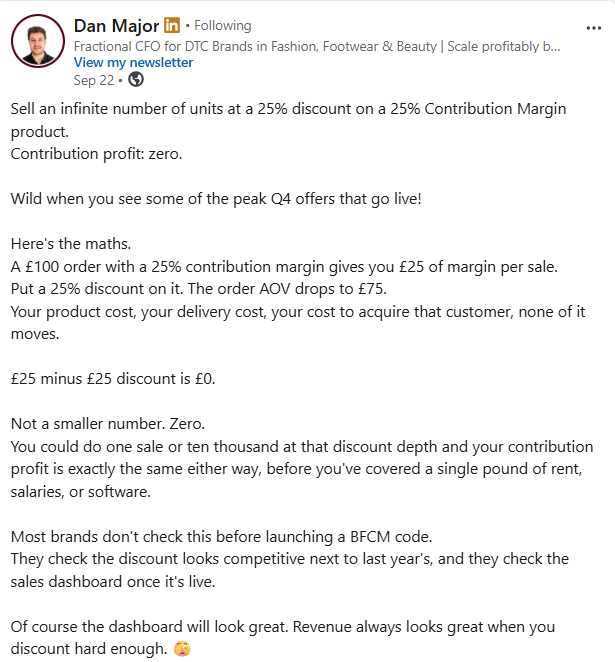
This framework shows why discount depth should be tested against contribution margin before a promotion launches. A discount equal to the existing contribution margin can eliminate the profit generated by each additional order even while revenue and unit sales climb.
Why it works: Modeling discounts against COGS, fulfillment, payment fees, and acquisition costs reveals the real economics before BFCM. It prevents teams from celebrating higher revenue that contributes little or nothing toward fixed costs and profit.
Where it needs balance: The math changes if higher discounts improve conversion, AOV, CAC, repeat purchases, or inventory economics. Some brands may deliberately accept lower first-order contribution for strategic reasons, but that trade-off should be modeled rather than assumed.
🎥 Reel of the Day

What Works:
1. Turn Content Into a Game - The “4 matcha shots, 1 wasabi shot” setup instantly gives viewers a challenge to solve. Instead of passively watching a tasting, they’re actively trying to identify the imposter.
2. Give Everyone a Role - Having multiple people taste the identical-looking shots creates different reactions, guesses and personalities. Each new participant becomes another clue, keeping the format entertaining without needing a complicated storyline.
3. Hide the Answer - Because all five drinks look almost identical, viewers can’t immediately spot the wasabi. That visual uncertainty creates an open loop that naturally holds attention until the final reveal.
Turn a simple product or tasting into a guessing game: make the options visually similar, hide one unexpected choice, involve multiple participants, capture their reactions and make viewers play along before revealing the answer.
🥳Events
🔥 What Changes When the Ad Runs From the Creator
Tomorrow | 11 AM ET | 60-Minute Virtual Event
Meta Partner Manager Reyna Baker joins Billo CEO Donatas Smailys to explain why creator-handle ads can outperform brand creative. Curtis Howland adds lessons from $100M+ in managed Meta spend so you can see what to test, compare, and change before your next campaign.
Can't attend the session live? Register anyway, and you’ll get the recordings in 24 hours.
🔥 Where to Put Your Next Growth Dollar Beyond Meta
October 29 | The Glasshouse, NYC | Free In-Person Event
Hear how Reddit CEO Steve Huffman thinks about discovery, how Cody Plofker helped scale Jones Road Beauty to nine figures, and how brands like Liquid I.V. and MANSCAPED use TV to drive measurable revenue. Bring your hardest acquisition question and leave with a sharper channel plan.
Advertise with Us
Wanna put out your message in front of over 40,000 best marketers and decision makers?
Thanks for reading this edition! Keep pushing boundaries, testing ideas, and staying inspired. See you in the next edition with more ways to ignite your marketing success. 🥰