Loosen ROAS to find buyers
🧭 Google's Smart Bidding exploration now covers Shopping and Performance Max, letting campaigns dip below target ROAS to reach new searches, Email performance starts before the open, and more!
Welcome to a space where every edition delivers insights, strategies, and inspiration to fuel your advertising brilliance. 🤯
🧭 Smart bidding exploration comes to Shopping and PMax: your questions, answered
Smart Bidding exploration just reached Shopping and Performance Max. According to PPC Land on October 25, Google's help documentation now lists it for Search, Shopping, and PMax, with or without a product feed. Here's what media buyers have been asking about it.
What does it actually do?
It lets Google bid below your ROAS target on searches it hasn't proven yet, to find new demand. You set a tolerance of 5% to 30% below target, and Google says results land within about 15% of the effective target. For Search, Google cites 27% more unique converting users and 19% more conversions.
What are the requirements?
Target ROAS bidding. Campaigns shouldn't be limited by budget. Portfolio strategies switch it off for Shopping and PMax. Without a feed, PMax exploration covers Search traffic only.
Which campaign should I try it on?
A Shopping or PMax campaign that's hitting target ROAS and isn't budget-limited. Budget-limited campaigns aren't candidates.
What tolerance should I start with?
10%. That's my judgment: enough room to learn without a big efficiency hit.
Why now and not in Black Friday week?
Exploring now builds your query base while clicks are cheaper. Exploring during peak spends premium prices on unproven traffic. Turn it on in early November, and results will be readable before November 20.
How do I know it worked?
Track new-customer conversions and newly converting search terms. More conversions at slightly lower ROAS only make sense if they come from new buyers.
Here's the logic with illustrative numbers. A Shopping campaign targets 400% ROAS on $10,000 a month. At 10% tolerance, Google may bid toward 360% on exploratory searches. If that brings 40 extra first-time buyers, and your average customer reorders twice a year, the weaker first order can pay back by spring. That only holds if new customers are tracked separately.
When should I turn it off?
Decide before Black Friday. If new-customer share rose and ROAS stayed within tolerance, keep it. If not, switch it off before peak week.
Who should skip it entirely?
Anyone whose margins are thin enough that a 10% ROAS dip makes campaigns unprofitable. Exploration can wait for a calmer quarter.
What should I watch weekly?
- ROAS against target
- New-customer conversions as a share of the total
- Newly converting search terms
Your shortlist
List your Shopping and PMax campaigns and cross off any that are budget-limited or on portfolio strategies. Whatever's left is where exploration can run this week.
Together with HubSpot
What If Your Next Prompt Updated Your CRM?

A quick question about your customers shouldn’t turn into an afternoon of pulling data and explaining it to AI. Especially when you still have to update the CRM afterward.
On November 5 at 11 AM ET, join HubSpot’s free live session to see how working with your CRM inside ChatGPT or Claude can remove those extra steps.
You’ll leave knowing how to:
- Get answers based on your customer data, without gathering and pasting the background into every chat.
- Update your CRM from the conversation, reducing the manual work between getting an answer and acting on it.
- Control what AI can access, so your team can use business data within boundaries you set.
See the connector in action, then ask HubSpot’s product team about your own workflow before investing time in setup.
Bring one task your team keeps doing manually and use the live Q&A to find out how you can simplify it and what you’d need to get started.
Can't attend the session live? Register anyway, and you’ll get the recordings in 24 hours.
⚡Email performance starts before the open
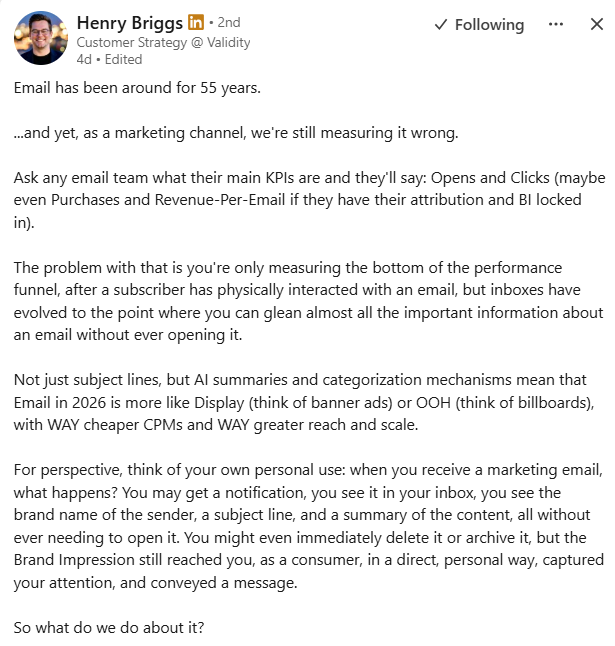
This framework argues that email should be measured beyond opens, clicks, and attributed revenue. Sender identity, subject lines, inbox placement, and AI-generated summaries can influence brand awareness and purchase decisions even when subscribers never open a message.
Why it works: Optimizing deliverability and the pre-open experience helps brands improve visibility across their subscriber base. Connecting email with SMS and other channels also creates more consistent customer journeys instead of treating each message as an isolated conversion opportunity.
Where it needs balance: A delivered email doesn't guarantee inbox placement or a meaningful brand impression. Inbox visibility is difficult to measure accurately, and opens are increasingly unreliable due to privacy features. Brands should balance reach and engagement signals with incremental revenue, subscriber quality, and long-term retention.
🎥 Reel of the Day

What Works:
1. Storytelling Through Transformation - A simple perfume bottle transforms into an entire tree of fragrances. This unexpected evolution creates curiosity and keeps viewers watching to discover what happens next.
2. Premium Visual Identity - Deep blue bottles, golden lighting, dramatic weather, and detailed textures create a luxurious atmosphere. Consistent colors make every transformation feel connected to the product.
3. Product Becomes the Story - Instead of explaining fragrance notes, the reel visualizes growth, nature, and transformation. The product remains central while the storytelling builds emotional appeal and brand memorability.
Use AI to transform an ordinary product into an extraordinary visual journey. Build anticipation through progressive transformations, maintain consistent branding, and finish with a seamless loop that rewards repeat viewing.
Advertise with Us
Wanna put out your message in front of over 40,000 best marketers and decision makers?
Thanks for reading this edition! Keep pushing boundaries, testing ideas, and staying inspired. See you in the next edition with more ways to ignite your marketing success. 🥰