Meta counts more conversions soon
📱 Meta will start measuring some conversions on customer devices by default from November 12, so set a baseline before reports shift, Amazon ad expansion should follow proven conversions, and more!
Welcome to a space where every edition delivers insights, strategies, and inspiration to fuel your advertising brilliance. 🤯
Together with Insense
1 UGC creator = 20+ ad variations to scale your Q4 creatives
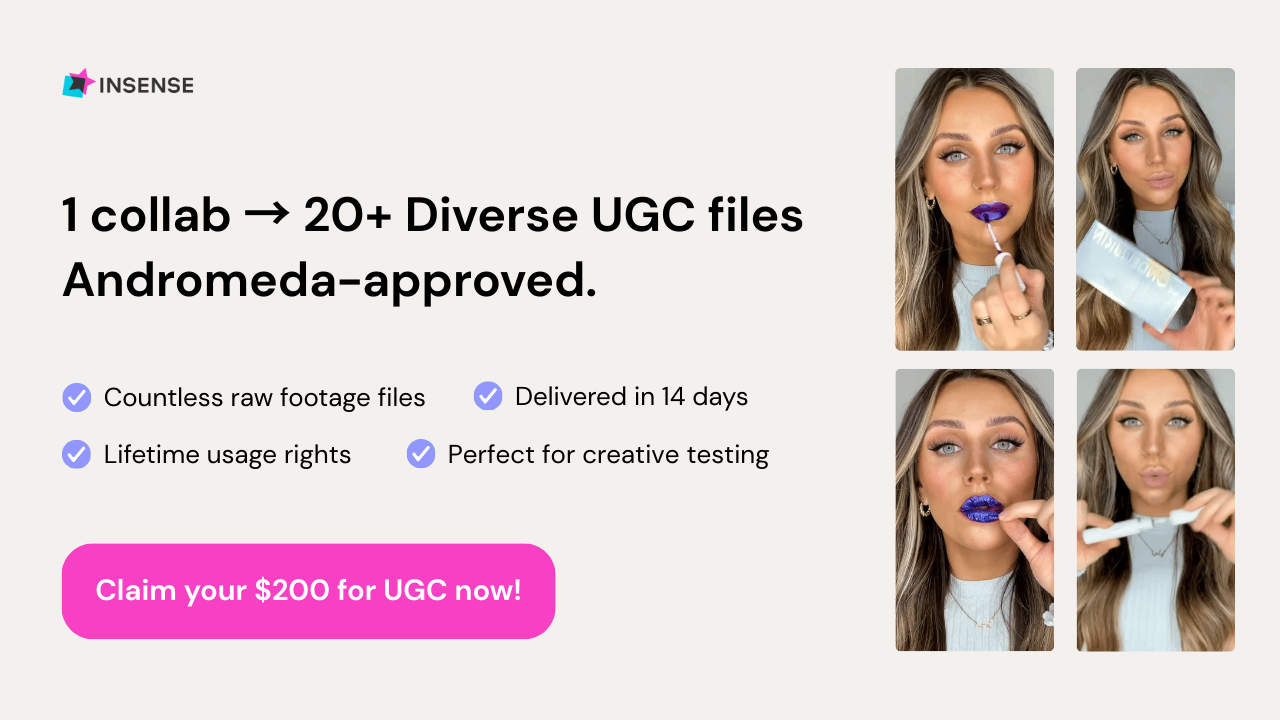
Insense makes UGC ads insanely cost-effective - and Andromeda-approved!
Meta's Andromeda update now rewards creative diversity (+22% ROAS), so the more distinct hooks and angles you test, the better you rank.
From one brief, get numerous raw footage clips to mix, match, and turn into multiple scroll-stopping creatives for your paid social ads.
Source 20+ pieces of raw content (per creator) with lifetime usage rights, all delivered in 14 days or less.
Here's the BFCM math: one winning ad takes 10-13 tested creatives, so 20+ variations per creator means more shots at a winner, and instant hook-swaps when an ad fatigues during BFCM week. Many versions from one shoot, not 50 shoots.
That’s how over 3,500 brands like Beauty Pie, Il Makiage, Revolut, and Monster Energy scale UGC without killing team bandwidth.
Cost-effective UGC with lifetime usage rights? Yes please!!
Book a free strategy call by November 6th and get $200 toward your first campaign.
📱 November 12 will make your Meta CPA look better. Here's your before-and-after plan
Somewhere around November 13, someone on your team will celebrate a drop in Meta cost per purchase. Before they do, check the calendar.
According to PPC Land, a notice in Meta's Events Manager says "Measure conversions on customer devices" will be on by default starting November 12, 2026, rolling out gradually. It applies to datasets already sending Pixel or Conversions API events, with no code change needed. You can opt out per dataset in Events Manager under the pixel's settings.
Meta hasn't said whether these conversions feed bidding or whether purchase value is included, and one report suggests the setting isn't active in the EU and UK.
More measured conversions mean better-looking results overnight, two weeks before Black Friday. Here's how to handle it by date.
Now until November 11: build the baseline
- Record daily purchases and revenue from Ads Manager and from your store backend. The gap between them is your normal reporting ratio.
- Open Events Manager and note the current state of the setting for every dataset.
- Tell finance and clients what's coming, so a sudden improvement doesn't become the new expectation.
Decide by November 11: in or out
Opting out keeps reporting consistent through peak season. Staying in may capture conversions you were missing. In my judgment, if you're mid-test on anything important, consistency wins until the test ends. Either way, choose deliberately for each dataset.
November 12: mark it everywhere
Add an annotation to every dashboard and client report. Nobody should credit a new creative or budget change for what is really a reporting shift.
November 13 onward: watch the ratio
Compare Meta-reported purchases with backend orders daily. If Meta's number rises faster than your store's, measurement is the likely cause.
Here's how that looks with illustrative numbers. In a normal week, Meta attributes 1,000 purchases while your backend records 1,400 orders from all channels. After November 12, Meta reports 1,150 and backend orders hold at 1,400. About 150 of those reported purchases likely come from the new measurement. Hold backend orders steady, and the ratio tells you the story.
Also keep an eye on
- Cost per purchase before and after the date
- Whether the algorithm starts favoring different campaigns
- Any change in reported purchase value, if Meta starts including it
Pin this
Pull two weeks of backend orders today and save them next to your Ads Manager export. When the numbers jump in mid-November, that file is how you'll know what's real.
⚡ Amazon ad expansion should follow proven conversion
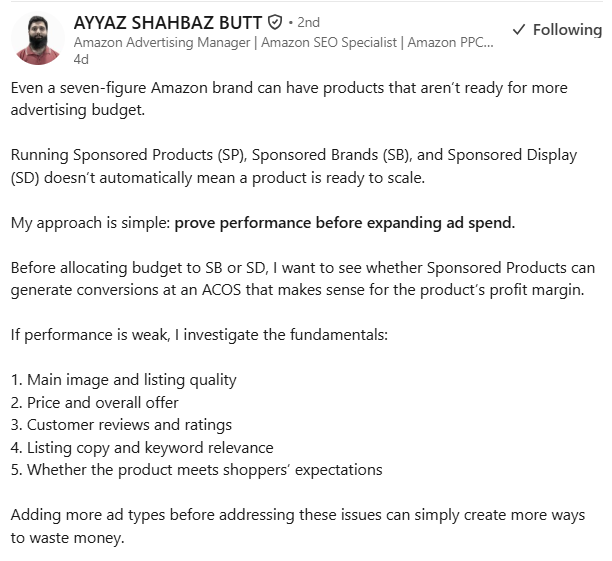
This framework argues that adding more Amazon ad formats won't fix a product that struggles to convert. Sponsored Products can help validate demand and acquisition economics before brands expand into Sponsored Brands or Sponsored Display.
Why it works: Testing high-intent traffic first helps identify whether weak performance comes from the listing, pricing, reviews, or offer. Fixing these fundamentals before increasing spend reduces wasted budget and creates a stronger foundation for scaling.
Where it needs balance: Sponsored Products performance isn't always a prerequisite for other formats. Sponsored Brands and Sponsored Display can serve different objectives, including awareness, competitor targeting, and remarketing. Each format should be evaluated on its own incremental contribution rather than following a rigid expansion sequence.
Together with Omnisend
One Plain-Text Email Outearned a Month of Campaigns
Before you send everyone the same BFCM discount, check who keeps coming back. Your repeat buyers could justify an offer of their own.
For one skincare brand, 36% of customers had ordered more than six times. Enflow Digital used Omnisend to turn that loyalty into nearly $18,000 from one plain-text email.
Omnisend helped the team:
- Find purchase patterns in minutes, cutting out hours of manual analysis.
- Build a VIP audience of customers with four or more orders, ready for a separate promotion.
- Keep the VIP offer focused on engaged buyers by filtering out contacts inactive for 180 days.
The offer was available only through email: a higher discount plus a gift above a higher spend threshold. It increased order value while helping clear slower-selling stock.
Co-founder Karolina shares how it came together so you can apply the approach to your own repeat buyers before your BFCM offers are locked in.
🎥 Reel of the Day
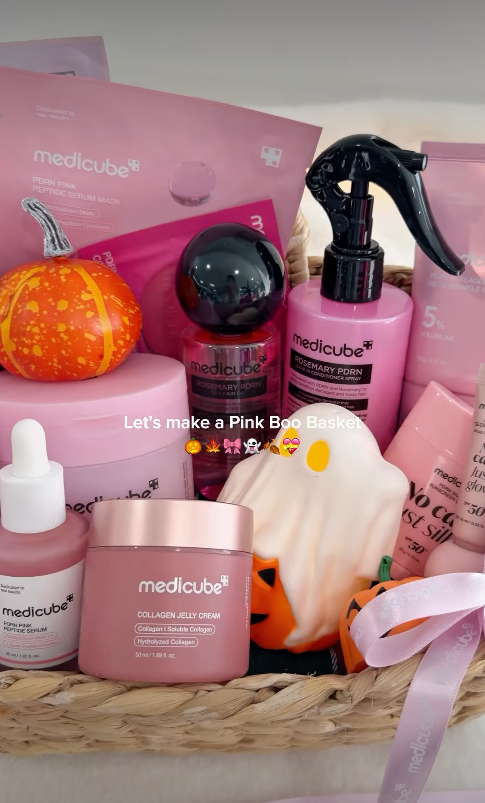
What Works:
1. Seasonal Trend Meets Product Gifting - Medicube taps into the Halloween “Boo Basket” trend, making skincare feel like a thoughtful seasonal gift rather than a traditional product promotion.
2. Satisfying Basket-Building Format - Products are added one by one, creating anticipation as viewers watch the basket fill. Each reveal encourages viewers to stay until the final arrangement.
3. Pink Aesthetic Drives Desire - Coordinated pink packaging, satin ribbons, and Halloween decorations create a visually cohesive, gift-worthy presentation that encourages saves and shares.
Turn trending gifting occasions into satisfying product-building reels. Use coordinated colors, sequential reveals, and seasonal details to make products feel collectible, desirable, and worth sharing.
Advertise with Us
Wanna put out your message in front of over 40,000 best marketers and decision makers?
Thanks for reading this edition! Keep pushing boundaries, testing ideas, and staying inspired. See you in the next edition with more ways to ignite your marketing success. 🥰