One prompt is not data
🎲 AI answers change from one run to the next, so a single screenshot of ChatGPT can't tell you whether you're winning, Repeat purchases validate growth beyond ad performance, and more!
Welcome to a space where every edition delivers insights, strategies, and inspiration to fuel your advertising brilliance. 🤯
🎲 Why one AI answer screenshot proves nothing, and what to track instead
Someone on your team asks ChatGPT for "the best running shoes for flat feet," sees your brand, and posts the screenshot in Slack.
A week later, someone else runs the same prompt and you're gone.
AI answers vary from run to run, so a single result is a sample of one.
The math of one run
Treat each run as a coin flip: you're either recommended or not. If your true recommendation rate is around 50%, the 95% margin of error looks like this:
- 10 runs: ±31 points
- 30 runs: ±18 points
- 100 runs: ±10 points
A move from 40% to 55% across ten runs is noise. The same move across 100 runs is worth reporting.
Step 1: Build a fixed prompt set
Write 30 prompts across the buying journey:
- Category questions: "best X for Y"
- Comparisons: "X vs Y"
- Problems: "how do I fix Z"
- Brand checks: "is [your brand] worth it"
Keep the wording identical every week. Changing a prompt resets the trend.
Step 2: Run each prompt five times a week
Thirty prompts at five runs gives 150 observations, which narrows the overall margin to about ±8 points. Prompts aren't fully independent, so treat that as a best case, in my judgment.
Use logged-out or fresh sessions, the same location and memory turned off, so personalization doesn't creep in.
Step 3: Score three levels
- Recommended: named as a top pick
- Mentioned: appears without being recommended
- Absent: not there at all
The gap between the first two levels is where teams get fooled, because a mention doesn't build pipeline. Three recent AirOps Growth Leader webinars point to the same shift: Kevin Indig's data shows ranking #1 for your key fan-out queries earns 58% of citations, four times more than rank #10, while Eli Schwartz's point is that every asset still needs a conversion path. Read the full takeaways to see where your content and off-site effort should go next.
Also note whether your site is cited as a source. Track your two main competitors the same way, so you can report share of recommendations.
Step 4: Set a decision rule
Call a change real only when it exceeds the margin of error for two weeks in a row.
Step 5: Budget the effort
At about a minute per run, 150 runs take roughly two and a half hours a week by hand. If you automate through an API, spot-check against the consumer app, since API answers can differ from what shoppers see.
Draft the prompt set, run each one five times, and record the first baseline. Every future screenshot gets judged against it.
Together with Omnisend
Your BFCM Plan Is Still Waiting on Better Prompts
How much time goes into pulling last year’s reports and explaining them to AI? If every useful answer takes another round of clarification, your BFCM prep barely moves forward.
Omnisend’s BFCM AI playbook gives you detailed prompts for the work you need to get done, so you can spend less time figuring out what to ask.
Use last year’s results to decide which campaigns deserve another run and check deliverability before increasing send volume.
Then turn those findings into a campaign calendar your team can work from.
Better yet, Omnisend connects with Claude or ChatGPT, so you can analyze performance and create editable email templates without leaving the chat.
New to Omnisend? Its email and SMS platform serves 150,000+ ecommerce brands, reporting an average $79 for every $1 spent. Migration is free and takes up to five business days.
Start now, with time to put the answers to work.
⚡Repeat purchases validate growth beyond ad performance
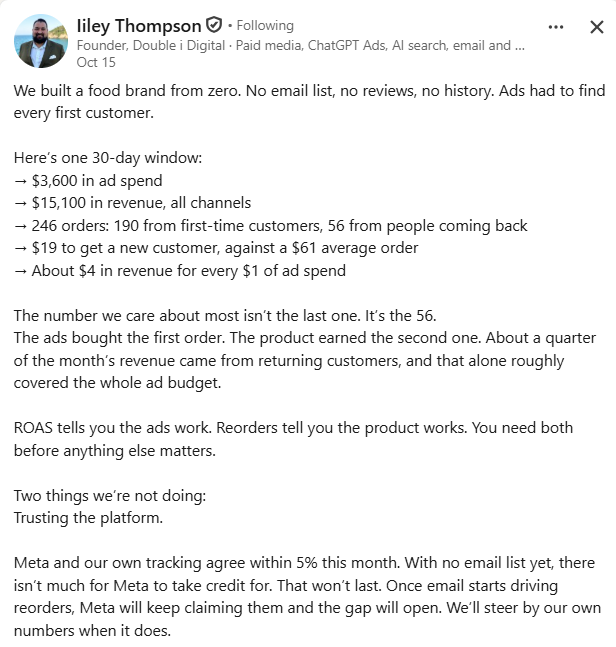
This framework argues that early DTC growth should be measured through both acquisition efficiency and repeat purchasing. Low new-customer CAC helps brands acquire buyers, while returning customers indicate whether the product can generate revenue beyond the initial advertising investment.
Why it works: Tracking first-time orders, repeat purchases, and blended revenue gives brands a clearer view of business performance than platform ROAS alone. Strong repeat economics can also provide more flexibility as acquisition costs increase during Q4.
Where it needs balance: Repeat orders within one month don't establish long-term retention, and returning-customer revenue doesn't automatically equal profit. Brands should measure cohort retention, contribution margin, payback periods, and CAC stability before assuming early performance can scale sustainably.
🎥 Reel of the Day
What Works:
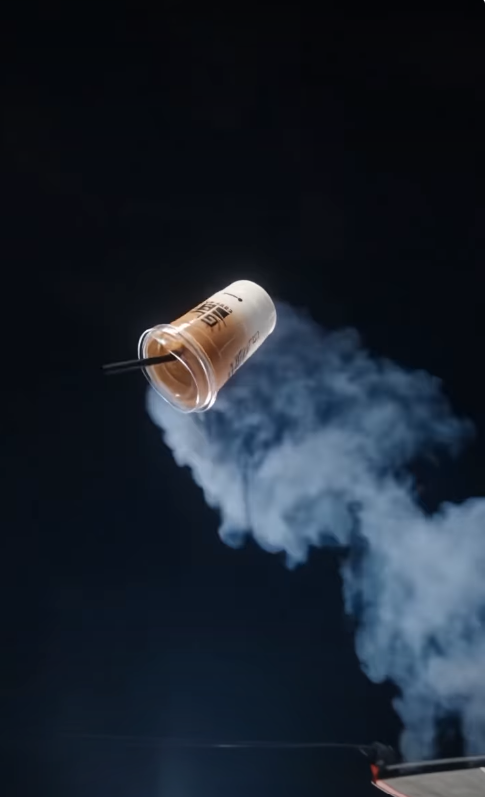
1. Viral Moment Repurposed - Glob Coffee recreates the viral Tesla showcase using AI, replacing the original spectacle with a flying coffee cup. This connects the brand to an already recognizable internet moment, making the content immediately attention-grabbing.
2. AI Enables Big Concepts - Using AI allows the brand to recreate a large-scale cinematic spectacle without physically building elaborate sets. The approach demonstrates how smaller brands can experiment with ambitious creative concepts while keeping production requirements manageable.
3. Unexpected Product Placement - The giant launch ramp and rocket-powered coffee cup create an absurd visual that interrupts scrolling. Placing an everyday drink inside an extraordinary scenario makes the product memorable without relying on traditional advertising.
Identify a recognizable viral spectacle and recreate its defining visual using AI, with your product as the unexpected centerpiece. Preserve the original moment's entertainment value, then finish with a polished product shot that makes the brand unmistakable.
🥳 Events
🔥 What Makes a Creator Program Worth More Budget
October 21 | Online | Free Festival
See how experienced teams prove creator impact before asking for more spend. Leaders from Adobe, ŌURA, Edelman, Ogilvy, and more will break down the metrics, campaign decisions, and operating systems that help creator programs earn trust, budget, and room to scale.
Can't attend every session live? Register anyway, and you’ll get the recordings in 24 hours.
Advertise with Us
Wanna put out your message in front of over 40,000 best marketers and decision makers?
Thanks for reading this edition! Keep pushing boundaries, testing ideas, and staying inspired. See you in the next edition with more ways to ignite your marketing success. 🥰