Your warranty belongs in ads
🛡️ Google Merchant Center now accepts warranty details for every product, and Quebec now requires them beside the price for many goods, Fake positive reviews can threaten Amazon sellers, and more!
Welcome to a space where every edition delivers insights, strategies, and inspiration to fuel your advertising brilliance. 🤯
🛡️ Warranty just became a feed field. Here’s who must use it and who should
Two changes landed within two weeks of each other.
On October 5, Quebec’s warranty of good working order took effect under Bill 29. For certain new goods, merchants must now show the legal warranty duration near the advertised price, prominently. Distance sales, including online orders, must also state the duration in the contract sent to the buyer.
On October 16, Search Engine Land reported that Google Merchant Center added a warranty attribute for all products. Until now, it covered only vehicle ads in Japan. You submit a duration and a unit in months or years, so a three-year warranty becomes “3:year.”
Google lists it for Shopping ads and free listings, and hasn’t promised any performance lift.
If you sell covered goods into Quebec, this is required
The durations set by regulation:
- Six years: refrigerators, freezers, air conditioners and heat pumps
- Five years: dishwashers, washing machines and dryers
- Four years: television sets
- Three years: desktop and laptop computers, tablets, cell phones and video game consoles
- Map every SKU in those categories to its legal duration.
- Add the warranty attribute to those feed items, using years.
- Check that every product page, ad, and promotional email shows the duration near the price.
If you sell extended warranties, Quebec also requires a prescribed notice before the sale. Have counsel confirm how the rules apply to your business, especially if you sell from outside the province.
If you sell anywhere else, consider it anyway.
In my judgment, warranty length is one of the few trust signals a shopper can compare at a glance, and holiday buyers spending on electronics or appliances care about it.
Use it where you beat the norm. If your warranty is longer than the typical one in your category, the attribute makes that visible before the click.
Skip it where you’re average. A standard one-year warranty adds little, and every field you submit is another one to keep accurate.
Match the feed to the page. Your feed, product page, and checkout should all state the same warranty. A mismatch can confuse shoppers, and in my judgment it invites listing problems.
A quick test for everyone else
Pick ten products where your warranty is unusually long. Add the attribute to only those, leave ten similar products without it, and compare click-through rate and conversion rate over four weeks. Google hasn’t promised a lift, so measure your own.
Your first step
Export your feed and filter for the categories on Quebec’s list. If any of those products ship to Quebec, add the warranty field before your Black Friday ads go live.
Together with Insense
Your BFCM Creator Calendar is Already Mapped

Still sourcing creators when your Black Friday ads should be running? Every delay leaves less time to test what actually sells before your biggest spending weeks.
Insense’s free BFCM + Q5 Creator Marketing Playbook gives marketers a week-by-week plan from September through January, so every creator campaign starts with a clear deadline and purpose.
Inside, you’ll find:
- A week-by-week August-to-January calendar showing when to secure permissions, test content, scale winning creators, and move into Q5.
- A practical creator scorecard using conversions, engagement quality, and reliability, so November budgets back proven performers over follower counts.
- Q5 action plan covering licence extensions, January creative, and the recommended 10–15% budget reserve for the lower-cost post-holiday window.
You’ll also get benchmarks for creator-handle ads, modular UGC testing, live shopping, hook rates, and creative volume, helping your team set measurable targets before spending rises.
⚡ Fake positive reviews can threaten amazon sellers
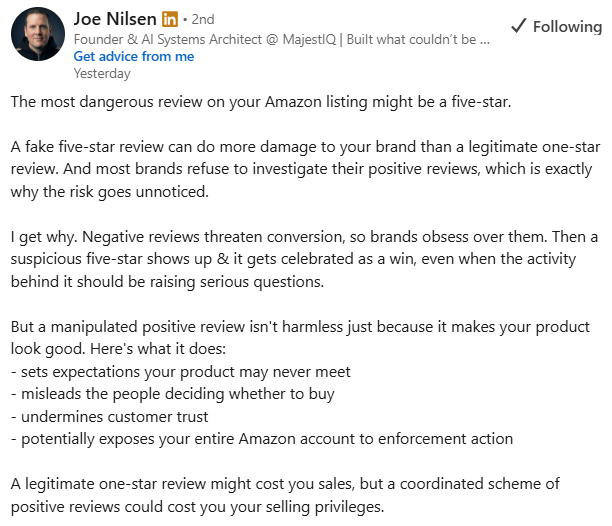
This framework argues that review integrity matters beyond protecting star ratings. Manipulated five-star reviews can mislead shoppers, create unrealistic product expectations, and expose sellers to account enforcement risks.
Why it works: Monitoring suspicious positive and negative review activity helps brands protect customer trust and maintain compliance with Amazon's policies. Genuine feedback also provides more reliable insights into product quality and customer satisfaction.
Where it needs balance: An unusually positive review isn't automatically fake, and sellers aren't necessarily responsible for every suspicious review posted. Investigations should rely on evidence, documented patterns, and Amazon's reporting processes rather than assumptions based on ratings alone.
🎥 Reel of the Day
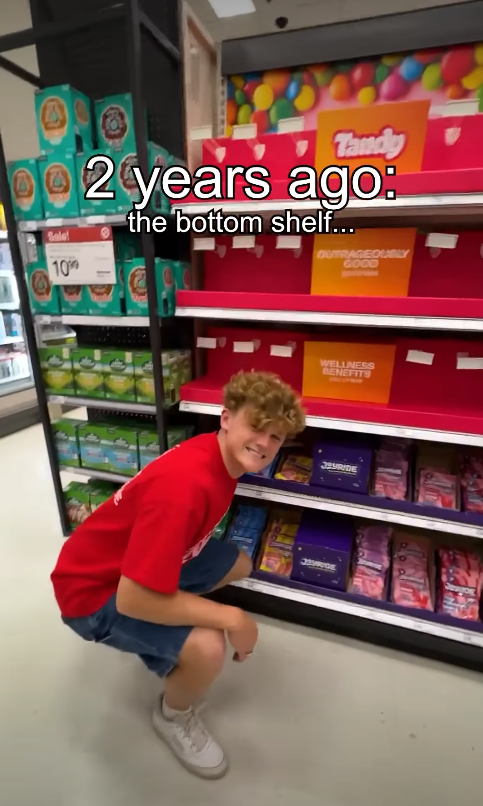
What Works:
1. Progress Creates the Hook - The reel opens with Joyride occupying a bottom shelf two years ago, then reveals an entire section beside established candy brands.
2. Shelf Space Signals Success - Instead of announcing revenue figures or distribution milestones, Joyride uses physical shelf space as evidence of progress. Seeing multiple shelves filled with colorful products makes the brand's expansion tangible.
3. The Product Becomes Social Proof - The camera reveals rows of Joyride products without relying on conventional product demonstrations or sales messaging.
Document your brand's earliest milestones, even when they seem insignificant. Revisit those exact moments as the business grows, using matching locations, camera angles, or situations to create unmistakable before-and-after comparisons.
Advertise with Us
Wanna put out your message in front of over 40,000 best marketers and decision makers?
Thanks for reading this edition! Keep pushing boundaries, testing ideas, and staying inspired. See you in the next edition with more ways to ignite your marketing success. 🥰