Set the gift threshold higher
🎁 A gift with purchase can lose money if the spend threshold sits too low, so price it against your real order values, Amazon profitability leaks extend beyond advertising, and more!
Welcome to a space where every edition delivers insights, strategies, and inspiration to fuel your advertising brilliance. 🤯
🎁 The gift-with-purchase threshold most stores set too low
A gift above a spend threshold is a classic BFCM lever. It lifts order value, moves slower stock, and feels generous without cutting the price of your bestsellers.
It can also quietly lose money. The threshold decides which.
Two thresholds, one store
Take an illustrative store with a $120 average order, a 60% gross margin, and a gift that costs $12. Across 1,000 orders:
Threshold at $150. About 20% of orders already clear it, so you give 200 gifts to people who would have spent that anyway: $2,400. Another 25% stretch up by roughly $35, which earns $21 each in margin, or $9 after the gift. That's $2,250. Net result: minus $150.
Threshold at $175. Only 8% already clear it, costing $960 in gifts. Fewer people stretch, around 18%, but each adds about $55, or $21 after the gift. That's $3,780. Net result: plus $2,820.
The higher threshold wins because it stops paying for orders that were coming anyway.
How to set yours
- Plot last year's order values. Find where orders naturally cluster.
- Count the free riders. Note what share of orders already sits above each candidate threshold.
- Set it just above the cluster. In my judgment, aim for a threshold that 5% to 10% of orders already pass.
- Price the gift at cost. Use the landed cost to you, never the retail value.
Ahead of BFCM, Enflow Digital paired a higher discount with a gift for a skincare client, setting a slightly higher spend threshold for the gift to lift order value and clear slower stock. Sent as one plain-text email to 1,676 customers selected through Omnisend's segmentation, it produced 110 orders at roughly $163 each. Watch Karolina explain how the offer was built here.
Choose the gift with a second goal
The best gifts do a second job:
- Clear slow stock: a product you'd otherwise discount in January.
- Start a habit: a sample size of something people reorder.
- Raise perceived value: something with a clear retail price, so the gift feels substantial.
Track it after the sale
Measure the share of orders above the threshold, average order value against last year and how many orders landed within $10 above the threshold. A tight cluster just above the line means it worked.
Omnisend serves 150,000+ ecommerce brands, which report an average of $79 for every $1 spent. You can check Omnisend here.
Export last year's November order values and find where they cluster. Your threshold sits just above that point.
Together with Insense
Save 40+ hrs/month in Q4 on UGC creator & influencer operations
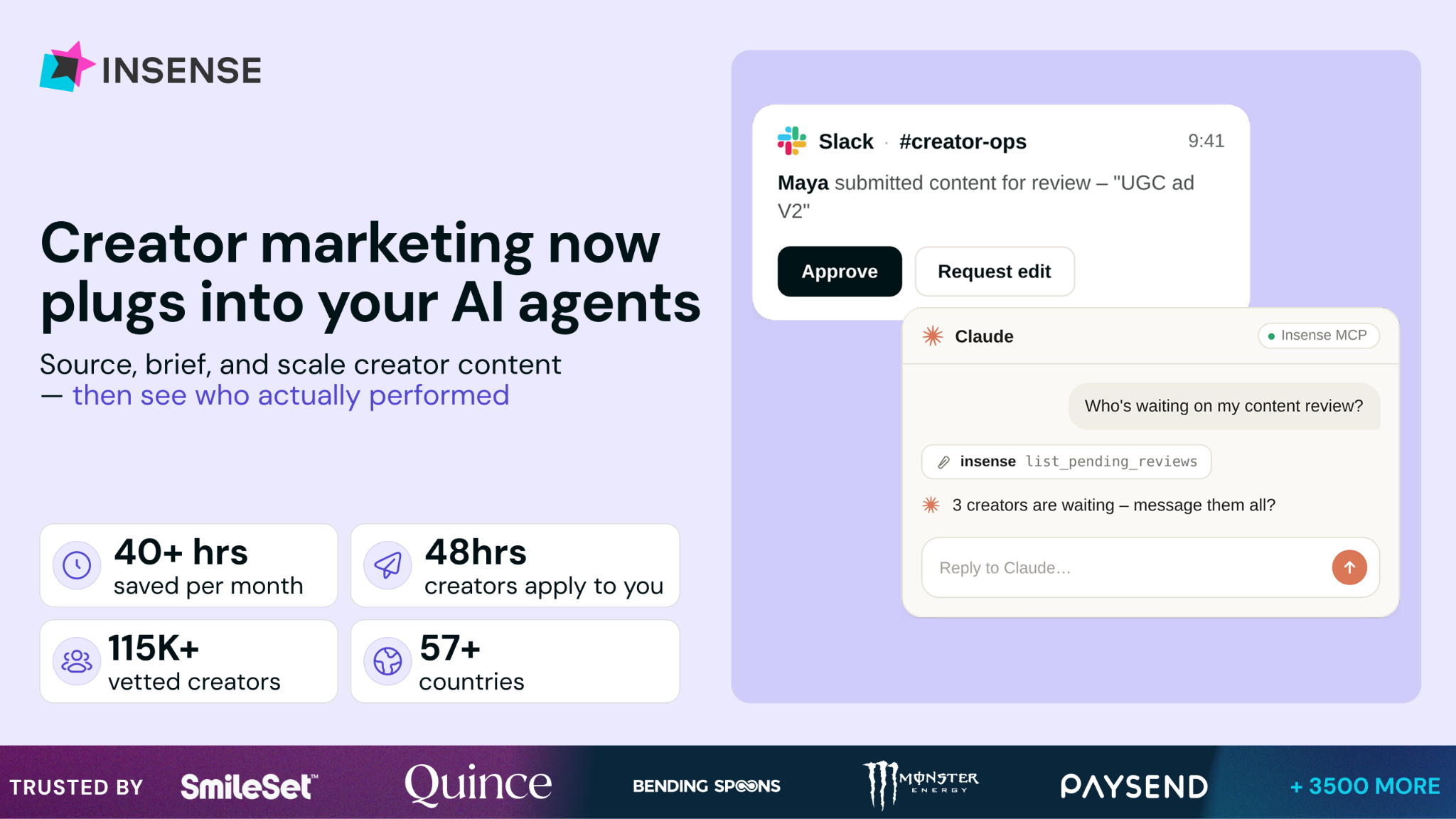
Your team already runs on Slack and AI agents. Your creator marketing should too.
Insense now plugs into the stack you already use, so you brief, approve, and track creator work without living in yet another dashboard.
Route campaigns and updates through Slack, put your AI agents (ChatGPT, Claude) to work on briefs and shortlists, and keep everything connected to your Ads Manager and analytics.
Underneath, the creator layer runs itself:
- Vetted creators apply to you within 48 hours - from a vetted marketplace of 115K+ creators across 57+ countries
- Run diverse campaign types - from UGC to seeding, influencer posting, and Meta Partnership Ads and TikTok Spark Ads
- Get creator performance insights - connect your Ads Manager and view which creators perform best - not only which ads
Over 3,500 brands and agencies use Insense, with first creator applications arriving within 48 hours and teams saving 40+ hours monthly.
Book a free strategy call and get $200 towards your first campaign.
⚡Amazon profitability leaks extend beyond advertising
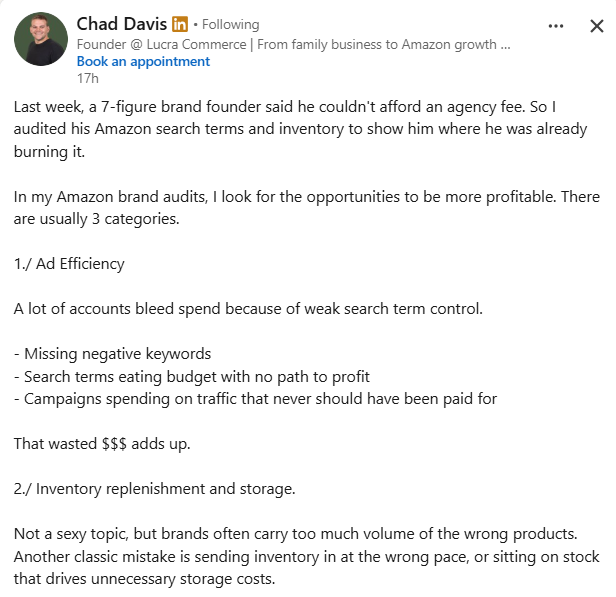
This framework identifies three common sources of wasted profit in Amazon accounts: inefficient search-term spending, poor inventory management, and budget allocation toward low-margin products. Fixing these areas can improve profitability without increasing sales.
Why it works: Auditing search terms, storage costs, replenishment, and SKU-level margins reveals expenses that standard advertising reports often miss. Redirecting spend toward profitable products while reducing inventory waste can improve overall contribution margin.
Where it needs balance: Not every expensive search term or low-margin SKU is necessarily wasteful. Some support organic ranking, customer acquisition, or broader catalog sales. Agency fees also need to be justified by measurable incremental profit rather than assuming every account contains enough recoverable waste to cover them.
🎥 Reel of the Day

What Works:
1. The Cutest Detail - The tiny branded cup holder attaching the Lip Butter Balm directly to the latte is the standout detail. It turns ordinary packaging into an adorable, shareable accessory that instantly attracts attention.
2. Products Become Experiences - Summer Fridays connects its Salted Mocha Butter Balm with a matching latte, bringing the product’s flavor inspiration to life. Customers can experience the collaboration beyond simply purchasing skincare.
3. Built for Sharing - The coordinated brown tones, heart-shaped cup branding, and miniature balm holder create a picture-perfect combination. Every detail makes the drink feel like something customers would naturally photograph and share.
Create one unexpectedly cute, functional detail that connects two products. Make it visually irresistible, easy to photograph, and exclusive enough that customers want to experience it themselves.
Advertise with Us
Wanna put out your message in front of over 40,000 best marketers and decision makers?
Thanks for reading this edition! Keep pushing boundaries, testing ideas, and staying inspired. See you in the next edition with more ways to ignite your marketing success. 🥰