Stop paying double for the same stuff
💪The $5.50 CTV arbitrage most brands are missing, Don’t pause ads that already proved they convert, and more!
Welcome to a space where every edition delivers insights, strategies, and inspiration to fuel your advertising brilliance. 🤯
💪 The $5.50 CTV Arbitrage Most Brands Are Missing
Here’s something your media buyer probably won’t tell you. The same CTV impression on the same streaming app can cost you $14 or $19.50, depending on which door you walk through. That’s a 39% markup for identical inventory, and most brands are paying it without knowing.
The cause is SSP saturation. The average CTV platform now authorizes around 30 SSPs to sell its inventory, double the number from just a year ago, with some platforms authorizing 60+.
A single CTV app’s impressions now travel through dozens of different sellers, often daisy-chained through resellers who each take 10–15% before the publisher sees a cent.
Jounce Media research found 114 distinct supply paths to a single CTV service.
Translation: you are buying the same impression multiple times, paying a middleman tax, and calling it a frequency cap failure.
Four moves to fix it:
Ask your DSP for a Seller Member ID audit. Pull the list of sellers bidding on your campaigns. Sort by CPM. If the same publisher appears across six SSPs at different prices, you’ve found your arbitrage. Route spend to the cheapest direct path and blacklist the resellers.
Bias toward Programmatic Guaranteed over Open Auction on your top 20% of inventory. PG deals cut the middleman entirely. An open auction is where the 39% reseller tax hides. For the inventory you already know converts, there’s no reason to let an extra hop eat your margin.
Turn on SupplyChain Object filtering in OpenRTB. Most buyers never do this. It lets you see every hop a bid takes before reaching you. Set a rule: max two hops. You’ll cut fraud exposure and ghost inventory in one move.
Run a direct vs reseller A/B on identical audiences. Two campaigns. Same creative. Same targeting. One route through curated direct deals only. The other runs an open auction. The CAC delta is your hidden tax.
Platforms like Tatari bake this transparency into every buy placement-level reporting on where each impression aired, what it cost, and what it drove, across linear, streaming, and direct publisher inventory. You can book a free demo and see what your numbers look like on TV!
The brands still treating CTV as a brand channel are getting charged brand channel prices. The ones treating it like a performance channel are exploiting the inefficiency.
The shortest path wins.
Every hop between you and the publisher is a tax on your CAC. Most brands are paying five hops of tax and wondering why CTV feels expensive. It isn’t expensive. It’s just been marked up four times before you touched it.
Together with Insense
You don't need another agency. You need a better system.
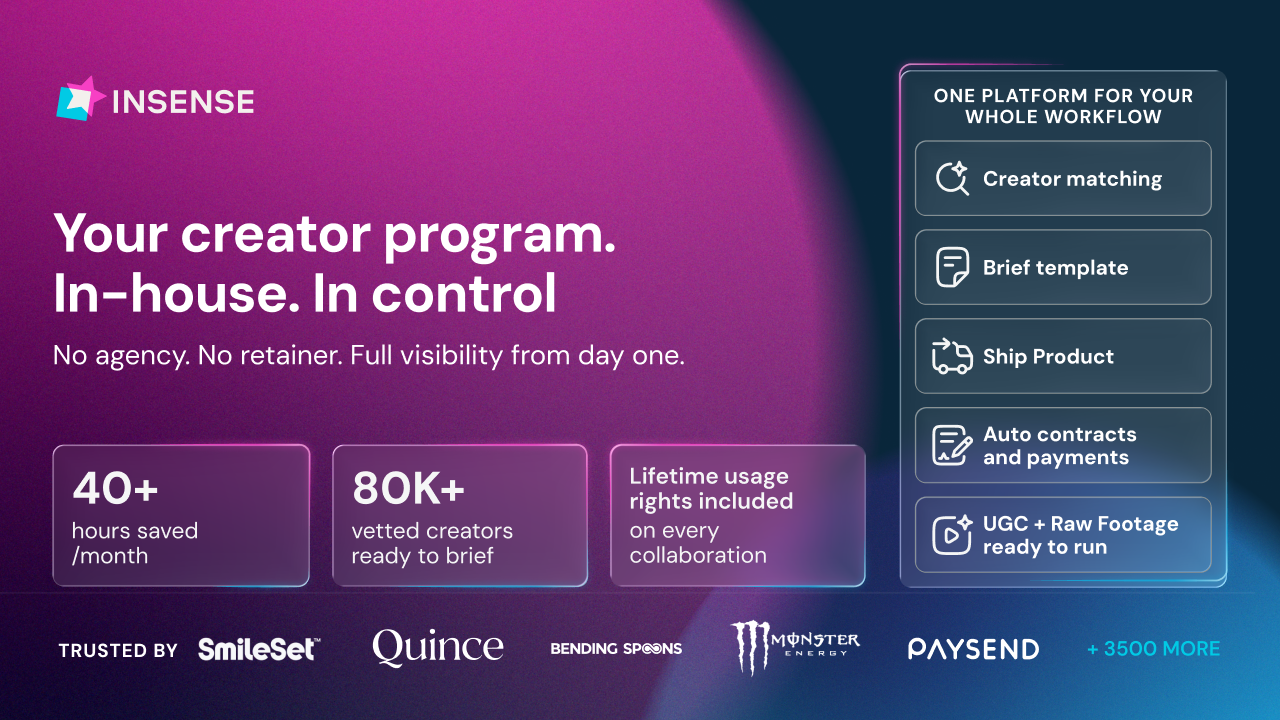
More DTC brands are pulling creator marketing in-house because agency models are too slow, too rigid, and too expensive to test at the speed that paid social demands.
Insense is the self-serve platform built for that transition.
Source from 80,000+ vetted creators, interactive brief templates and approvals in one place, automated contracts and payments, and lifetime usage rights included on every piece of content.
Trusted by over 3500 brands like Quince, Paysend, SmileSet, and Monster Energy,
No retainer. No middleman. Full visibility and control from day one. Brands save 40+ hours a month and get first creator applications within 48 hours.
P.S. If you need occasional assistance with influencer scouting, post-production, or platform management, they offer customizable and hybrid managed services.
Book a free strategy call by May 8 and get a $200 platform credit towards your first campaign.
⚡Don’t Kill Winners, Let Them Recycle Back Into Performance
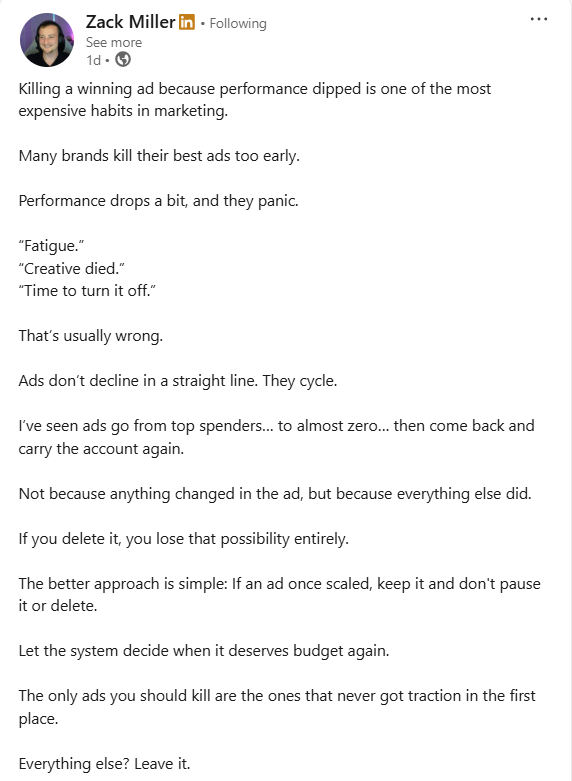
This view argues that ad performance is cyclical, not linear. Ads that once performed well can dip due to external factors like auction dynamics or new creatives, not because they are permanently “fatigued.” Instead of killing them, keep them active so platforms can reallocate budget when conditions improve.
Why it works: Ad performance depends on auction competition, audience overlap, and creative rotation. Previously successful ads have proven signals, so platforms can re-prioritize them when conditions shift, restoring efficiency without new testing.
Where it needs balance: Keeping all past winners active can clutter accounts and dilute the budget. Some creatives do permanently fatigue. Regular review is still needed to avoid over-relying on old ads instead of finding new, scalable winners.
🚀 Reel of the Day

What Works:
Cold Sensory Coding: This reel doesn’t show skincare; it makes you feel temperature. Ice, condensation, glass textures, and slow drips create a physical sensation, so the product is experienced before it’s understood intellectually.
Ingredient Without Listing - Egg shells, ice blocks, and liquid drops all act as symbolic ingredients. Instead of saying “clean formulation,” they build a visual metaphor system that communicates purity and structure without a single bullet point.
Narrative Over Product - The caption confirms it. They are not selling features; they are selling a narrative system. The visuals define the brand before the product even needs to justify itself.
Pick one sensory territory, like cold, softness, or pressure, and build your entire visual system around it. When everything aligns, the product inherits meaning without explanation.
Thanks for reading this edition! Keep pushing boundaries, testing ideas, and staying inspired. See you in the next edition with more ways to ignite your marketing success. 🥰