Write for match not coverage
🥹Your AI search strategy is built on the wrong signals, Your bidding strategy should match your conversion signals, and more!
Welcome to a space where every edition delivers insights, strategies, and inspiration to fuel your advertising brilliance. 🤯
🥹Your AI Search Strategy Is Built on the Wrong Signals
Most content teams are optimizing for a search engine that no longer makes the final call. Google still matters. But ChatGPT, Perplexity, and Claude are now the first stop for millions of high-intent queries, and they pick winners differently.
Here’s what actually drives citation in AI search, and how to build for it.
Stop writing for coverage. Write for match.
The instinct is to go broad, cover every angle, answer every sub-question, pad the page. But research across 16,851 ChatGPT queries found that pages covering 26–50% of a query’s sub-topics get cited more often than pages covering 100%. Comprehensiveness isn’t the signal. Precision is.
Write tighter. One clear topic per page, one specific answer per heading. The page that directly answers the question wins more often than the page trying to answer everything adjacent to it.
Your headline is doing more work than you think.
Pages with headings that closely mirror the user’s query get cited 41% of the time. Pages with loosely related headings? 29%. That’s a 12-point gap driven entirely by how well your H1 reflects what someone actually typed.
Audit your top pages. If the heading is clever instead of clear, rewrite it. In AI search, specificity in structure is a ranking factor, not just a readability consideration.
Retrieval rank is the real ceiling.
A page sitting at position one in retrieval has a 58% citation probability. By position ten, that drops to 14%. This means traditional SEO still feeds AI search, but only if your content is precise enough to be retrieved for the right query in the first place.
The teams pulling ahead are building content workflows that scale this precision across hundreds or thousands of pages simultaneously, not just their top ten. AirOps studied exactly this across 353K pages and 20+ citation signals, the full breakdown is in their Fan-Out Effect Report. You can read the Fan-Out Report
Domain authority is not a shortcut.
Pages that get consistently cited actually carry lower domain authority than pages that never get cited. What separates them is content quality and structural relevance. A newer page with a sharp heading and a precise scope will outperform a legacy page with a strong backlink profile.
This changes the calculus for content investment. The question is no longer how authoritative your domain is. It’s how well each individual page answers a specific question.
AI search rewards specificity at scale. Build accordingly.
Together with Templafy
Your team is prompting AI decks. Your brand has no idea.

Every presentation your team generates without guardrails is a brand liability waiting to happen.
Templafy works inside PowerPoint. You set the brand rules, approved assets, and content guardrails once. Every AI-generated deck your team builds after that follows them automatically.
- Brand rules are enforced on every AI-generated deck
- Client-ready presentations that are on-message by default
- 4M+ users at Adobe, KPMG, and Pandora are already running on it
BDO saved $1.65M in a year. Adobe teams got back 72% of their time. Your brand shows up right, every time, without you having to police it.
⚡Choose tCPA or tROAS Based on Data, Not Preference
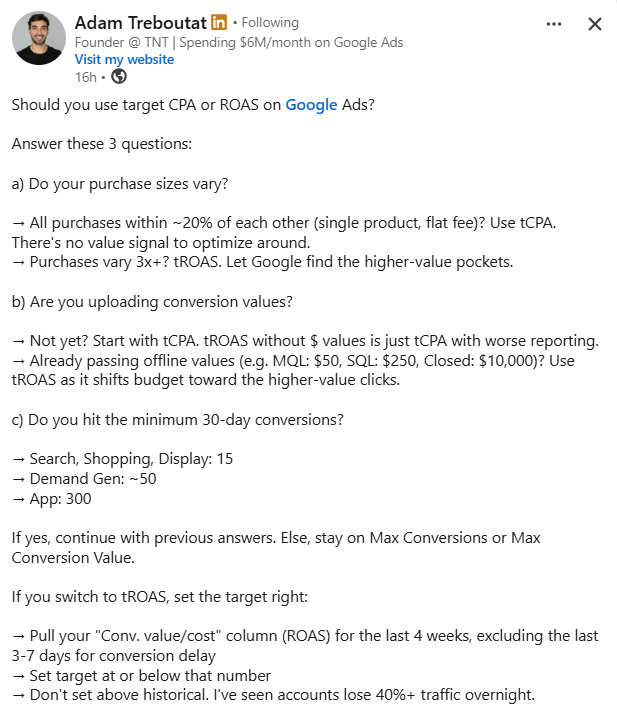
This framework helps decide bidding strategy using three variables: purchase variability, value tracking, and conversion volume. tCPA works when purchases are consistent and value signals are weak, while tROAS is effective when values vary and are tracked accurately. The choice depends on data maturity, not platform defaults.
Why it works: Google optimizes based on available signals. When value data exists and varies, tROAS prioritizes higher-value conversions. When it doesn’t, tCPA simplifies optimization around conversion volume, improving stability and performance.
Where it needs balance: Strict rules can overlook edge cases like hybrid models or seasonal shifts. Low data volume limits both strategies. Continuous monitoring and gradual adjustments are required to avoid volatility and performance drops.
🚀 Reel of the Day

What Works:
Creative Constraint Win - This reel works because the brand turns a vague direction, “be more creative,” into a visual operating system. Instead of showing golf apparel in standard lifestyle mode, it shows motion, distortion, and frame experimentation as the product story itself.
Motion Becomes Message - The stretched frames, blur trails, black and white treatment, and boxed compositions do more than look cool. They translate swing speed, rhythm, and athletic flow into visual language, so the edit makes performance feel visible.
Premium Signal System - Everything signals premium without saying premium. Sparse typography, clean framing, selective effects, muted palette, and restrained product naming tell viewers this brand trusts aesthetic confidence more than loud persuasion.
Take one product truth, like movement, flexibility, or speed, and exaggerate it through the edit until the viewer can feel it. When the visual effect expresses the benefit, the sell feels effortless.
Thanks for reading this edition! Keep pushing boundaries, testing ideas, and staying inspired. See you in the next edition with more ways to ignite your marketing success. 🥰