Top teams spend less on paid social
📉 Top-quartile marketing teams spend 8% less on paid social and 3x more on attribution tools. The lever isn't more budget, it's a different mix, Choose the message before the creative format, and more!
Welcome to a space where every edition delivers insights, strategies, and inspiration to fuel your advertising brilliance. 🤯
📉 Top-Quartile marketing teams spend less on paid social, more on measurement
Top-quartile ROI performers spend roughly 8% less on paid social than the median marketing team, and roughly three times more on attribution tools. That's a genuinely counterintuitive pairing.
The teams getting the best return aren't the ones pouring more into the channel that drives visible activity. They're the ones spending comparatively less there and putting the difference into the infrastructure that tells them which of that spend is actually working.
That reframes a budget conversation that usually only has one lever: more. Most resourcing requests ask for additional total spend without questioning the mix of what's already funded, which means a team can be meaningfully under-invested in measurement while appearing adequately funded on paper, simply because the money is concentrated in the channel everyone assumes needs it most.
Calculate your current spend mix before asking for more of it
Pull your last twelve months of spend and calculate that ratio directly: paid social and paid search as a share of total budget, against attribution and analytics tooling as a share of the same total.
Compare it against the top-quartile pattern. A team spending heavily on channels and thinly on measurement is optimizing for activity it can't verify is working. This is the kind of resourcing math Krithika Shankarraman and AirOps CMO Christy Roach unpack on September 17.
Model what a small reallocation would actually buy
An 8% reduction in paid social spend sounds like a real cut until it's converted into what it could fund instead, which for most mid-sized budgets is a meaningful jump in measurement capability rather than a rounding error.
Run the specific math for your own budget: what does 8% of current paid social spend equal in dollars, and what attribution or incrementality capability could that fund if redirected. A team that's never run this calculation is defending a spend mix by default, not by decision.
Make the case as a reallocation, not a request for new money
"We need more budget" competes with every other team's version of the same ask. "We want to shift 8% of paid social toward measurement, matching the mix top-quartile teams already run" is a specific, benchmarked case that doesn't require finance to find new dollars at all.
More budget is one lever. A better mix of the budget already funded is usually the faster one to pull. You can reserve your free spot here to hear more from a survey of 300+ marketing leaders navigating the same pressure.
Together with AirOps
How High-Growth Marketing Teams Secure More Resources
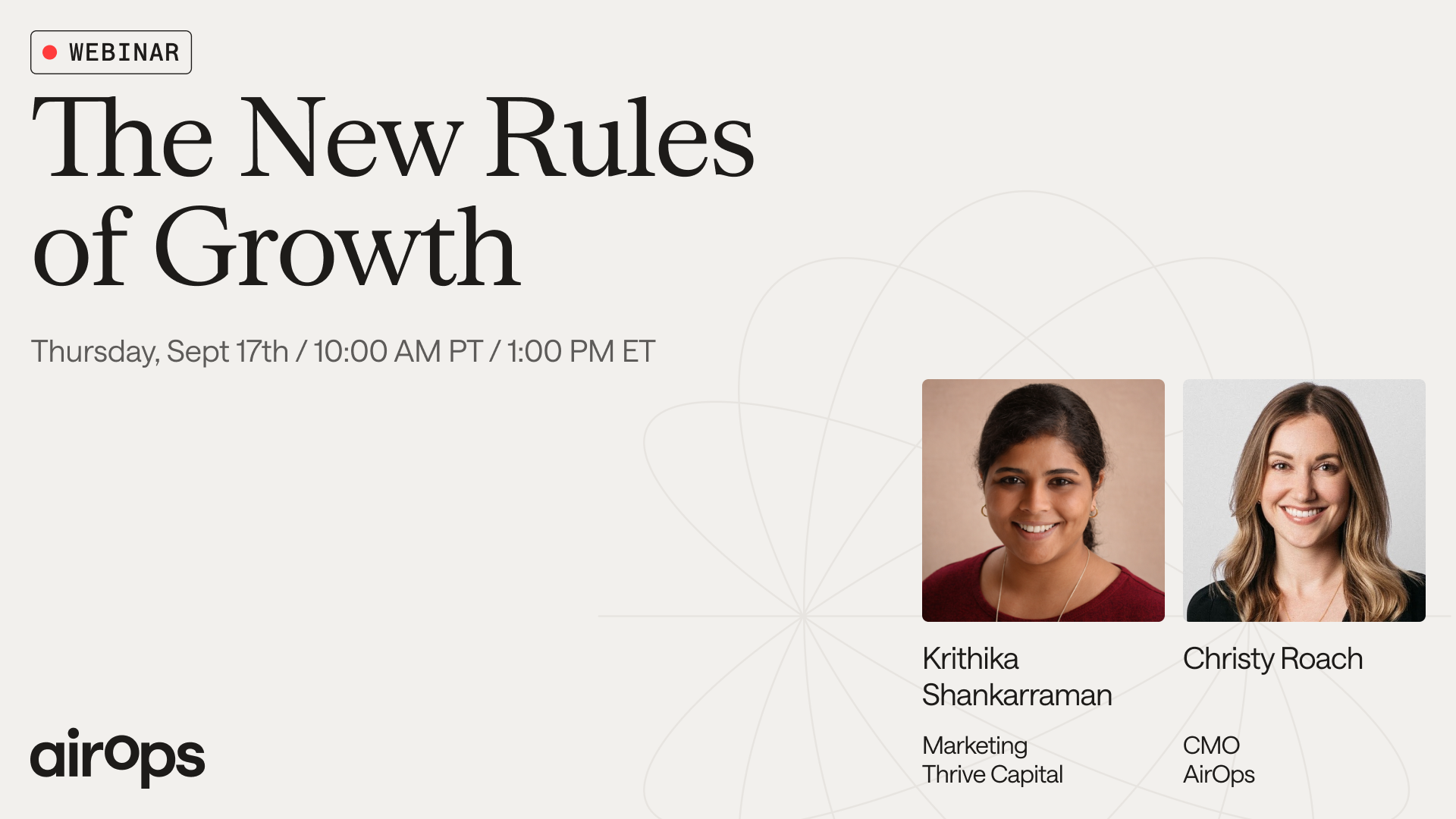
75.4% of marketing teams face higher pipeline or revenue targets, yet only 43% received a budget increase. If your team is expected to close that gap, you need a stronger operating playbook.
On September 17, Krithika Shankarraman, the first marketing hire at Stripe and OpenAI, joins AirOps CMO Christy Roach to unpack findings from 300+ marketing leaders.
You’ll learn how to:
- Strengthen budget and headcount requests by tying investment to business growth
- Push back when expectations exceed resources while protecting work that moves pipeline
- Design a smaller, senior team with clearer ownership and greater leverage
Krithika built both marketing functions from the ground up. Christy has held leadership roles at AssemblyAI, Airtable, Asana, and Gusto.
You’ll leave knowing where to invest and how to make a stronger case for the people and budget needed to hit your targets.
Reserve your free spot and learn how to secure more resources for your team.
⚡ Choose the message before the creative format
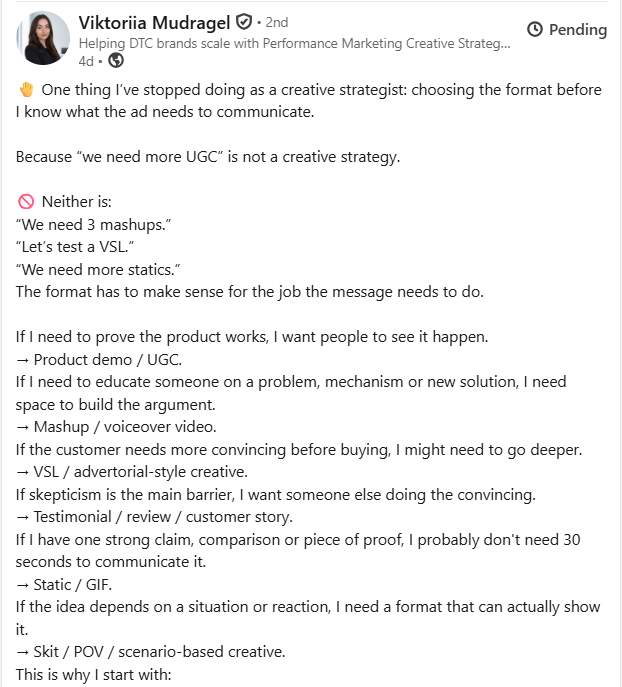
This framework argues that creative strategy should begin with what the customer needs to see, understand, or believe. The format should then be selected based on whether the message requires demonstration, education, proof, depth, or storytelling.
Why it works: Matching format to communication objective gives every asset a clear job. Demos prove performance, testimonials reduce skepticism, VSLs explain complex arguments, while statics efficiently communicate simple claims or comparisons.
Where it needs balance: Format itself can still influence performance, and testing unexpected formats can uncover new winners. The strongest approach starts with the message, chooses the most logical vehicle, then tests alternative executions when the data supports it.
🎥 Reel of the Day

What Works:
1. Clickable Ingredient Hook - The floating emoji lineup mimics an interactive digital menu, instantly creating curiosity. Viewers understand the mechanic without explanation and stay to see how each “click” physically transforms the drink.
2. Cursor Drives Story - Using the mouse pointer as the protagonist gives every transformation a clear trigger. Each movement creates anticipation because viewers learn that wherever the cursor clicks, something satisfying will happen next.
3. Progressive Product Build - Instead of revealing the finished Lemon Lavender Fizz immediately, the reel assembles it ingredient by ingredient. Blueberries, color, lemon and mint create sequential micro-payoffs that naturally sustain retention until completion.
Turn product creation into an interactive interface: place ingredients, features or options as clickable icons above the product, then make each cursor interaction trigger an immediate real-world transformation.
Advertise with Us
Wanna put out your message in front of over 40,000 best marketers and decision makers?
Thanks for reading this edition! Keep pushing boundaries, testing ideas, and staying inspired. See you in the next edition with more ways to ignite your marketing success. 🥰