What's a subscriber worth now?
💵 Before you pay for one more lead ad this month, work out what an email subscriber is actually worth to you over 90 days, Amazon conversion drops need context before listing changes, and more!
Welcome to a space where every edition delivers insights, strategies, and inspiration to fuel your advertising brilliance. 🤯
💵 Price an email subscriber before you bid for one This Black Friday
The signal
Lead ads get pricier every week into Black Friday. Last year, Lebesgue's analysis of $22.6 million in Meta spend had median CPMs 27% above September by November 20. Plenty of teams keep buying subscribers anyway, without a ceiling.
Meanwhile, the subscriber's value keeps rising: Omnisend's 2026 report on 2025 activity found automated emails earned $2.87 per send against $0.18 for campaigns, and nearly one in three clicks on an automated email ended in a purchase.
The read
You can't judge a $4 cost per lead without knowing what the lead returns. Most ad accounts never calculate that number, so the bid ceiling ends up being whatever last month cost.
The math
Use a group of subscribers who joined at least 90 days ago, so everyone has had a full 90 days to buy. Calculate paid and organic subscribers separately. Illustrative numbers:
- First-order rate: 1,000 new subscribers, 70 bought within 30 days. That's 7%.
- First-order margin: $80 average order at 50% gross margin, $40 per order.
- Repeat: 20% of those 70 buyers placed one additional order within 90 days of subscribing. That's 14 extra orders, assuming the same $40 gross profit per order.
- Value: (70 + 14) × $40 = $3,360, or $3.36 per subscriber.
That gives you $3.36 in gross profit per subscriber over 90 days, before acquisition and other costs. Paying $2.50 to acquire one leaves $0.86 to cover those remaining costs. Paying $4.80 puts you $1.44 behind even before those costs. Use this as a rough starting point for your spending limit, not a guarantee of profit.
The moves
- Set the cap. As a starting rule, aim to spend no more than 80% of the estimated gross profit per paid subscriber, roughly $2.70 here. That leaves about $0.66 for other costs and uncertainty, so lower the cap if those costs are higher. The 80% rule is my judgment.
- Value Black Friday joiners separately. In my judgment, holiday signups often buy faster and repeat less. Rerun the math on last year's November cohort before trusting the annual figure.
- Lower the blended cost. Collecting subscribers from your existing Instagram audience can reduce your average acquisition cost, but assess paid leads separately so cheaper organic signups don't hide an unprofitable campaign.
Omnisend's Social Capture is included in paid plans: ask people to comment or DM your chosen keyword, and it automatically replies asking for their email. Include content and tool costs when calculating what those subscribers cost.
The watch list
- Cost per lead against your $2.70 cap, daily from now to Cyber Monday.
- 30-day first-order rate for this month's paid cohort against your organic one.
- Unsubscribes in the first week, by source.
Before you log off
Pull your 90-day cohort and run the four lines above. It takes 15 minutes, and it tells you whether this week's lead budget should go up or stop.
Together with New Engen
Your January Ads Should Be in Production Now
If your Meta account has stalled, another month of the same creative gives you little new to work with.
Grapevine, now part of New Engen, produces creator ads you can run through creators’ accounts, with production handled for you.
- Approve angles and ship product. Grapevine books and pays creators, writes briefs, and edits in-house.
- Get fresh creative in under 30 days from kickoff, giving you time to test before January.
- Start with flexible pricing and no minimum spend, then test month to month before committing further.
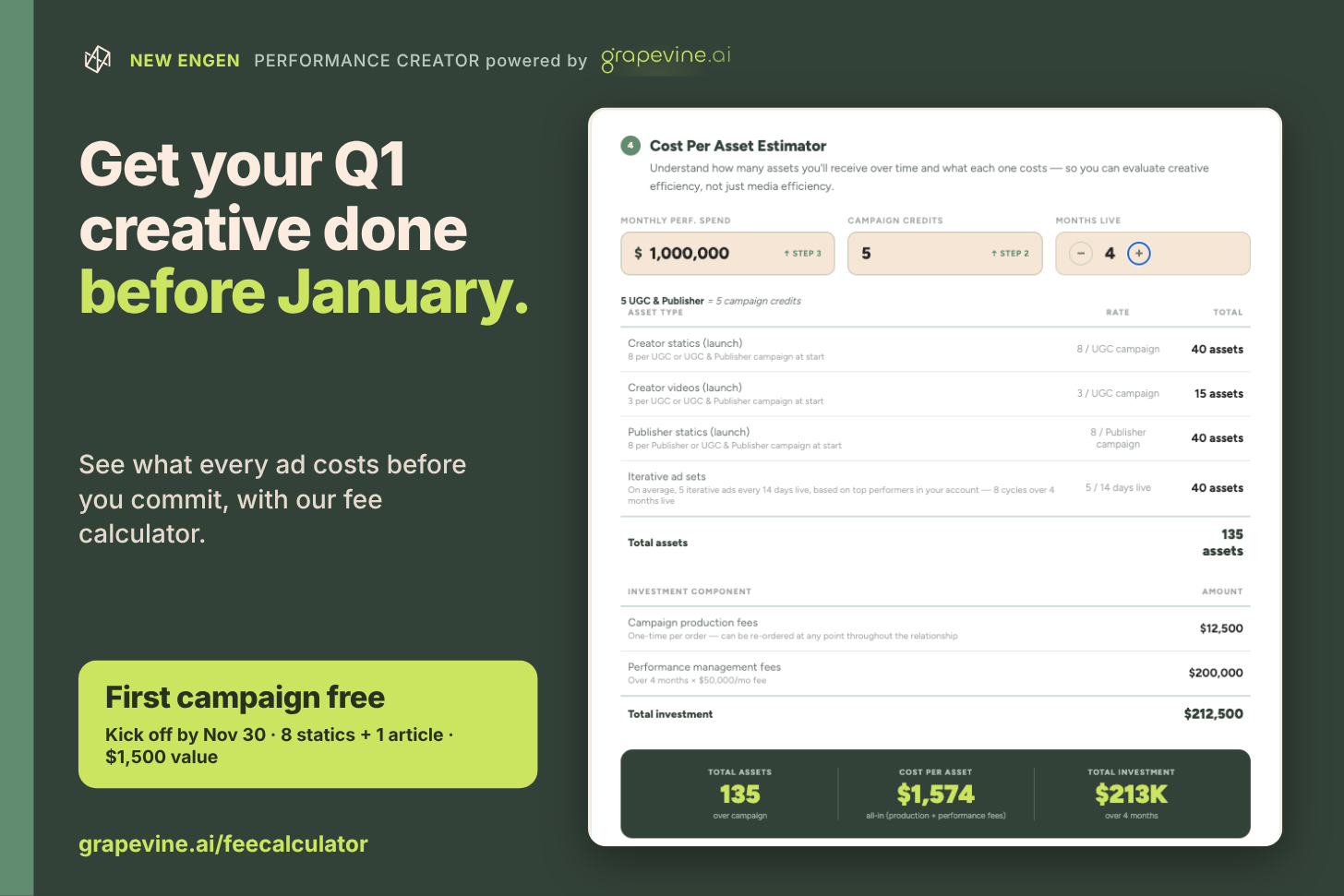
Futurhealth runs over 40% of its account on Grapevine assets and improved CPA by more than 15%. To budget for your own test, check your cost per asset in the fee calculator.
Kick off by November 30 and your first campaign is free: 8 statics and 1 article worth $1,500. Head into Q1 with fresh creative ready to put to work.
⚡ Amazon conversion drops need context before listing changes
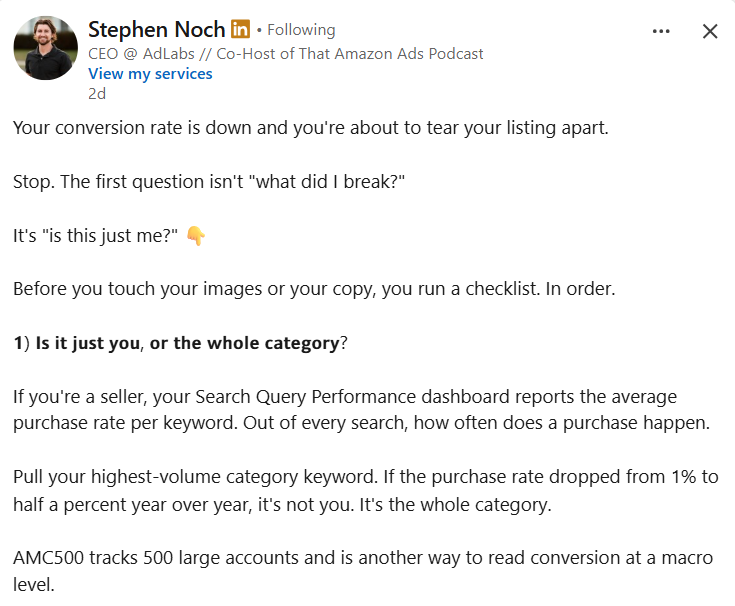
This framework recommends diagnosing falling conversion rates by checking category-wide demand, competitor pricing, and listing performance in sequence. The goal is to identify external market changes before assuming the product page needs improvement.
Why it works: Comparing search-query trends, pricing shifts, and customer reviews helps isolate potential causes of declining sales. This prevents unnecessary listing changes when weaker demand or more competitive offers may be responsible.
Where it needs balance: Category-wide declines don't rule out product-specific problems, and a price increase doesn't always reduce revenue. The example's 12% decline applies to unit sales, not revenue, which falls 12% only if price stays unchanged. Brands should validate changes using comparable traffic, conversion, and revenue data.
🎥 Reel of the Day

What Works:
1. The Finished Curls Create Instant Desire - The reel opens with beautifully defined curls before showing the styling process. This results-first approach immediately establishes what viewers can achieve and gives them a reason to watch the tutorial.
2. Every Styling Step Builds Anticipation - The video progresses through product application, brushing, sectioning, and curl definition. Each step visibly changes the hair, creating a satisfying transformation that encourages viewers to stay until the final reveal.
3. A Tutorial Designed to Be Saved - The caption explicitly encourages viewers to save the routine and lists three styling products. Combining practical demonstrations with product names makes the reel a useful reference for future wash days.
Show the final transformation first, then break down the process into satisfying, repeatable steps. Highlight one impressive detail before the final reveal, and list products to encourage saves.
💃Events
🔥 How to Show What Your AI Search Budget Actually Bought
November 20 | 2 PM ET | Virtual Event
Google Meridian creator Hitesh Wadhwani and AirOps COO Matt Hammel break down how to quantify AI search exposure, distinguish recommendations from simple mentions, and bring that signal into marketing mix models. Leave with the exact measurement gaps to fix before your next budget review.
Can't attend the session live? Register anyway, and you’ll get the recordings in 24 hours.
Advertise with Us
Wanna put out your message in front of over 40,000 best marketers and decision makers?
Thanks for reading this edition! Keep pushing boundaries, testing ideas, and staying inspired. See you in the next edition with more ways to ignite your marketing success. 🥰