Seasonality adjustments reach Demand Gen
📈 Google's help docs now list Demand Gen for seasonality adjustments, a tool built for short sale events like Black Friday weekend, Meta attribution changes could inflate reported ROAS, and more!
Welcome to a space where every edition delivers insights, strategies, and inspiration to fuel your advertising brilliance. 🤯
📈 Your black friday seasonality adjustment settings filled in
Smart Bidding learns from recent conversion rates. On Black Friday, conversion rates jump within hours, and bidding can lag behind the spike. Seasonality adjustments warn Google in advance.
Demand Gen may now be on the list. According to Relevant Audience on October 24, Google's seasonality adjustments help page lists Demand Gen alongside Search, Shopping and Display for Target CPA and Target ROAS. Performance Max and App campaigns work with any bid strategy. The page creating adjustments hadn't caught up yet, and there's been no formal announcement.
Google calls the tool "ideal for short events of 1-7 days" and says it "may not work as well" beyond 14 days. One event can cover up to 2,000 campaigns.
Below are settings for two events, built from one store's history. Every number is illustrative, so swap in your own.
The history behind them
Conversion rate averaged 3% in the two weeks before Black Friday last year. It hit 5.1% on the day, a 70% rise. Cyber Monday reached 4.2%, a 40% rise.
Event 1
- Name: BF weekend 2026
- Dates: Black Friday 00:00 to Sunday 23:59
- Campaigns: Search, Shopping and PMax running the sale
- Expected conversion rate change: +60%
- Why +60%: slightly below last year's 70%, to stay cautious. The discount is my judgment. Raise it if this year's offer is stronger.
Event 2
- Name: Cyber Monday 2026
- Dates: Cyber Monday 00:00 to 23:59
- Campaigns: the same set, minus anything whose offer ends on Sunday
- Expected conversion rate change: +35%
About Demand Gen
Confirm the option actually appears for your Demand Gen campaigns before adding them. Until the documentation catches up, treat it as likely but unconfirmed, and keep Demand Gen in a separate event so you can remove it cleanly.
Settings to avoid
- One event stretched across all of November
- An end time later than the end of your sale, which leaves bids inflated into a normal Tuesday
- Copying last year's lift unchanged when your offer is weaker
Watch during and after
- Conversion rate during each event against your setting
- Cost per conversion on adjusted days
- Performance in the three days after, when bidding settles back down
If actual lift lands far from your setting, note the gap. It makes next year's numbers better.
Before you set anything
Pull last year's daily conversion rates from November 15 to December 5 and mark the days that spiked. Those dates and that lift fill in the fields above.
Together with New Engen
Your next winning ad needs a different voice
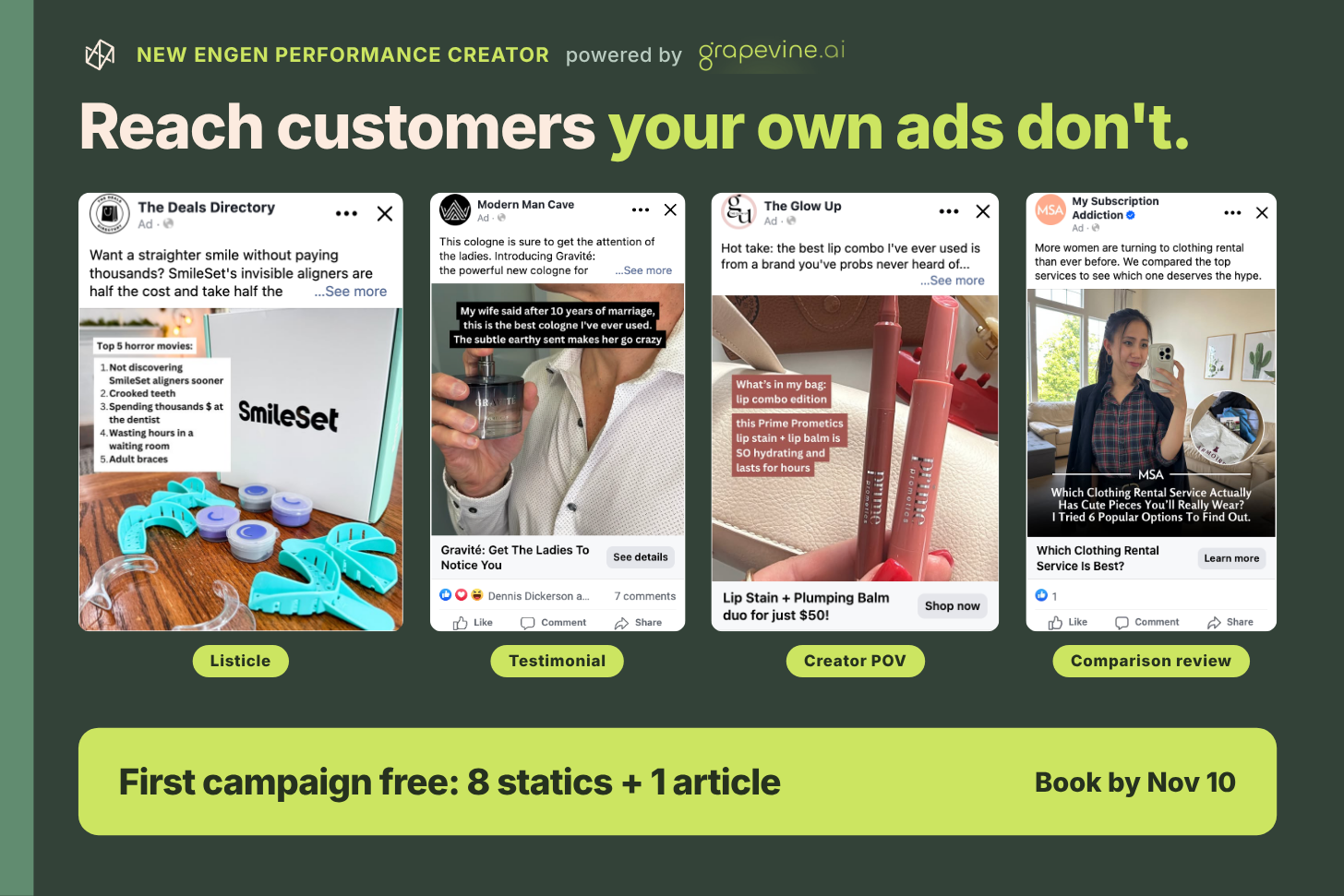
Your product solves a real problem. But when every ad makes a promise, buyers need a reason to believe yours.
A qualified expert explaining how it works can give them that reason.
Grapevine, now part of New Engen, creates ads delivered through creator and publisher handles with production managed from brief to launch.
You approve the angles and ship product. Grapevine sources creators, handles briefs and payments, then produces and posts the content.
- Madison Reed achieved 20% efficiencies over target CPA and 50% higher LTV.
- Mathnasium cut Meta CPL by 33% in under 30 days.
- Cirkul achieved 15-50% lower TikTok CPA and nearly doubled CTR through creator whitelisting.
Put this approach to work with your first campaign on Grapevine.
Kick off by November 30 and your first campaign is free: 8 statics and 1 article worth $1,500.
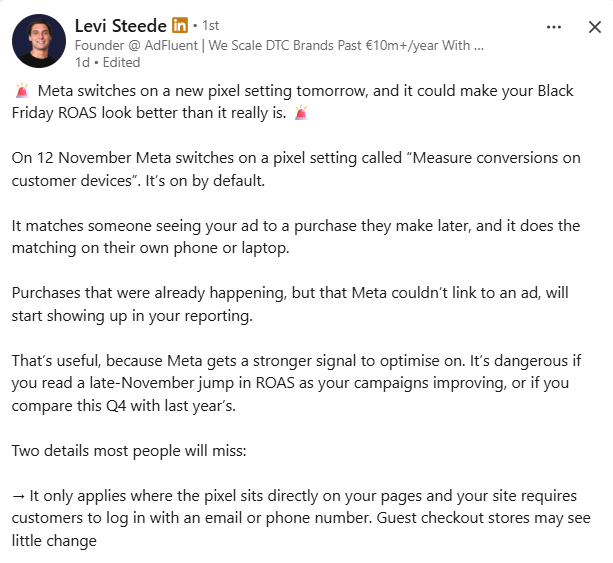
⚡Meta attribution changes could inflate reported ROAS
This framework argues that smaller marketplaces don't need to match Amazon's conversion rate to attract creators. By offering higher commissions and sharing those costs with sellers, they can increase earnings per click (EPC) despite converting fewer shoppers.
Why it works: Creators prioritize the revenue their traffic generates, not just conversion rates. Co-commissioning allows marketplaces and sellers to combine incentives, potentially making affiliate promotion more attractive without placing the entire commission burden on the platform.
Where it needs balance: Higher EPC doesn't automatically guarantee sustainable growth. Commission increases can reduce seller profitability, while conversion rates and average order values vary across audiences. Marketplaces should evaluate incremental sales, contribution margins, and creator retention before scaling commission incentives.
🎥 Reel of the Day

What Works:
1. A POV That Makes Pet Owners Stop Scrolling - The hook “POV: You got your puppy his own car seat right next to you 🥹” immediately appeals to pet owners who treat their dogs like family.
2. The Puppy Does the Selling - The final shot of the puppy curled up comfortably inside the seat creates the reel's emotional payoff. The product becomes desirable through the dog's adorable appearance and relaxed behavior rather than a list of features.
3. A Product Demo Disguised as a Cute Moment - The reel uses casual, everyday footage inside a car rather than polished advertising. This creator-style presentation makes the recommendation feel more like a personal discovery than a conventional sales pitch.
For pet products, demonstrate the transformation through the animal's experience. Start with a relatable situation, reveal the product in action, and finish with an adorable payoff that encourages viewers to share it with other pet owners.
Advertise with Us
Wanna put out your message in front of over 40,000 best marketers and decision makers?
Thanks for reading this edition! Keep pushing boundaries, testing ideas, and staying inspired. See you in the next edition with more ways to ignite your marketing success. 🥰