You Trained Your Supplier To Lie
🥺That lie is ruining your brand and costing you sales, TikTok Shop changed acquisition from bidding to creator-driven distribution, and more!
Welcome to a space where every edition delivers insights, strategies, and inspiration to fuel your advertising brilliance. 🤯
🥲 You Trained Your Supplier To Lie
Order #2. The factory emails: "Slight issue with the lining material, supplier shortage. We can substitute a similar weight, 5% lower GSM. Same look, same feel. Shipment stays on schedule. OK?"
You're already booked into Q4 inventory deadlines. You say yes. It ships fine. Customers don't notice.
Order #4. Same kind of email. Different deviation. You say yes again.
Order #8. The factory stops asking. They've quietly priced the cheaper material into your unit cost, kept the savings, and your "premium" SKU is now 11% lighter, 14% less durable, and showing up in returns as "feels different than I remembered."
You didn't get scammed. You taught the factory that your specs are negotiable under deadline pressure. They're behaving rationally. You set the precedent.
1. Make deviations a written event, not an email reply
Every deviation request gets logged in a single document, date, original spec, proposed change, reason given, your decision, and the order it applied to. Send the log back to the supplier, signed every quarter. The act of writing it down changes the behavior on both sides. The supplier sees a paper trail forming. You see the pattern before order #8 instead of after.
2. Price the "yes" before you give it
When a supplier proposes a deviation that lowers their cost, the savings belong to you, not them. A 5% GSM reduction is a cost reduction. The next PO should reflect a unit price drop equal to the input cost saved, or the original spec gets restored.
Most founders never ask; the supplier banks the delta as margin, and the cheaper input becomes the new normal. Ask once, and you reset the entire dynamic.
This is where Accio Work earns its slot. The platform tracks deviation history per supplier and flags input cost changes against your unit price automatically, so the renegotiation conversation has receipts. You can try for one week free!
3. Run a golden-sample audit every fourth order
Pull a unit from production at order #4, #8, and #12. Compare it side by side against the original golden sample, weight, stitching, finish, and color delta. Document the variance. The drift is invisible at order #2 and obvious at order #12, but only if you check.
The audit isn't to catch the supplier. It's to catch yourself before you've accepted twelve "small" deviations that compound into a different product.
The supplier isn't your enemy. The deadline is.
Every "just this once" you say under deadline pressure becomes the new floor. Build the system that makes the next yes harder than the last one, or accept that the product you launched isn't the product you're selling 14 months from now.
Together with Pounce
Your competitors don't have this accuracy. Yet.

The biggest mobile studios don't guess what creative to ship next. Supercell, Wildlife Studios, and DeNA built a dedicated intelligence system to analyze creative, spot winning angles, and brief what gets made.
That system is now inside Pounce available to any brand running ads, and the accuracy gap is not close.
Pounce scored 98.5% on the April 2026 Mobile Gaming Video Ads Benchmark. The best frontier model scored 76.9%
Generic AI misreads your creative 1 in 4 times. Pounce gets it wrong 1 in 50, which means every creative call, every brief, every optimization is running on intelligence that was previously out of reach.
Get started for free with Pounce today!
⚡ TikTok Shop Changed the Economics of Customer Acquisition
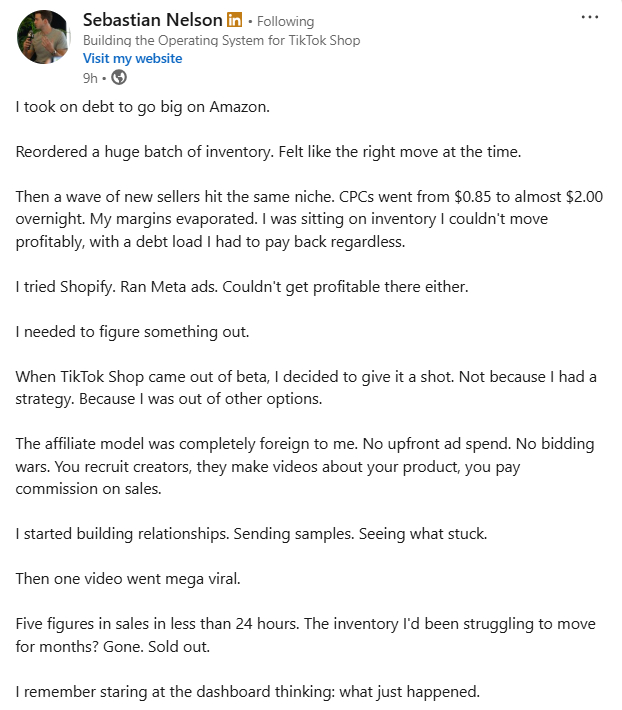
This story highlights the shift from paid acquisition dependency to creator-led commerce. Rising Amazon CPCs destroyed profitability, while TikTok Shop introduced a model based on creator distribution and commission-driven sales. Instead of buying attention directly, the strategy leveraged trusted creators to generate organic demand at scale.
Why it works: Creator recommendations carry built-in trust and social proof. The affiliate model reduces upfront acquisition risk while enabling rapid distribution through viral content. This changes customer acquisition from pure bidding competition to relationship-driven commerce.
Where it needs balance: Viral success is unpredictable and difficult to systemize consistently. Heavy reliance on creators can reduce brand control and forecasting accuracy. Long-term sustainability still requires operational stability, retention, and diversified acquisition channels.
🎥 Reel of the Day
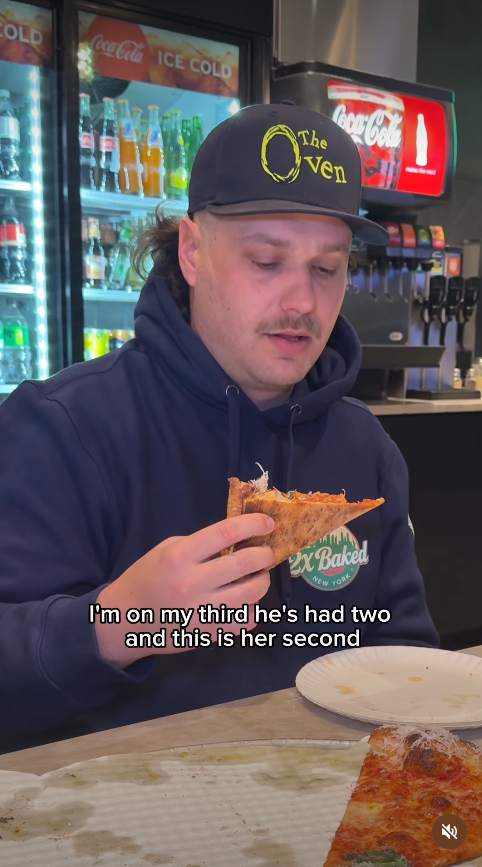
What Works:
Internal Monologue Hook - The reel works because audiences instantly recognize those irrational food thoughts they would never say aloud. Turning silent social calculations into dialogue creates instant psychological intimacy and insanely high relatability.
Food As Competitive Drama - The pizza becomes a social survival object instead of just food. By framing the final slice like a competitive battlefield, the brand transforms ordinary dining into emotionally engaging entertainment viewers subconsciously invest within.
Environmental Memory Anchors - The neon signs, pizza trays, soda coolers, and oversized slices constantly reinforce restaurant identity passively. Even while audiences focus on jokes, the environment quietly burns strong location memory into viewers subconsciously.
Do not just show people eating your product. Turn the product into the center of an emotional social game where hidden thoughts, silent competition, and irrational behavior become the actual entertainment engine.
Advertise with Us
Wanna put out your message in front of over 40,000 best marketers and decision makers?
Thanks for reading this edition! Keep pushing boundaries, testing ideas, and staying inspired. See you in the next edition with more ways to ignite your marketing success. 🥰