Hacking Reach The Right Way
👀The only two metrics that decide whether your content reaches anyone, Content needs both standout ideas and structured variation, and more!
Welcome to a space where every edition delivers insights, strategies, and inspiration to fuel your advertising brilliance. 🤯
👀 The Only Two Metrics That Decide Whether Your Content Reaches Anyone
Follower count no longer determines reach. The algorithm has one question: did people watch, and did they keep watching? Everything else is noise.
Hook rate and hold rate are the only signals that expand content beyond your existing audience. Brands still optimizing for likes and comments are measuring the exhaust, not the engine.
Strategy 1: Hook rate is decided at the brief level, not the delivery level
The instinct when the hook rate is low is to coach creators to be more energetic. That's the wrong diagnosis.
Hook rate is determined by the psychological tension you open with, not how well it's delivered. High-tension openings share one characteristic: they create an information gap that the viewer cannot close without watching further.
"The reason your pre-workout stops working after three weeks" creates a gap. "This pre-workout changed my life" closes before it opens.
Brief creators with the specific information gap, not the topic. The gap is the hook. Everything else is execution.
Strategy 2: Hold rate drop-off timestamps are a content autopsy
Average watch time tells you nothing actionable. Timestamp-level hold rate tells you exactly what broke and where:
- Drop at second 2-3: the first frame didn't deliver on the hook's promise
- Drop at second 7-9: the transition from hook to body lost momentum
- Drop at 40-50%: the payoff wasn't worth the setup
Each timestamp is a different diagnosis requiring a different fix. Averaging them into one number solves none of them. Pull timestamp data on every piece of content, identify which drop-off pattern repeats most consistently, and fix that specific failure before producing anything new.
Strategy 3: Organic hook and hold rate pre-qualifies paid creative before you spend a dollar
Content holding 60%+ of viewers to the halfway point on organic almost always outperforms agency-produced creative when put behind spend, real audiences already validated the tension without algorithmic amplification.
Run every concept organically first. Content clearing your hook and hold threshold goes to paid. Content that doesn't gets rewritten, not promoted.
Particl's competitor tracking surfaces which content formats are gaining the most organic traction across your category right now, pair it with ChatGPT and identify which hooks your competitive set hasn't touched yet before briefing a single creator. You can ask Particl your first question today.
The bottom line
Hook rate and hold rate aren't content metrics. They're distribution metrics. Engineer the tension before the camera turns on, diagnose drop-off by timestamp, and let organic pre-qualify everything before paid touches it.
Together with PrettyDamnQuick
Your Checkout Has Issues. It Just Won't Tell You.
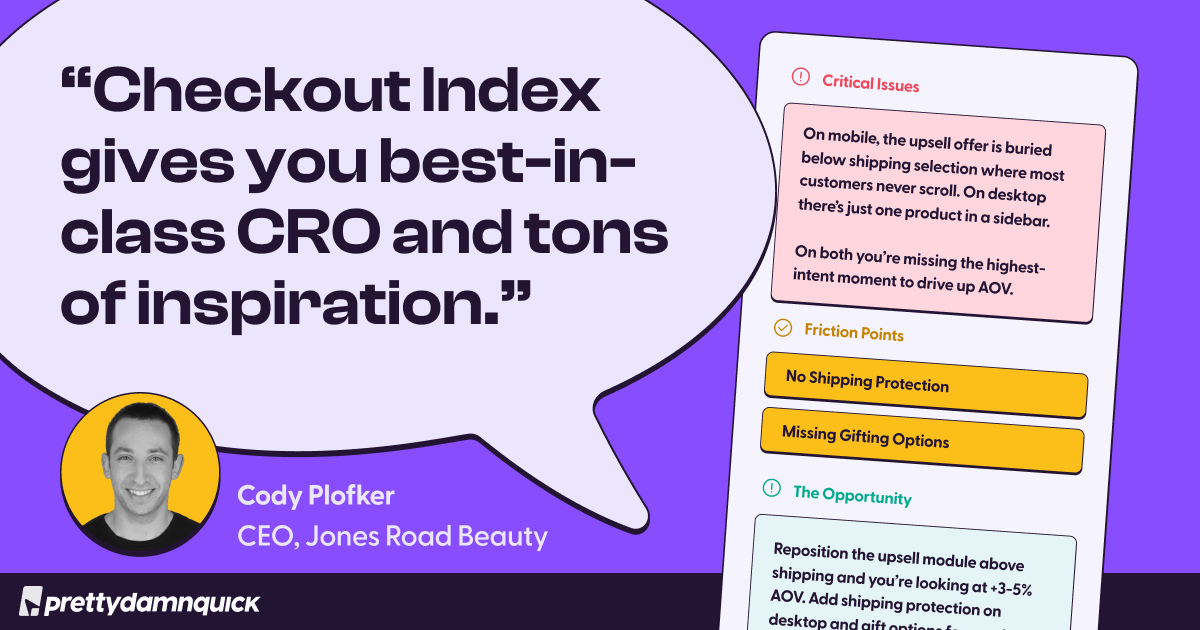
Most checkout tools tell you your CVR. Checkout Index tells you why it's leaking and exactly where to fix it.
Jones Road Beauty ran their checkout through Checkout Index, expecting nothing. They found one critical issue and two friction points they'd completely missed, including upsells buried so deep in the flow that customers couldn't act on them.
Checkout Index projected a 3-5% AOV lift from one placement change.
That's the thing about checkout. The leaks are quiet. Shipping options that overlap so customers won't upgrade. Upsells invisible on mobile. Progress bars are showing the wrong threshold. None of it trips an alarm. All of it costs you.
Checkout Index benchmarks your store against millions of orders across 500+ brands.
Enter your URL, and in 60 seconds, you get a personalized score and projected revenue impact.
No install. No demo call. Just a URL.
⚡ Scaling Requires Creative Mix, Not Just More Creatives
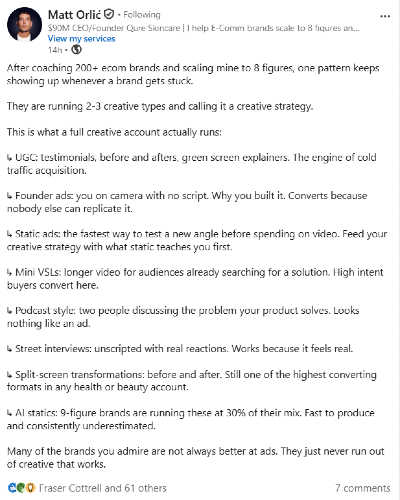
This post argues that most brands mistake a few formats for a real strategy. Instead of relying on 2–3 creative types, high-performing accounts run a diversified mix tailored to different stages, intents, and audiences. The goal is not volume alone, but coverage across multiple persuasion styles.
Why it works: Different formats capture different intent levels and audience preferences. A diversified mix increases reach, reduces fatigue, and ensures continuous performance. It also creates a steady pipeline of new winners.
Where it needs balance: Running too many formats without clear testing structure can dilute focus. Smaller teams may struggle with production capacity. Success depends on aligning formats with strategy, not just expanding output blindly.
🎥 Reel of the Day
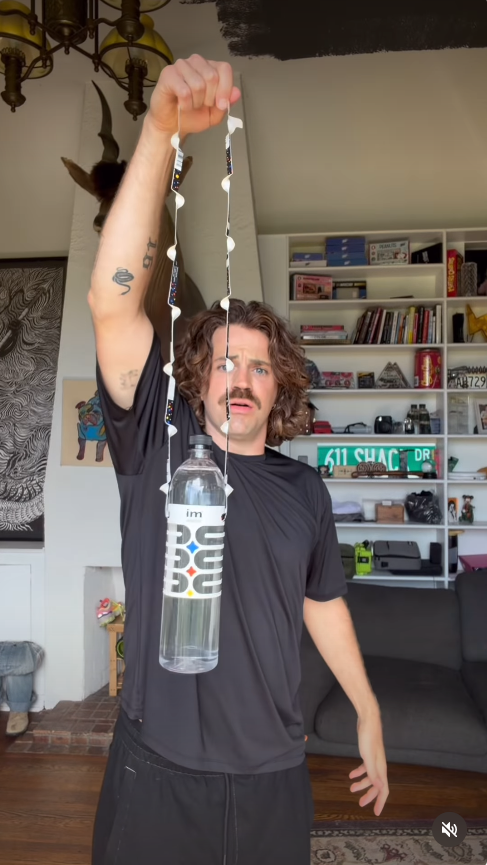
What Works:
Wearable Utility - This reel turns water from a boring product into a mobility product. That is the genius. They are not selling hydration, they are selling freedom from carrying things.
Demo-Led Desire - The product does not need explanation because the demonstration does the selling. Stretch, wear, walk, carry multiples, stay hands-free. Every benefit becomes visible proof, not a claim.
Retention Engineering - Every few seconds adds a new layer. First curiosity, then sticker reveal, then body strap, then multi-bottle chaos, then hands-free payoff. The reel keeps upgrading the joke.
Take a boring product and give it a physical “party trick.” If the product can be demonstrated in one weird, visual, repeatable action, it becomes content before it becomes commerce.
Advertise with Us
Wanna put out your message in front of over 40,000 best marketers and decision makers?
Thanks for reading this edition! Keep pushing boundaries, testing ideas, and staying inspired. See you in the next edition with more ways to ignite your marketing success. 🥰