Your AI citations are working against you
⚠️Outdated review, stale Reddit thread, that’s the language training every AI answer about you, and more!
Welcome to a space where every edition delivers insights, strategies, and inspiration to fuel your advertising brilliance. 🤯
👨💻 Your AI citations are working against you.
Marketers are obsessed with how often AI mentions their brand. Almost nobody is auditing how AI describes their brand when it does. One outdated review, one stale Reddit thread, one 2022 comparison article, that’s the language training every AI answer about you.
A G2 review citing your brand as “great but expensive” doesn’t just live on G2. It trains AI to describe you as expensive every time it pulls from that source. A Reddit thread recommending you as “the option for smaller budgets” locks that positioning into every AI answer referencing it, regardless of how your pricing has changed since.
Citation frequency is a vanity metric if the sentiment context is wrong. Here’s how to fix it.
Identify the upstream source poisoning everything downstream
Negative sentiment framing rarely originates equally across every source. One article, one thread, or one review cluster seeds the language, and every subsequent source citing or referencing it inherits the framing.
That upstream source is doing disproportionate damage. A comparison article from 2022 describing you as “better for small teams” is still seeding that positioning across every source that cited it since. Fixing ten downstream sources while the upstream one remains untouched changes nothing. Find the root. Fix it there first.
Dilute sentiment clusters mathematically
AI extracts the dominant language pattern across an entire citation cluster, not a single review. Which means you don’t need to remove negative language. You need to outvolume it with competing language in the same cluster.
If “expensive” appears in eight of your top twenty G2 reviews, introducing “ROI,” “pays for itself,” and “cost per outcome” language across twelve new reviews shifts the dominant extraction pattern without touching a single negative review. AI pulls the frequency winner. Engineer the frequency deliberately.
Use competitive co-citation to reposition by association
AI systems often cite multiple brands together when answering evaluation queries. Consistently appearing alongside a weaker competitor frames you as the superior option by default. Consistently appearing alongside the category leader frames you as an alternative, not a peer.
SEMrush’s AI Visibility Toolkit tracks exactly how you’re described across ChatGPT and Google AI Mode, including sentiment breakdown and competitive co-citation patterns, so you can see which associations are helping and which are anchoring you to the wrong positioning. Try it free for 7 days.
Audit the language. Fix the root. Engineer the cluster. The narrative shifts from there.
Together with PrettyDamnQuick
Your checkout is leaking. Your analytics just won't tell you where.
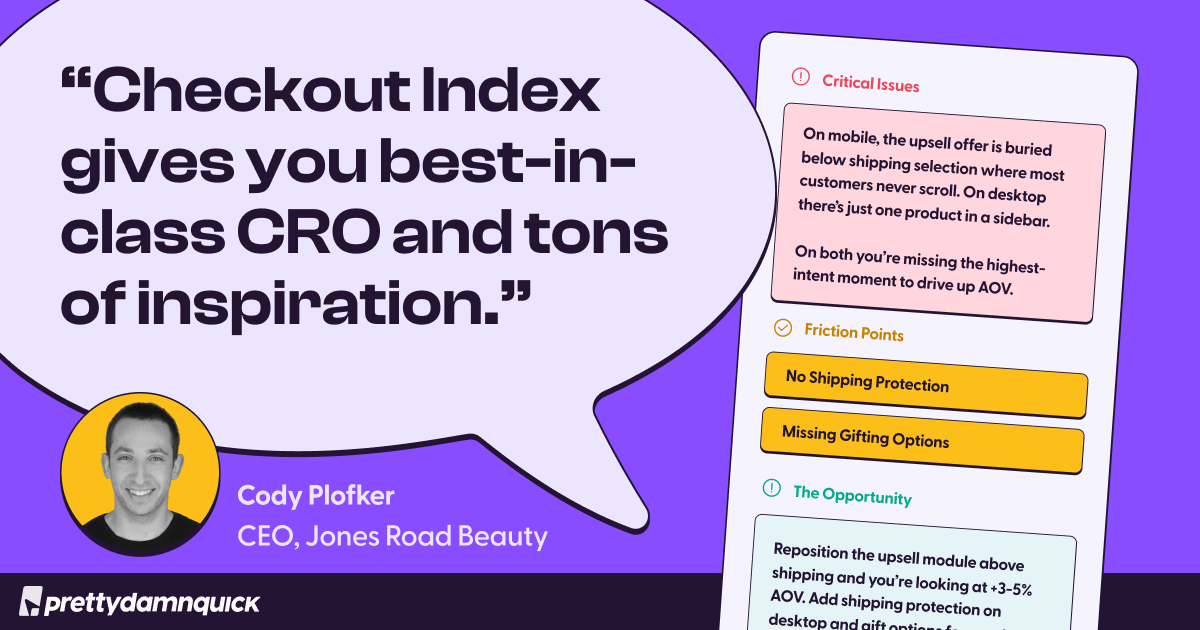
You can see your CVR. You can see your AOV. What you can't see is exactly which part of your checkout is quietly killing both.
Checkout Index by PDQ fixes that in 60 seconds.
It scans 47+ checkout signals across your Shopify store, benchmarks you against 130M+ sessions across 500+ brands, and hands you a personalized health score with a projected revenue recovery figure.
No install. No demo call. No credit card. Enter your URL, and you're done.
Jones Road Beauty ran their store through it, expecting nothing. One critical issue surfaced immediately. Upsell was buried below shipping on mobile, where most customers never scroll, missing shipping protection and gifting options.
One fix and a projected 3-5% AOV lift from a single placement change
⚡Growth Is Often Limited by Cash Flow, Not Demand
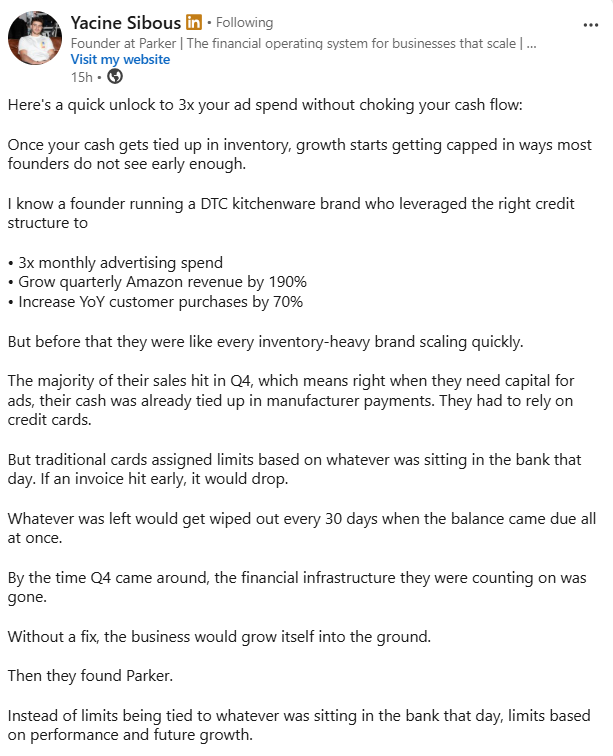
This post highlights how scaling often stalls not because of weak ads or demand, but because cash gets locked in inventory. Without flexible financing, brands cannot deploy capital when it matters most, especially during peak seasons. The solution presented is aligning credit structures with business performance and seasonality.
Why it works: Cash flow determines how much you can invest in growth. Flexible credit tied to performance allows brands to scale ads and inventory simultaneously. This unlocks demand capture without liquidity constraints.
Where it needs balance: Leverage increases risk if demand forecasts are wrong. Overextending on credit can strain margins or create repayment pressure. Financial discipline and accurate demand planning remain critical when scaling with external capital.
🚀 Reel of the Day

What Works:
Theft Signals Value - She doesn’t hesitate before taking the pizza, which subconsciously tells viewers this specific product is worth impulsive decisions, acting as a behavioral endorsement far stronger than any direct claim or review.
Environment Builds Desire - The aesthetic setting, clean table, styled drink, and lighting quietly signal premium quality. Before the product is even consumed, the space elevates perceived taste and overall brand experience.
Dual Audience Hook - It attracts both people who relate to the situation and those drawn to the food. This layered appeal expands reach by combining emotional relatability with visual craving triggers.
Create moments where your product triggers slightly irrational behavior. When people see others act impulsively because of it, they don’t just notice the product, they feel the urge themselves.
Thanks for reading this edition! Keep pushing boundaries, testing ideas, and staying inspired. See you in the next edition with more ways to ignite your marketing success. 🥰